How to Number Mineral Specimens Without Chaos
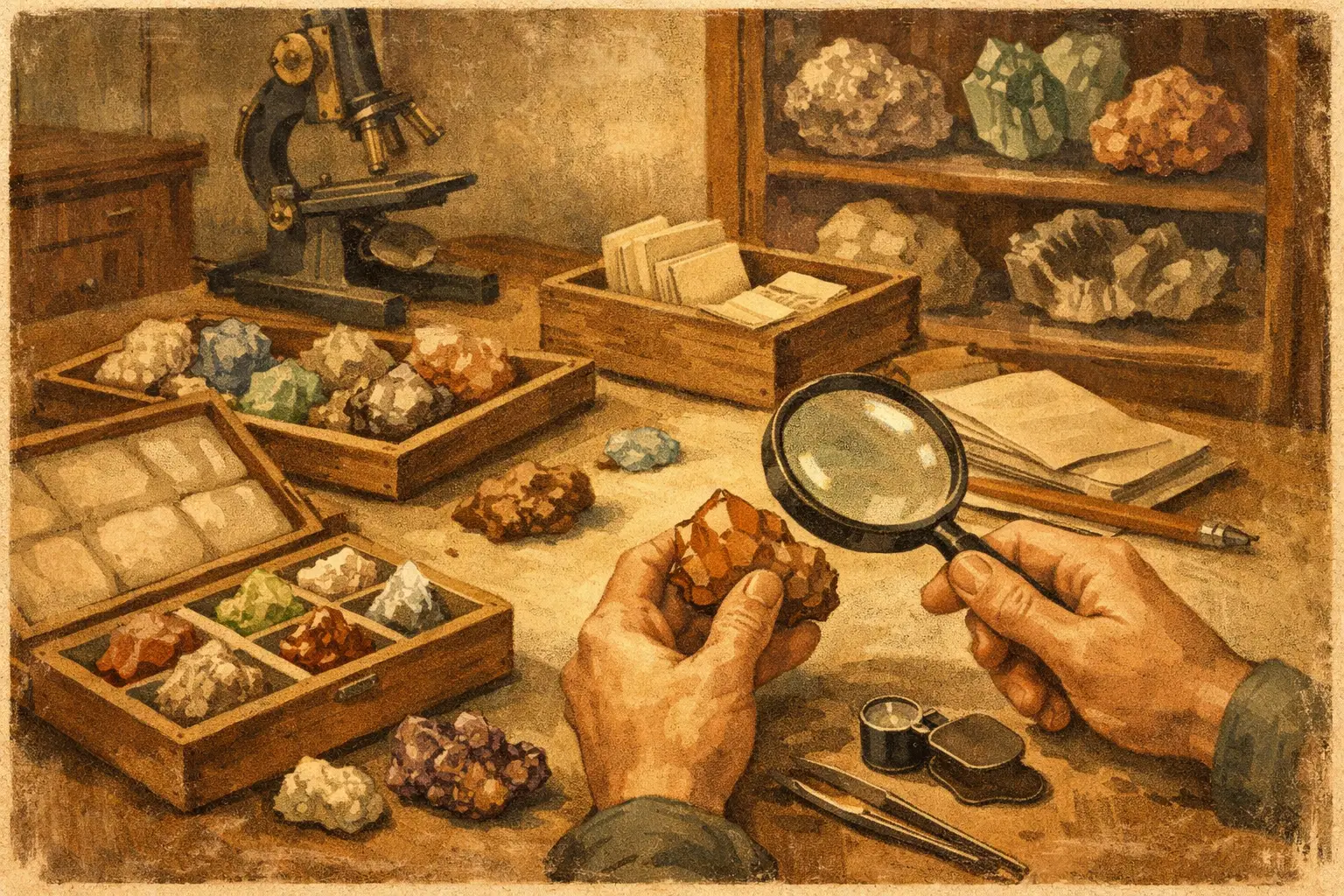
How to number mineral specimens to avoid chaos? Discover a proven numbering, labeling, and cataloging system for small and large collections.
A collector usually notices the numbering problem too late - when the same fluorite appears in three places: in a tray, in a photo folder, and in a notebook under a different ID. If you are asking how to number mineral specimens, the real goal is not just adding numbers. It is building a system that keeps the specimen, its label, its provenance, and its images tied together for years.
For a small collection, almost any method seems to work. For a growing collection, inconsistency becomes expensive. You lose time, misplace locality data, duplicate records, and make future labeling harder than it should be. A good numbering system should be stable, readable, scalable, and easy to maintain whether you own 30 specimens or 3,000.
How to number mineral specimens so the system survives collection expansion
The best numbering method is the one you can follow without exceptions. Collectors often overcomplicate this at the beginning by trying to encode every detail into the accession number: mineral species, locality, year of purchase, display cabinet, and size category. That looks efficient until one specimen contains multiple species, changes cabinet, or gets re-identified.
A strong collector-grade system separates the specimen ID from the specimen description. The number should identify the object itself. Taxonomy, locality, dimensions, acquisition source, and display location should live in the catalog record, not inside the number.
In practice, that means the cleanest approach is usually a sequential accession number. Examples include:
- 0001
- 0002
- 0003
Or, if you prefer a prefix:
- MIN-0001
- MIN-0002
- MIN-0003
This structure has three major advantages:
- it does not break when a specimen is reclassified
- it scales cleanly into large collections
- it stays easy to read on labels, storage trays, and image files
If your collection includes more than minerals alone, a prefix can help. For example, MIN for minerals, MET for meteorites, FOS for fossils. If you collect minerals only, the prefix is optional rather than necessary.
What a numbering system should and should not contain
A specimen number should be unique. That is the non-negotiable rule. Once assigned, it should never be reused, even if a specimen is sold, traded, or removed from the collection. Reusing numbers creates ambiguity in old labels, archived photos, and insurance or valuation records.
What should the number contain? Usually just a stable accession sequence. What should it not contain? Anything likely to change.
Avoid embedding these elements directly into the ID:
- species name
- locality name
- storage location
- purchase year as the main organizing logic
- specimen size or quality grade
There are exceptions. Some collectors maintain year-based accession blocks such as 2024-001, 2024-002, and 2025-001. This can work well if acquisition chronology matters to you. The trade-off is that year-based systems are slightly longer and sometimes encourage separate annual workflows rather than one continuous collection sequence. If you are disciplined, they are perfectly usable. If you want maximum simplicity, a single uninterrupted sequence is harder to break.
The practical workflow: assign, label, record, verify
A numbering system works only when tied to a repeatable workflow. The order matters.
1. Assign the number at intake
The accession number should be assigned when the specimen enters the collection, not weeks later when you finally have time to catalog it. Delayed numbering is how temporary notes become permanent confusion.
If you acquire several specimens at once, process them one by one. Assign one number per specimen and move immediately to the next step.
2. Attach the number to the specimen
The number needs a physical presence. For many collectors, that means a small archival label or reversible base mark associated with the specimen. The exact labeling technique depends on the specimen surface, size, and curatorial standards you follow, but the principle stays the same: the object must remain linked to its accession number even when separated from its box or display label.
Very small thumbnails may require the number to live on the box insert rather than directly on the specimen. That is acceptable, but only if the storage method is consistent and minimizes mix-ups.
3. Create the catalog record immediately
At minimum, each number should connect to a record containing:
- mineral species
- locality
- dimensions
- acquisition date
- seller, source, or previous collection if known
- price or valuation, if you track it
- notes on habit, associations, damage, or preparation
This is where serious collection management starts to separate from casual ownership. The number is only the anchor. The record is the real asset.
4. Match images to the same ID
Your photo naming convention should reflect the accession number. If specimen MIN-0124 has overview images, macro details, and matrix close-ups, the files should remain visibly tied to that ID. Otherwise, image archives become detached from the catalog over time.
A simple convention works best, such as:
- MIN-0124-01
- MIN-0124-02
- MIN-0124-detail-01
5. Verify before filing
Before the specimen goes into a drawer, box, or cabinet, confirm that the physical label, catalog entry, and image folder all match. This short verification step prevents most long-term numbering errors.
Common mistakes when deciding how to number mineral specimens
Collectors usually run into the same problems.
The first is descriptive numbering. An ID such as FLUORITE-CHINA-GREEN-2023-BOX2 may feel informative, but it becomes fragile as soon as one detail changes. It is also long, awkward on labels, and difficult to standardize.
The second is duplicate numbering. This often happens when paper notes and digital records are maintained separately, or when temporary inventory sheets are later entered by hand. One authoritative catalog should control the numbering sequence.
The third is inconsistent formatting. If one specimen is 17, another is 017, and another is MIN17, your records will sort poorly and invite human error. Pick one format and keep it exact.
The fourth is treating storage location as identity. Drawer B4 is not a specimen identity. Cabinets change. Numbering should survive reorganization.
How to number inherited, old, or partially cataloged collections
This is where it depends on the condition of the existing documentation.
If an older collection already has stable numbers on labels, boxes, and notebooks, preserving that legacy system is often the better curatorial decision. You can modernize the database around it rather than replacing the entire identity structure.
If the old numbers are incomplete, duplicated, or inconsistent, a new accession sequence may be safer. In that case, retain the historical markings in a separate field such as “previous label number” or “legacy inventory number.” That preserves provenance without forcing disorder into the new system.
For mixed collections, a dual-record approach works well:
- assign a new primary accession number
- retain all legacy numbers in notes or dedicated fields
- photograph old labels before rehousing or relabeling
This is especially valuable for specimens from named collections, older dealers, or historic labels where documentation has collector value beyond the specimen itself.
Digital cataloging makes numbering much more reliable
A numbering system becomes stronger when the specimen ID connects not just to a notebook, but to a structured record with images, locality data, taxonomy, and label output. That is where digital collection management offers a real advantage over spreadsheets alone.
A spreadsheet can store accession numbers, but it often becomes brittle as the collection grows. Version conflicts appear, image tracking gets messy, and fields are used inconsistently. A dedicated collection platform makes it easier to treat the accession number as the core object identifier across the whole record.
For collectors who care about presentation as much as documentation, this also matters when generating museum-style labels, publishing a public collection profile, or maintaining a shareable archive of provenance and specimen imagery. Cabinet No. 40 is built around that exact connection between ID, documentation, and presentation.
A simple numbering model that works for most collections
If you want a reliable starting point, use this:
- choose one prefix or no prefix
- use a fixed number of digits, such as 4 or 5
- assign numbers sequentially
- never reuse a retired number
- keep all specimen details outside the ID itself
So instead of creating smart numbers, create stable numbers.
That distinction matters. Smart numbers try to carry information. Stable numbers preserve identity. In mineral collecting, identity should remain fixed even when your knowledge of the specimen improves.
The best numbering system is the one that still makes sense after your next hundred specimens, your next cabinet reorganization, and your next round of photography. If a number can survive all three, it is doing its job.