Mineral Specimen Labels - What They Should Contain
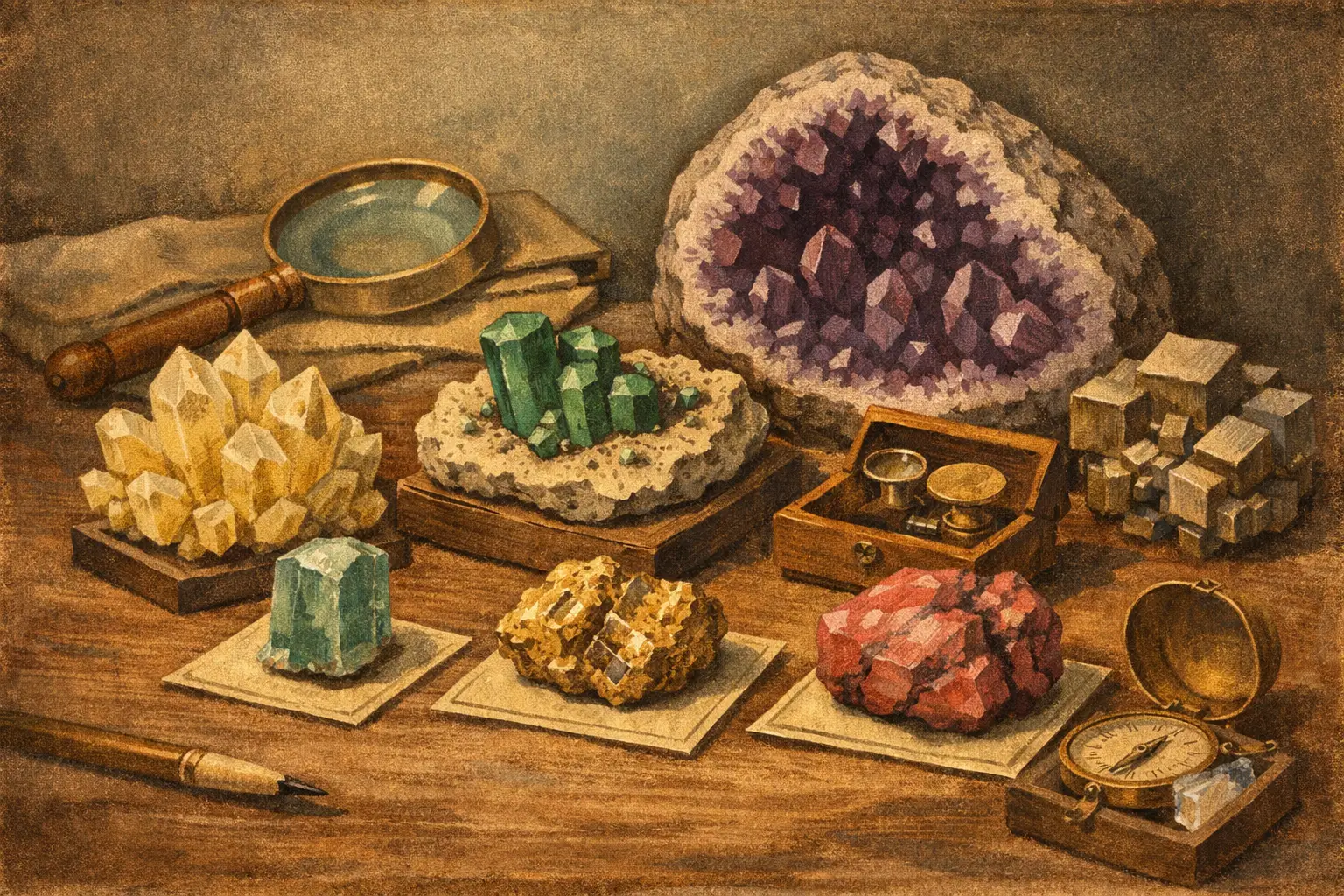
Mineral specimen labels organize a collection, protect provenance data, and improve display. Check what information is worth including on them.
A collector's first mistake rarely concerns the specimen itself. It usually starts with information recorded "for later" – a name on a loose scrap of paper, a place of purchase without a specific locality, a number without a key to the catalog. Good mineral specimen labels solve this problem immediately: they bind identification, provenance, collection order, and presentation style into one cohesive system.
In practice, a label is not an add-on to the mineral. It is part of the specimen's documentation. For a collector building a collection consciously, it has almost the same utility value as a photograph, an inventory number, or a record of dimensions. Without it, even a valuable piece quickly loses its context.
Why Mineral Specimen Labels Matter
In beginner collections, labels are sometimes treated as a purely aesthetic element. In advanced collections, they already serve an archival function. This is a significant difference. An elegant description under a specimen improves the perception of the display, but its main task is to preserve data that becomes harder to reconstruct over time.
The most important factor is the continuity of information. If a specimen changes boxes, display cases, or owners, the label should still clearly answer basic questions: what it is, where it comes from, and how it relates to the rest of the collection. When this is missing, the collection begins to function as a set of loose objects rather than an organized assembly with documentary value.
There is also a second aspect – the credibility of identification. Many minerals occur in visually similar forms, and some old trade names or abbreviated descriptions persist for years despite being imprecise. A well-prepared label enforces naming discipline. This is particularly important for species with numerous crystal habits, twins, and associations with other minerals.
What a Good Label Should Contain
Not every collection needs the same level of detail. A teaching specimen is described differently than a display piece, and differently still from systematically cataloged material. Nevertheless, there is a core of data worth maintaining.
Species Name and Correct Identification
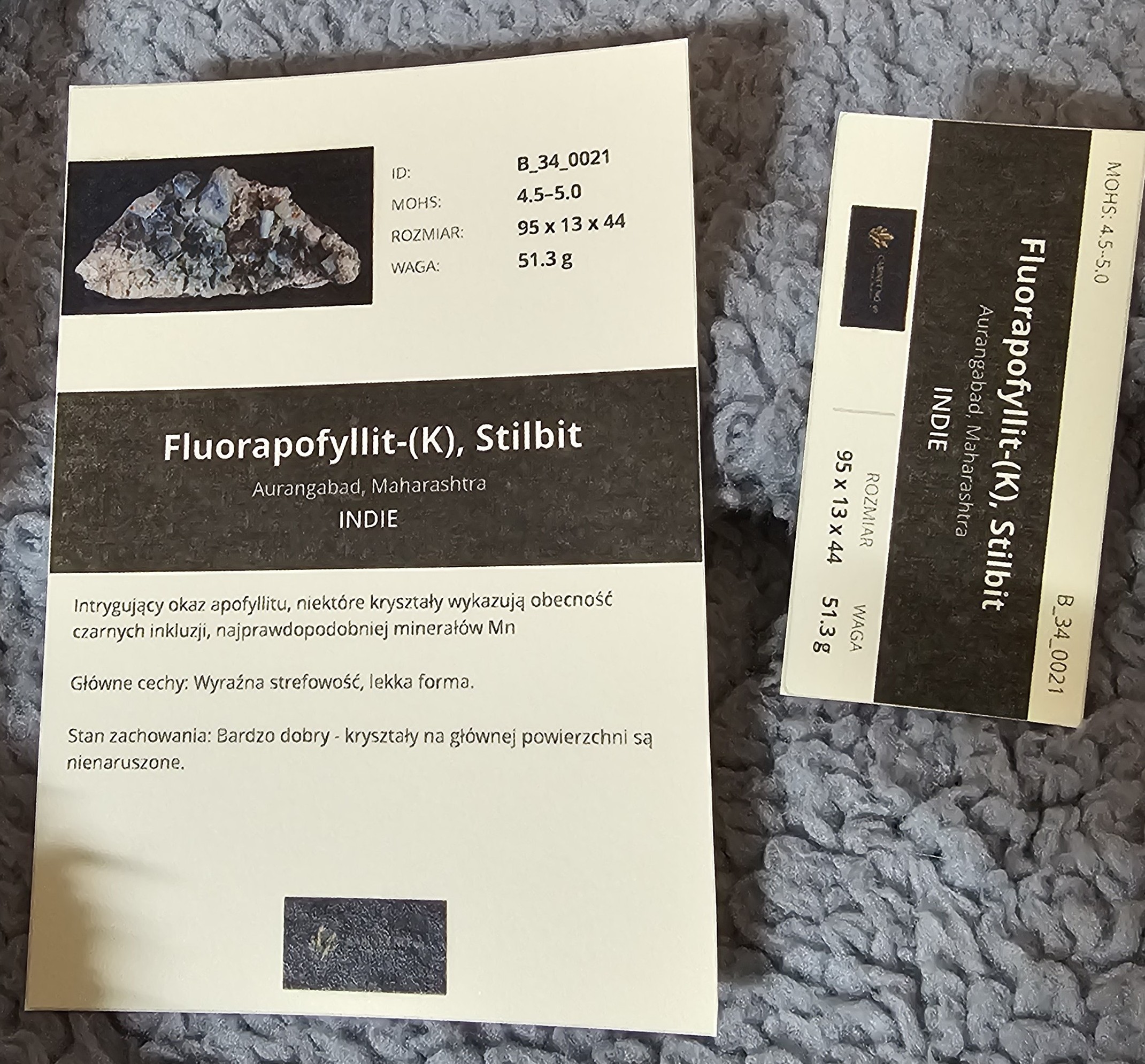
The foundation is the mineral name. It is best to provide it in its current, unambiguous form, without random abbreviations. If the specimen contains several significant components, it is worth noting the relationship between them, for example, which mineral is dominant and which constitutes an overgrowth, inclusion, or accompanying association.
In more advanced collections, adding the mineralogical class or chemical formula can be helpful, but this depends on the collection's goal. If the label is to remain legible in a display case, an excess of data may weaken its function. It is better to maintain a hierarchy of information than to fill every millimeter with text.
Locality, or the Specimen's Provenance
The second pillar is locality. The more accurate, the better, provided the data is certain. The minimum standard is the country and region. In a collection maintained at an archival level, it is worth going deeper: mine, quarry, district, and sometimes even a specific zone or exploitation level, if such information is available and verified.
It is often the provenance that determines the scientific or collector value of a specimen. Two visually similar fluorite crystals can have completely different collecting significance if they come from different, well-recognized localities. The label should preserve this context.
Catalog Number
The catalog number is an underrated element until the collection exceeds several dozen items. Then it becomes essential. Thanks to it, the label links the physical specimen with a record in a database, photos, purchase history, previous designations, and notes.
The most important thing is for the system to be consistent. It doesn't matter much whether you use a simple numerical sequence or a code with a class prefix or year of acquisition. What matters is that the same number appears on the label, the packaging, and in the digital catalog.
Dimensions, Date of Acquisition, and Source
This information does not always make it onto a small display label, but it is often worth including at least in the full version. Dimensions are useful for photographic documentation and display planning. The acquisition date helps track the collection's development. The source of acquisition – dealer, show, exchange, old collection – strengthens the transparency of documentation.
If space is limited, data can be split into two levels: a short label for the display case and a full record in the catalog. This is often the best solution.
How to Design a Label for Readability
In mineral collections, readability is more important than decorativeness. The label should not compete with the specimen but rather organize it. An overly decorative typeface, excessive contrast, or too many lines of text quickly reduce functionality.
A simple layout based on a clear hierarchy works best. The species name can be highlighted, the locality slightly smaller, and the catalog number and additional data most visually understated. In practice, this usually means two or three font sizes, without typographic experiments.
Material also matters. Paper with too low a weight deforms easily, and poor printing quickly loses contrast. In closed display cases, high-quality paper with durable pigment or laser printing works well. In working boxes, simpler solutions are acceptable, but even there, random, hand-cut slips of paper without a consistent format should be avoided.
Small Label or Full Card?
This depends on the nature of the collection. If you display specimens in cabinet-style drawers, a small label under each piece is usually sufficient, provided it is linked to a full catalog. If you are creating a reference or educational collection, or documenting local sites, fuller cards may be more useful.
A good compromise is the two-layer model. The first layer is the label visible with the specimen: name, locality, number. The second layer is a digital record or an inventory card with full data. Such a system is particularly practical as the collection grows and begins to include macro photographs, data on crystal habit, mineral associations, or the history of identification.
Common Mistakes in Specimen Labeling
Most problems do not stem from a lack of mineralogical knowledge, but from a lack of consistency. A collector starts with one format, then changes nomenclature, shortens localities, omits numbers, or creates several parallel systems. After a year, the data is harder to merge than the collection itself is to expand.
The second common mistake is overconfidence. If identification or locality is unconfirmed, it is better to mark it as such than to enter the information definitively. A label should not pretend to be certain where only a working attribution exists. In specialized collections, such caution increases credibility rather than weakening it.
Format size can also be an issue. A miniature label looks discreet, but if the text becomes illegible without leaning into the display case, the informational function disappears. The size must be chosen according to the display style, viewing distance, and amount of data.
Mineral Specimen Labels and the Digital Catalog
A modern collection increasingly operates in two spaces simultaneously – physical and digital. This does not change the role of the label but expands it. The catalog number and basic data on paper become the entry point to a larger record: 360-degree photographs, provenance maps, purchase history, or identification notes.
For the collector, this means one major benefit: there is no need to overload the label. It is enough that it is precise and consistent with the database. Everything else can function within the catalog system, as long as the relationship between the object and the record remains unambiguous. This is why professionally designed labels work so well with collection management platforms, including the model used by Cabinet No. 40.
What Standard Should Be Adopted from the Start
It is wisest to start with a standard that will withstand the growth of the collection. It's not about maximum complexity, but about the durability of the system. If you have 20 specimens today and 200 in two years, the labels should still work without the need for a total overhaul.
A good practice is to establish a single vocabulary for names, one format for localities, and one numbering scheme. Later, details can be expanded: adding fields for associations, aggregate type, dimensions, source of acquisition, or conservation notes. The core remains the same.
It is also worth thinking about visual consistency from the outset. A uniformly described collection looks more professional, but above all, it is easier to read. This matters not only for your own work with the collection but also when specimens are presented publicly, photographed, or passed on.
A well-prepared label does not attract more attention than the specimen. And that is precisely why it is so valuable – it organizes knowledge, secures provenance, and allows the collection to mature without losing its context.