Fluorite
Chemical formula: CaF<sub>2</sub>
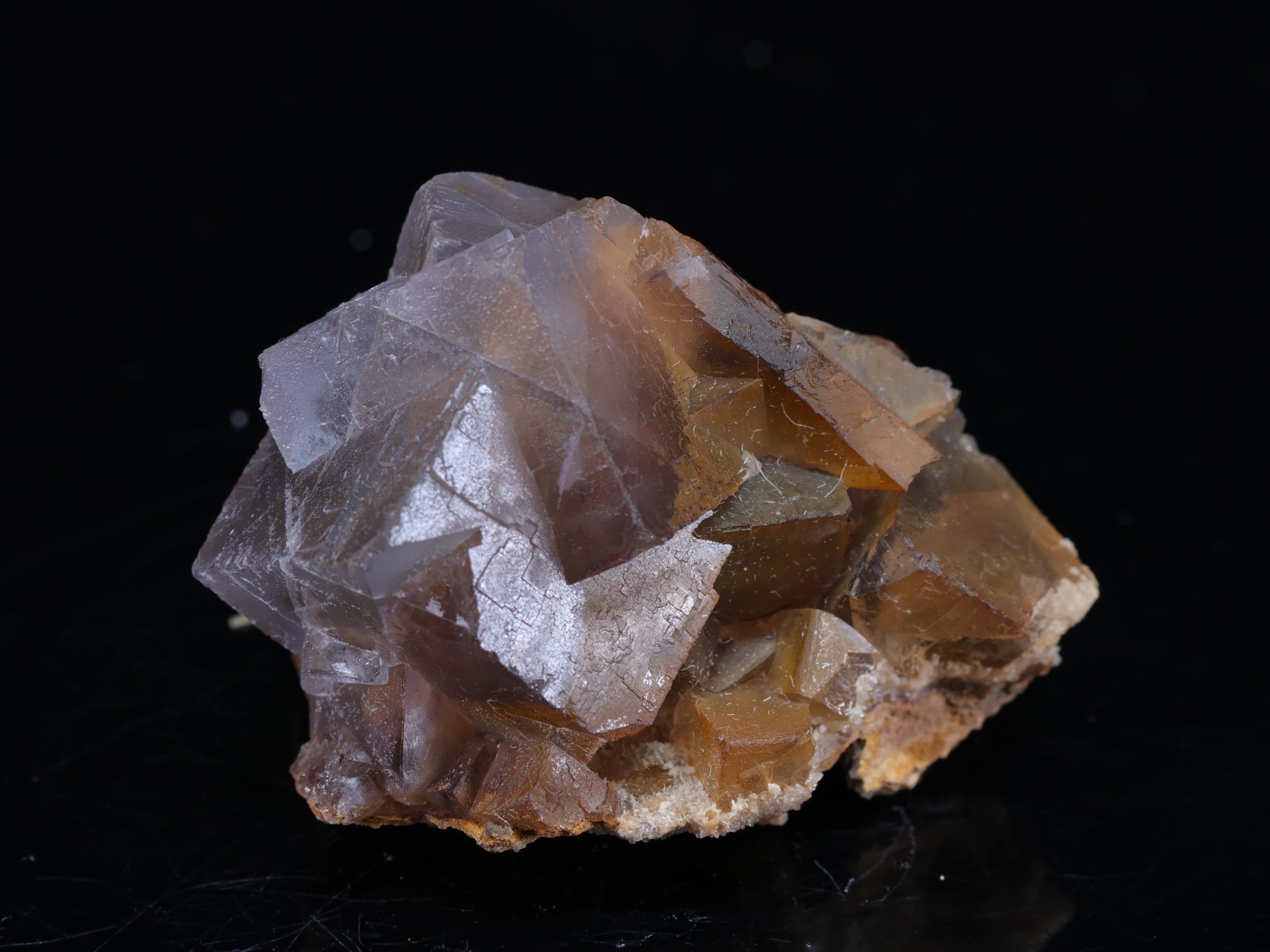
Fluorite is a halide mineral characterized by a wide range of colors and excellent cleavage, often forming well-developed cubic or octahedral crystals.
Properties
- Mohs hardness
- 4
- Luster
- Vitreous
- Streak
- White
- Density
- 3.175
- Cleavage
- Perfect on {111}, very easy.
- Transparency
- Transparent
- Crystal system
- Isometric
Diagnostic features
## Identification Fluorite can be identified by its characteristic crystal habit (most often cubes), wide range of colors, vitreous luster, and relatively low hardness (4 on the Mohs scale). A key diagnostic feature is its excellent cleavage along octahedral planes, often manifested by visible fractures or stepped surfaces. Many fluorite specimens also exhibit fluorescence under UV light. ## Distinguishing from Similar Minerals Fluorite is sometimes confused with some minerals of similar appearance, such as amethyst (a variety of quartz) or calcite. It is distinguished from amethyst by its significantly lower hardness (amethyst has a hardness of 7) and excellent cleavage, which quartz lacks. From calcite (hardness 3), fluorite is harder, and its cleavage is octahedral, whereas calcite has rhombohedral cleavage. The streak of fluorite is white, which also helps distinguish it from other darker-colored minerals. ## Crystal Forms Fluorite most commonly forms cubic crystals, often with visible modifications of faces. Octahedral or rhombic dodecahedral crystals are less common. Crystals can be single or form twins and aggregates. Granular, massive, or radial aggregates are also frequently found, as are crusts and coatings.
Geological environment
## Genesis Fluorite forms in diverse geological environments. It is common in hydrothermal veins, where it crystallizes from hot aqueous solutions. It also occurs in pegmatites, greisens, skarn rocks, and in sedimentary carbonate rocks, where it forms as a result of diagenetic processes. It can also be a component of some igneous rocks, especially granites. ## Mineral Associations Fluorite often co-occurs with many other minerals. In hydrothermal veins, it is accompanied by quartz, calcite, barite, galena, sphalerite, chalcopyrite, and pyrite. In pegmatites, it can occur with topaz, beryl, and tourmaline. In sedimentary rocks, it is often found with dolomite and calcite. ## Localities Numerous locations worldwide are known for rich fluorite deposits. The most important include: United States (Illinois, Kentucky, Colorado), Mexico (Naica, San Luis Potosí), China (Inner Mongolia, Hunan), Germany (Saxony, Harz), United Kingdom (Derbyshire, Cornwall), Spain (Asturias), Russia (Dalnegorsk), and Namibia (Erongo). In Poland, fluorite occurrences are known in Lower Silesia, e.g., in the vicinity of Kletno and Stanisławów.
Rarity
Very Common
For collectors
## Quality Criteria The collector's appeal of fluorite depends on several factors. The most important are the intensity and purity of color, the transparency of the crystals, and their size and perfection of form. Specimens with well-formed, undamaged crystals are highly valued, especially those with rare colors or interesting zonal colorations. Specimens with matrix, i.e., intergrown with another rock or mineral, can also be highly sought after, provided they present an aesthetic composition. ## Popular Localities The most prized fluorite localities are those that yield specimens of exceptional aesthetic quality. Beautiful, often multicolored crystals come from China, especially from Hunan province and Inner Mongolia. Spanish deposits in Asturias are famous for large, purple and green cubes. From the United Kingdom, especially Derbyshire, come classic blue and purple specimens. Mexico, particularly the Naica region, provides impressive, large crystals. The United States, especially Illinois and Kentucky, are also sources of high-quality fluorites.
Care and storage
## Cleaning Fluorite is a relatively soft mineral, so it should be handled with care. For cleaning specimens, it is best to use a soft brush and lukewarm water. For heavier dirt, a mild soap can be used, followed by thorough rinsing with distilled water to avoid deposits. ## What to Avoid Fluorite is sensitive to high temperatures, which can cause color change or loss. Contact with acids, which can damage the mineral's surface, should be avoided. Prolonged exposure to direct sunlight can also lead to color fading. Due to its excellent cleavage, fluorite is susceptible to mechanical damage, so it should be protected from impacts and falls. ## Storage Fluorite specimens are best stored in closed display cases or boxes, away from heat sources and direct sunlight. It is advisable to place them on a soft surface to prevent scratches and damage. For high-value collectible specimens, consider storage in controlled humidity conditions.