What Information Should a Mineral Catalog Include?
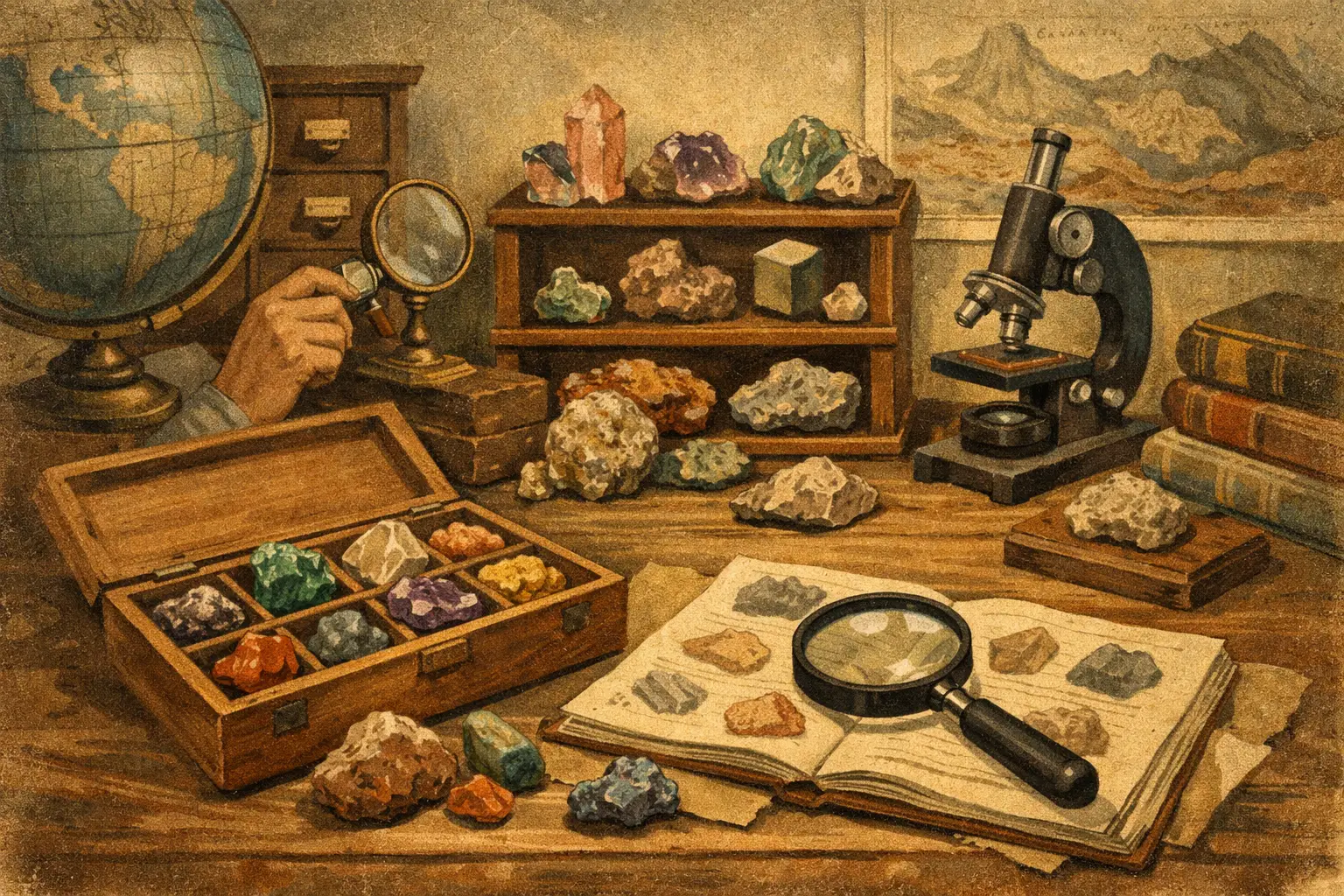
What information should a mineral catalog include? Learn the essential specimen data, imaging, provenance, and organization fields collectors need.
A mineral catalog stops being useful the moment it cannot answer a basic collector question: What is this specimen, where did it come from, and why does it belong in the collection? That is why asking what information should a mineral catalog include is not a clerical exercise. It is really a question about identification, provenance, comparability, and long-term collection value.
For casual inventory, a name and a photo may be enough. For a serious collection, that level of documentation breaks down quickly. Labels get separated, old locality names change, acquisitions blur together, and a specimen that once seemed memorable becomes difficult to place without supporting data. A strong catalog solves that by recording information in a way that is searchable, consistent, and presentation-ready.
What information should a mineral catalog include first?
The foundation is always specimen identity. Without that, every other field becomes less reliable.
At minimum, a catalog should record the mineral species name. If the specimen includes more than one species, the primary species should be clearly distinguished from associated minerals. This matters because a cabinet entry for fluorite with quartz and pyrite is not the same as a pyrite specimen on fluorite matrix. The catalog should reflect collecting intent, not just raw composition.
A unique catalog number is equally essential. Names can repeat across a collection, but an accession-style identifier should never do so. That number becomes the anchor for labels, image filenames, storage locations, insurance documentation, and sales or loan records. If a collector skips this field early on, reworking the system later is usually far more difficult.
Good identity data usually includes:
- catalog number
- mineral species
- associated minerals
- mineral group or class
- specimen status such as self-collected, purchased, traded, or inherited
Some collectors also include variety names, but this is where precision matters. Varietal terms can be useful, yet they should not replace the accepted species name. If both are recorded, the relationship should be clear.
Locality data is not optional
Among experienced collectors, locality is often as important as species. The same mineral from two different districts can have completely different significance, habit, and collector interest.
A catalog should include locality information at the most precise level available. Ideally, that means mine or pocket, district, county, state or province, and country. If exact information is unknown, the record should say so rather than imply certainty. Approximate data is still better than silence, but it should be marked as approximate.
This is one area where older labels often create problems. A historic specimen may use outdated political boundaries, obsolete mine names, or shorthand known only to the original collector. A good catalog can preserve the original wording while also adding a normalized modern locality field for searching and mapping.
Useful locality fields often include:
- original locality text from the label
- standardized locality name
- mine, quarry, or occurrence
- district or region
- county
- state or province
- country
- geographic coordinates, if known
Coordinates are not always necessary, and in some cases they may be sensitive or unavailable. But for broad collection management, a map-ready locality structure is highly valuable.
Physical description should support identification
A catalog is not just a checklist. It should help a collector recognize the specimen without having it in hand.
That means recording physical characteristics that matter to both identification and presentation. Color is an obvious field, but color alone is often too broad to be useful. Crystal habit, luster, transparency, aggregate form, and matrix relationship usually tell a more complete story. A sharp entry does not need to read like a textbook, but it should capture the specimen’s defining visual traits.
For example, “green fluorite” is weak documentation. “Transparent pale green fluorite cubes on drusy quartz matrix” is far more useful. The difference becomes clear when searching a large collection or preparing an exhibit label.
Important descriptive fields may include:
- overall dimensions
- weight
- color
- crystal habit
- luster
- transparency or opacity
- aggregate type or growth style
- matrix description
- damage or restoration notes
Condition notes deserve special attention. Chips, repaired contacts, cleaved areas, or trimming are part of the specimen record. They are not flaws in cataloging. In fact, omitting them usually creates more confusion later, especially for insurance, resale, or exhibition planning.
Acquisition records give the catalog context
A mineral collection is also a history of acquisition. Knowing when, where, and from whom a specimen entered the collection adds practical and scholarly value.
At minimum, a catalog should record the acquisition method and date. If the specimen was purchased, the seller should be listed. If it was field collected, the collector and collection date should be recorded. If it was obtained by trade, the trade partner and exchanged material can also be useful.
Financial data depends on the collector’s goals. Some prefer to separate it from the main display record, while others want it integrated. There is no single correct approach, but if value tracking matters, the data should be structured from the beginning.
Common acquisition fields include:
- acquisition date
- source or seller
- previous collection, if known
- purchase price or appraised value
- invoice or receipt reference
- collection event details for self-collected material
This information is especially useful when a collection grows past the point where memory can carry it. It also helps distinguish specimens with similar appearance but different origins or collecting histories.
Images are part of the record, not an afterthought
Many catalogs still treat photography as optional. For collector-grade documentation, it should be considered a core field.
At minimum, each specimen record should include a clear overall image. Better still, the catalog should support multiple views: front, back, side, close-up, and detail photographs of significant crystal features or damage. For micromounts and fine-detail pieces, macro or microscope images may be more important than a standard cabinet shot.
Image quality matters, but consistency matters just as much. If every specimen is photographed against a different background, at different scales, and under different lighting, comparison becomes harder. Standardized imaging makes the catalog more useful as a visual archive.
A strong image set may include:
- primary specimen photo
- secondary angles
- scale reference or measured dimensions
- macro detail images
- label images
- old collection tags or historical paperwork
Collectors often underestimate the value of photographing labels and handwritten notes. Those documents can preserve provenance details that are easy to lose during rehousing or digitization.
Classification and organization fields make the catalog usable
A catalog filled with good data can still fail if it is not structured for retrieval. Searchability is what turns documentation into a working tool.
That is why a mineral catalog should include organizational fields beyond specimen description. Storage location is one of the most practical. Cabinet, drawer, shelf, box, or tray position should be recorded in a consistent format. If the specimen is on display, in storage, on loan, sold, or reserved for study, that status should be visible as well.
Custom tags are also useful when the collection serves more than one purpose. A collector may want to group specimens by system, locality suite, aesthetic tier, micromount category, thumbnails, or fluorescence. These classifications are not universal, but they become powerful when applied consistently.
Useful organizational fields include:
- storage location
- display status
- collection category
- size class
- thematic tags
- publication or exhibit history
This is where a digital platform becomes far more practical than a spreadsheet. Once the collection reaches any scale, filtered views, label generation, image grouping, and public-facing presentation all depend on structured fields rather than freeform notes.
What information should a mineral catalog include for advanced collections?
Advanced collections often need more than baseline inventory data. If the goal is research-grade documentation, museum-style presentation, or detailed collection management, the catalog should also account for verification and interpretive notes.
This may include identification confidence, analytical methods, literature references, or remarks about old species names and revised classifications. Not every specimen needs a technical dossier, but some do. Pseudomorphs, mixed-species specimens, uncommon localities, and historic pieces especially benefit from expanded notes.
Additional high-value fields include:
- identification notes
- analysis or testing method
- alternate or historic names
- provenance chain
- exhibition label text
- curator notes
- reference citations
The key is restraint. More fields are not always better. If a field will never be used consistently, it becomes clutter. The right catalog includes enough structure to support collecting decisions without turning routine entry into a burden.
The best catalog balances discipline and practicality
Collectors often overcorrect in one of two directions. Some build a catalog that is too thin to be trustworthy. Others create a data model so ambitious that they stop updating it after a month.
The best approach is tiered. Record the non-negotiable fields for every specimen: identity, locality, dimensions, acquisition, image, and storage location. Then add advanced fields where the specimen justifies them. That keeps the catalog usable while preserving room for serious documentation.
For collectors building a long-term digital archive, that balance matters more than perfection. A well-structured catalog should help you identify a specimen quickly, trace its history confidently, and present it with the same care you gave when adding it to the collection. If your records can do that, the catalog is not just complete enough. It is doing its real job.