Mineral specimens with provenance – what they change
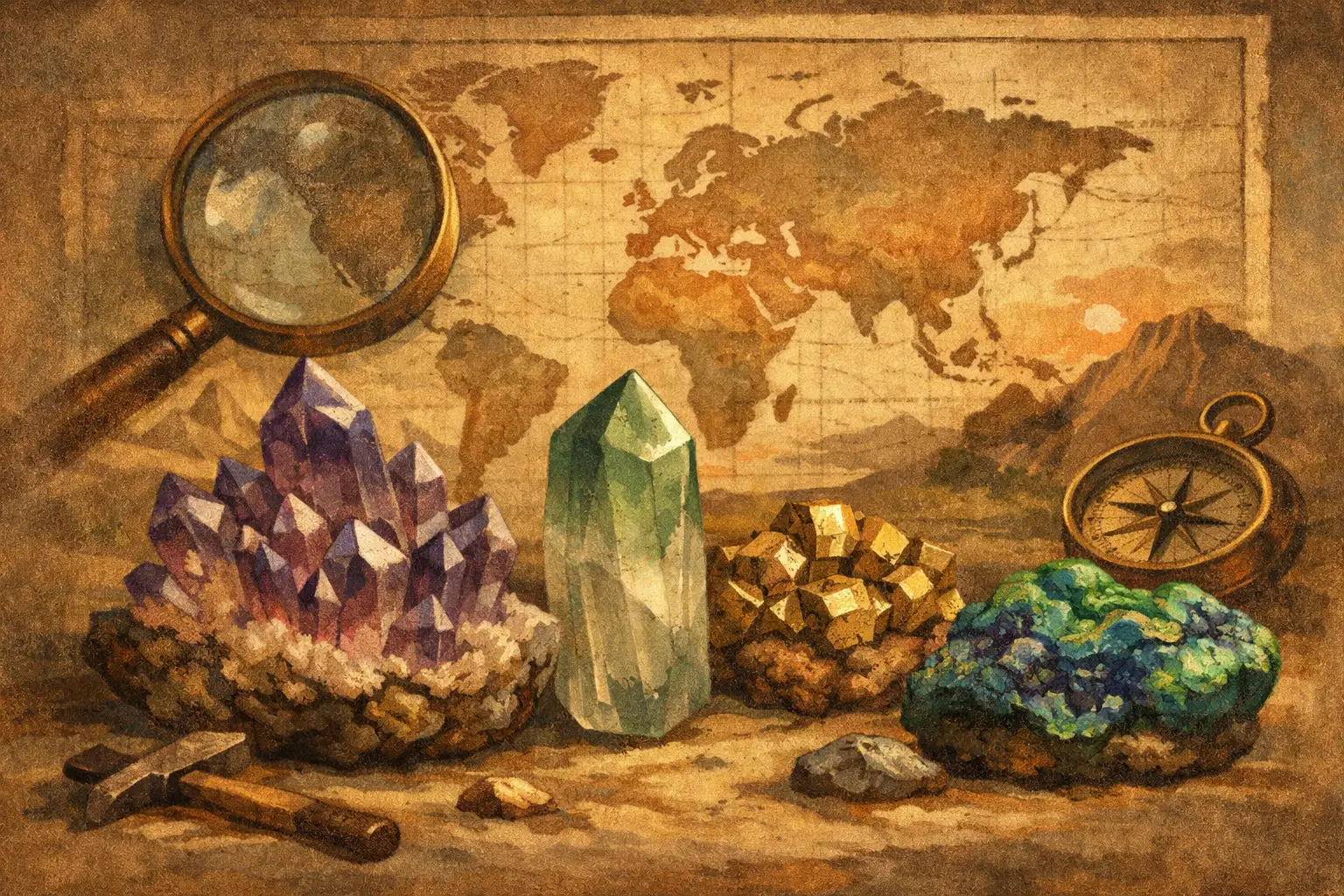
Mineral specimens with provenance offer the collector more than just aesthetics: they confirm authenticity, context, and documentary value.
When buying the same mineral from two different sources, a collector is often not buying the same object at all. Mineral specimens with provenance carry not only the species name and an attractive habit, but also a specific geological, historical, and collecting context. It is this context that determines whether we are dealing with an interesting decorative piece or an object that can be meaningfully integrated into an organized collection.
For a collector, provenance is not an add-on to the label. It is one of the fundamental descriptive data points, alongside mineral identification, chemical class, crystal morphology, and the specimen's state of preservation. Without this information, a specimen loses part of its cognitive value, and sometimes its market value as well.
Why mineral specimens with provenance carry more significance
Provenance tells exactly where a specimen comes from - which mine, vein, region, and in the best-case scenario, even a specific production zone or historical mining batch. This is not a detail for purists. In mineralogy, locality often co-creates the specimen's identity.
Take fluorite. Fluorite from one deposit may have a cubic habit typical of the locality and a specific range of colors, while a specimen from another region will be recognizable by its growth zoning, transparency, or associations with calcite or barite. The name of the mineral alone does not capture this difference. Only provenance allows the specimen to be interpreted correctly.
The same applies to vanadinite, pyrite, or malachite. For an advanced audience, the species name is only the beginning of the description. The find spot organizes the specimen within a broader system of references - geological, typological, and collecting-related.
What "provenance" of a specimen actually means
In practice, the level of accuracy regarding provenance data varies greatly. The weakest variant is just the country or a general region. Such a description is sometimes better than a total lack of information, but for a reference collector, it is limited. Much more valuable is data including the mine, mountain, quarry, mining district, or historical name of the site.
Multi-level descriptions are the most useful, for example: mine, town, district, administrative region, country. Such a record facilitates comparison with literature, archival labels, and other specimens from the same locality. This is especially important when site naming has changed over time or functions in several languages simultaneously.
Provenance also sometimes includes previous collecting history. If a specimen comes from an old collection, a liquidated specialized collection, or from material acquired during a specific period of operation, its documentation gains an additional layer. This does not always affect aesthetics, but it often affects the object's status.
Authenticity, identification, and trust
Well-documented provenance acts as a checkpoint. It does not replace mineralogical identification, but it significantly strengthens it. If a specimen is described as pyromorphite from a classic site where the occurrence of this species is well-confirmed, we have consistency between the declaration and geological probability. If a label indicates a rare mineral from a location with which it is not associated, it is worth being cautious and checking the description more closely.
This is particularly important for specimens that are often confused due to similarities in color, luster, or habit. Provenance helps reduce attribution errors, though it obviously does not eliminate them entirely. There are localities where several similar species co-occur, and in such cases, the label alone is not enough. Macro photos, observation of details, and sometimes instrumental analysis are still needed. However, a lack of provenance usually makes everything difficult from the start.
From a purchasing perspective, provenance is also an element of trust in the seller. A seller who provides the location precisely and consistently shows that they work with data, not just general trade names. For a collector, this is a clear qualitative difference.
Collector value does not depend solely on appearance
In the mineral market, visual appeal matters, but it is not the only criterion. Two specimens of similar size and aesthetics can have very different collector values if one has full site documentation and the other is anonymous.
This happens for several reasons. First, a well-documented specimen is easier to compare with reference material. Second, it can be meaningfully cataloged. Third, it can be presented in a collection in a way that goes beyond visual form alone. The specimen begins to participate in a story about the deposit, paragenesis, mining history, or a characteristic type of mineralization.
This does not mean that every specimen without provenance is worthless. Many collections contain inherited pieces, old purchases without labels, or specimens acquired long ago when documentation standards were lower. However, their role is different. They can remain visually or educationally interesting, but it is harder to treat them as strong elements of a systematic or locality-based collection.
How to evaluate mineral specimens with provenance before purchasing
It is best to look at provenance not as a single entry, but as part of an entire data set. Good practice starts with asking whether the location is specified concretely and whether it sounds consistent with the type of specimen. If you see a very broad name, it is worth determining whether more precise information exists but was not shown, or if it was simply never available.
The second step is to check the quality of visual documentation. General photos are necessary, but for assessing the consistency of the location and typical habit, macro shots are often equally important. They show crystal forms, zoning, relationships between minerals, and surface features. In practice, only the combination of image and description provides a solid basis for evaluation.
The third element is the label. A good label does not have to be graphically impressive, but it should be legible, terminologically stable, and complete. Species, location, size, and possibly the date of acquisition or catalog number - this is the minimum that facilitates further work with the collection.
When provenance is uncertain
Not every gap in documentation signifies a problem, but every gap should be named honestly. In older specimens, one encounters handwritten labels, incomplete town names, old mining names, or abbreviations understood only by the original owner. In such cases, it is worth distinguishing between three situations: confirmed provenance, probable provenance, and tentatively assigned provenance.
This distinction has practical significance. If a location is reconstructed based on an archival label and specimen characteristics, this should be noted. The collection then gains transparency, even if not every answer is one hundred percent certain. In the long run, such reliability is worth more than the apparent completeness of data.
Documenting provenance after purchase
Buying a well-described specimen is only the beginning. If the data is not preserved and organized, its value quickly diminishes. The most common mistake collectors make is not buying poor specimens, but losing information about good ones.
Therefore, documentation should include both the physical label and a digital record. It is worth storing the full location name, historical variants, date of purchase, source of acquisition, dimensions, photos, and catalog number. Such a system allows for later filtering of specimens by region, species, chemical class, or display type.
In this area, the advantage of an organized cataloging tool is obvious. For a consciously developed collection, documentation is not an administrative add-on, but part of collecting itself. Cabinet No. 40 is building exactly such a model of working with a specimen - from identification and presentation to archiving data that stays with the object for years.
Provenance and the method of building a collection
Mineral specimens with provenance work particularly well in collections created according to a clear key. This could be a systematic collection, a collection of one species from different localities, a collection of specimens from a specific region, or a comparative set showing morphological variation.
In each of these models, location ceases to be a footnote. It becomes the axis organizing the whole. Thanks to it, one can compare, for example, calcites from several classic sites and compare not only color but also habit, type of overgrowths, and paragenesis. This kind of collection is clear, educational, and much more resistant to the randomness of purchases.
If, on the other hand, the collection is purely aesthetic in nature, the importance of provenance may be smaller, though it is still worth preserving. Even a collection built primarily visually gains when each specimen has an assigned geographical and documentary identity.
The best specimens do not end with what is visible under the light. They remain in memory and in the catalog because their place on the map can be pointed out, they can be embedded in the geology of the site, and they can be described without ambiguity. If a collection is to mature, and not just grow, provenance is one of those data points that is truly worth starting with.