How to Identify Fluorite
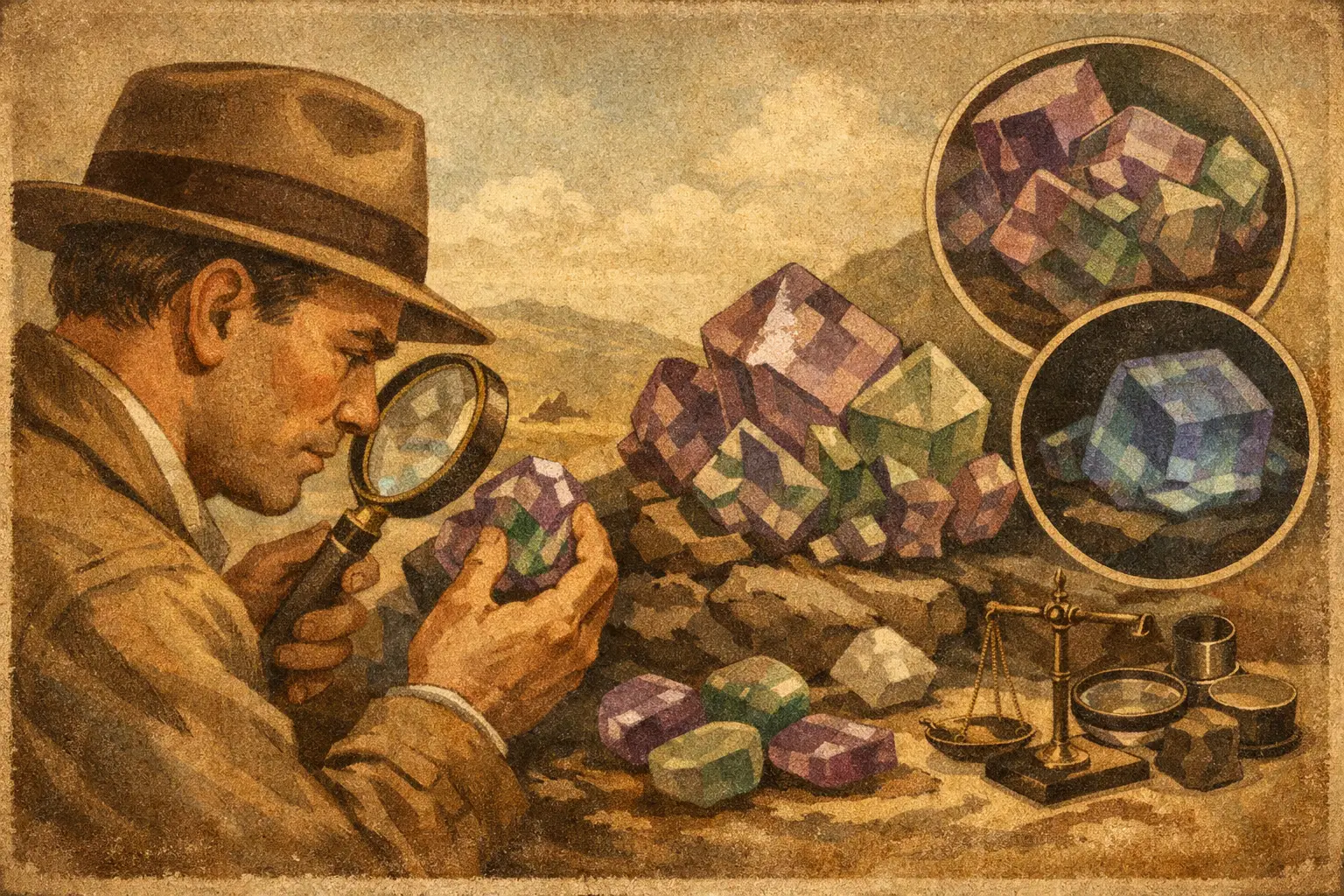
How to identify fluorite in a collector's specimen? Check the color, cleavage, hardness, habit, and common identification mistakes.
Not every purple or green mineral is fluorite - and that is exactly where most collector mistakes begin. If you are asking how to identify fluorite, it is worth moving away from color alone and looking at diagnostic features that actually work: crystal habit, cleavage, hardness, luster, and the context of occurrence. In practice, it is a set of observations, rather than a single flashy feature, that provides a certain identification.
Fluorite, or CaF2, belongs to the halides and is one of the most recognizable minerals in collecting, yet also one of the most frequently misidentified by beginners. This is due to its variable color. Specimens can be colorless, green, purple, yellow, bluish, pink, as well as multicolored with distinct zoning. Color itself is therefore a clue, but never a decisive argument.
How to identify fluorite by physical properties
The most important characteristic of fluorite is its perfect cleavage in four directions. In practice, this means that when broken or damaged, the mineral does not produce random, conchoidal surfaces like quartz, but smooth planes that often form shapes resembling octahedrons. For a collector, this is one of the most useful diagnostic features, especially in less aesthetic parts of the matrix or fragments at the base of a specimen.
The second essential feature is a hardness of 4 on the Mohs scale. Fluorite is significantly softer than quartz, which has a hardness of 7. This matters in the field and when evaluating unlabeled specimens. Fluorite can be scratched with a steel tool, and it will not scratch quartz. However, this test should be performed carefully and preferably only on a technical fragment, never on a representative crystal face.
The luster of fluorite is usually vitreous (glassy), sometimes slightly greasy on cleavage surfaces. Transparency can vary greatly - from completely transparent crystals to almost opaque material. In good collector specimens, internal growth zones, color banding, or subtle tonal transitions are often visible. This is a valuable clue, but still auxiliary, not decisive.
Fluorite crystal habit
If you want an accurate identification, look not only at the color but primarily at the geometry. Fluorite most commonly forms cubic crystals. This is the classic form that most collectors associate with it: cubes with sharp edges, sometimes with delicate face modifications. Many specimens also show the phenomenon of intergrowth or the gradual growth of successive crystal generations.
The second common form is the octahedron, although in the collector market, these are more often encountered as a result of natural cleavage rather than as perfectly formed crystals. More complex habits also occur, intermediate between a cube and an octahedron. For an advanced collector, the arrangement of the faces alone can narrow down the number of probable identifications.
It is also worth remembering associations. Fluorite often co-occurs with calcite, quartz, galena, sphalerite, baryte, and pyrites of various generations. Of course, the association with other minerals does not automatically identify a sample, but it builds a geological context. If you see cubic, vitreously lustrous crystals with perfect cleavage in the company of galena and calcite, the probability of it being fluorite increases significantly.
Fluorite color - helpful but unreliable
It is the color that most often leads to error. Fluorite can be intensely purple, soft green, honey yellow, or almost colorless. In many specimens, a single crystal transitions from a colorless center to purple or green zones at the edges. Such zoning is typical and highly valued by collectors, but it is not unique to this species alone.
The problem is that beginners often equate fluorite with any transparent purple mineral. Meanwhile, amethyst varieties of quartz, some calcites, and even glass can produce a similar visual effect. Therefore, if an identification ends with the statement "it's purple," it is not yet an identification, but a guess.
An additional clue can be fluorescence, from which the name of the phenomenon actually derives. Some fluorites exhibit a glow under UV radiation, usually blue or purple, but this is not a mandatory feature. Some specimens glow distinctly, others weakly, and some not at all. The composition of trace elements and the origin of the deposit are of great importance here. Therefore, the absence of fluorescence does not rule out fluorite.
Common minerals mistaken for fluorite
The most common mistake involves quartz. In general appearance, both minerals can look similar, especially when dealing with transparent or purple crystals. However, the difference is fundamental. Quartz does not have perfect cleavage, is significantly harder, and usually forms prismatic crystals terminated by rhombohedrons, not cubes. If you see a cube, think of fluorite first, not quartz.
The second frequent source of confusion is calcite. Calcite can also have various colors, can be transparent, and occurs with fluorite in the same parageneses. However, it differs by its rhombohedral cleavage, lower hardness, and reaction with dilute hydrochloric acid. In practice, the angle between the cleavage planes alone is often a good lead for the trained eye.
Sometimes fluorite is also confused with slag glass or synthetic material, especially when a specimen has a very saturated color and unbelievably clean transparency. Here, the quality of documentation, observation of natural growth zones, micro-damage, contact with the matrix, and overall morphology are key. A natural specimen usually betrays its origin through subtle irregularities that imitations often lack.
How to identify fluorite in a collector's specimen
In collecting, a mineral is not examined in a vacuum. The form of preparation, the label, the location, and the consistency of features with typical material from a given deposit all count. If a specimen described as fluorite from a classic region shows cubic crystals, color zoning, and expected associations, the identification is consistent. If, however, the description says one thing and the morphology another, one must be cautious.
The most sensible identification path is as follows: first, evaluate the crystal habit, then check the luster and transparency, next look for traces of cleavage, and only then treat color as a supporting feature. Finally, compare the specimen with typical forms from a specific location. This is how one works with collector material when aiming for an identification based on data rather than association.
If you are documenting a collection, it is worth recording not only the name of the mineral but also its identifying features visible in that specific piece. For fluorite, these might be, for example: cubic habit, green-purple zoning, perfect cleavage, and association with calcite. Such a description is more valuable than just a species label because it allows you to return to the identification years later and verify it without guessing.
When identification is not obvious
Not every specimen allows for easy recognition. Massive aggregates, damaged crystals, specimens after old repairs, or samples without locality data can be problematic. In such cases, a single feature is rarely enough. One must combine macroscopic observations with documentation and comparisons to well-identified references.
This applies particularly to specimens that have been cleaned, glued, or stripped of part of their matrix. Overly aggressive preparation can remove traces of natural cleavage or spatial relationships with other minerals. For the collector, this means a simple rule: the better the documentation and the clearer the provenance, the lower the risk of an identification error.
In practice, the best results come from combining visual observation with proper cataloging. This is one reason why collectors increasingly treat photography, notes, and locality data as part of the specimen itself, rather than an add-on. A well-documented fluorite is easier to identify today and much easier ten years from now.
So, if you want to identify fluorite more confidently, look like a collection curator, not like a casual buyer of color. First form, then structure, then contex - and only at the end, the visual impression. This is a more deliberate method, but it is the one that most often leads to an accurate identification.