How to Identify Pyrite
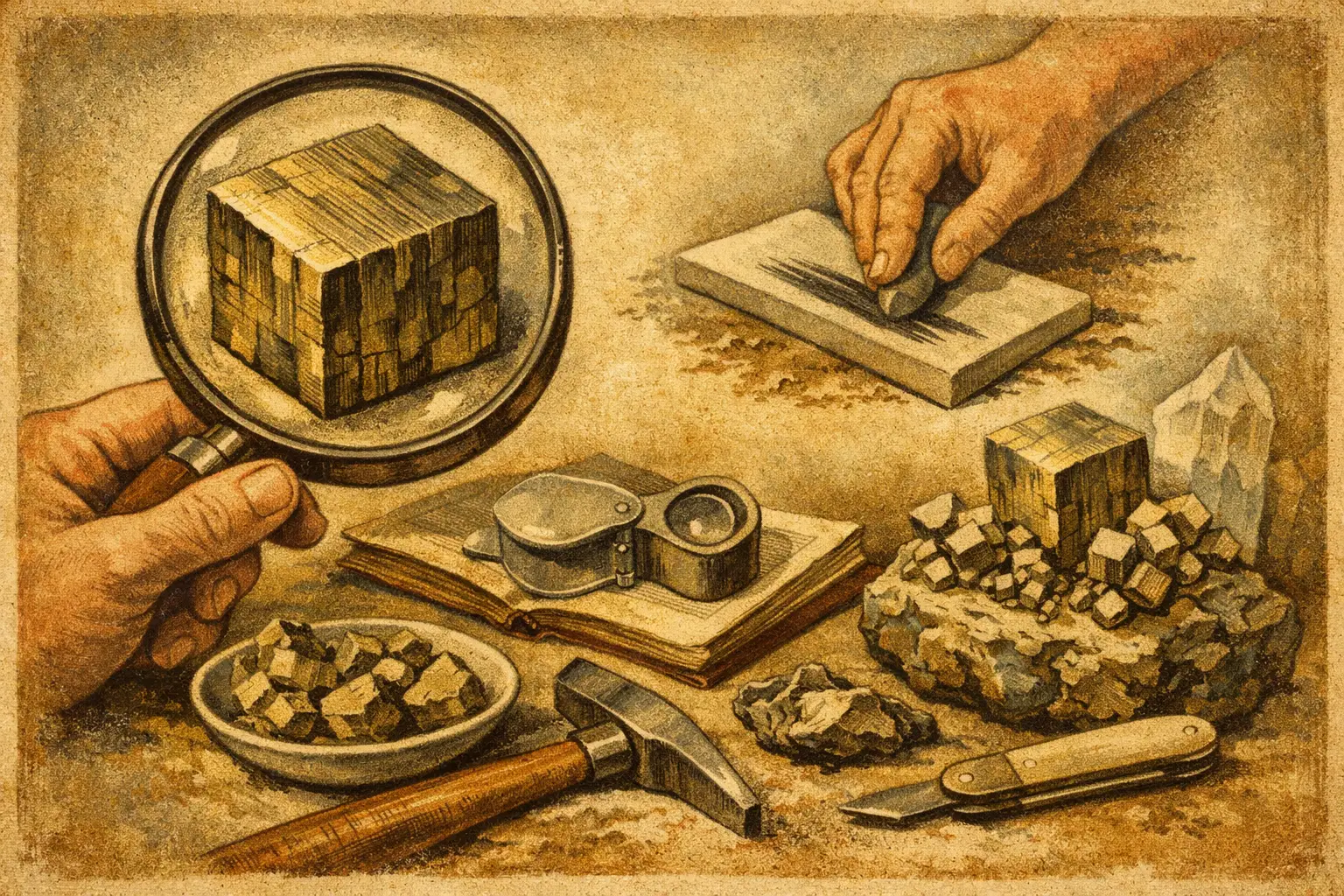
How to identify pyrite in the field and in a collection? Check the luster, color, hardness, streak, and crystal habit to distinguish it from gold.
Pyrite can deceive even a careful eye. In photos, it is often mistaken for gold; in the field, for other sulfides; and in a collection, for specimens with a similar metallic luster. However, if you know which features to look for, the question of how to identify pyrite stops being a guessing game and becomes a simple identification procedure.
How to identify pyrite - where to start
It is best to start with features visible without any tools. Pyrite usually has a brass-yellow color, but it is not as warm and "soft" as gold. Its luster is distinctly metallic, often with a cooler, more steely character. In good light, the surface of pyrite crystals reflects light sharply and harshly, which is one of the first clues for a collector.
The second matter is the habit. Pyrite very often forms cubic crystals, sometimes also pyritohedrons (pentagonal dodecahedrons) or forms with distinct striations on the faces. This is an important feature because native gold rarely shows such regular geometry. If a specimen looks like it is built of small metallic cubes, pyrite becomes much more likely.
In practice, identification should not rely on a single impression. Color can vary due to tarnish, weathering, and inclusions, and luster depends on surface quality. Therefore, collectors treat macroscopic observation as the first stage, not the final verdict.
Diagnostic features of pyrite
The most useful diagnostic features of pyrite are hardness, streak, cleavage (or rather the lack thereof), and the type of fracture. Pyrite has a hardness of 6-6.5 on the Mohs scale. This means it is significantly harder than gold and most materials it is amateurishly compared to. It cannot be easily scratched with a fingernail, a copper coin, or even a steel blade without significant pressure.
The streak of pyrite is greenish-black to brownish-black. This is one of the most reliable field characteristics, provided you have an unglazed porcelain streak plate available. Gold leaves a yellow streak, while pyrite produces a distinctly darker mark. For those building an organized collection, this test is more valuable than just assessing the surface color.
Pyrite is also brittle. Under pressure or impact, it does not flatten like gold but shatters. This distinction is very important but requires caution. In the case of aesthetic collector specimens, a destructive test usually makes no sense. It is better to use this feature when evaluating small fragments or less representative material.
Density also helps, though more so in the hands of an experienced collector. Pyrite is heavy, but gold is significantly heavier. If two specimens of similar size are compared in the hand, gold feels almost unnaturally massive. Pyrite gives a sense of high mass, but not to such an extreme degree.
Pyrite vs. Gold - the most common mistake
The term "fool's gold" is catchy, but from a collecting point of view, it simplifies the subject a bit. Yes, pyrite and gold are often confused, especially by beginners. The problem is that the differences only become obvious when you compare specific features rather than just a general impression of color.
Gold has a more saturated and warmer color. Pyrite more often falls into a pale yellow, brassy shade, sometimes with a slight hint of gray. Gold does not form such regular cubes and usually occurs in irregular, flaky, granular, or wire-like forms. Pyrite, on the other hand, favors geometry, and it is this geometric nature that often reveals its identity faster than the color itself.
The mechanical reaction is also different. Gold is malleable - it can be flattened. Pyrite is brittle - it crumbles or breaks. In home conditions, however, it is not worth testing this on a high-quality specimen. If the material has collector value, it is safer to rely on the observation of crystals, streak, and hardness.
How to identify pyrite in the field
In the field, speed and simplicity count. First, look at the geological context. Pyrite often appears in sedimentary, metamorphic, and hydrothermal rocks; it can be associated with quartz veins, shales, marls, or ore deposits. The environment of occurrence alone does not provide certainty, but it narrows down the possibilities.
Next, evaluate the shape and surface. If you see small cubes, cubic clusters, or granular aggregates with a metallic luster, that is a strong signal. Pay attention to the striations on the crystal faces. In pyrite, these are common and clearly visible in side lighting.
If you have a streak plate, use it. If not, do not try to replace it with a random stone, as the result will be misleading. In the field, it is also easy to overestimate color alone, especially in bright sunlight or after rain, when surfaces are optically more intense.
It is worth remembering that weathered pyrite may look different from a fresh fracture. Brownish tarnish, iridescent discolorations, or dulling may appear on the surface. Such changes do not rule out identification but make it harder for those looking at only one feature.
How to identify pyrite in a collection
In a collection, you have an advantage over field conditions - you can work more slowly and accurately. Good side lighting, a 10x loupe, and the ability to view the specimen from several sides are enough to identify most typical specimens without interfering with their structure.
Document first, then evaluate. Note the color, luster, crystal habit, size of intergrowths, and the host rock. If you keep a catalog, it is also worth recording the place of acquisition and any trade label, even if it raises doubts. Subsequent verification is then much simpler.
For high-end collector specimens, viewing the surface under magnification is particularly valuable. Pyrite then shows sharp edges, regularity of faces, and characteristic growth details. This approach is closer to curatorial work than amateur "guessing by color," and that is why it yields better results.
If you have a doubt between pyrite and marcasite, the matter becomes more subtle. Both minerals have the same chemical composition - FeS2 - but a different crystal structure. Marcasite more often forms radiating, tabular, cockscomb habits and concretions, and its stability can be poorer. In collections, old marcasite material may degrade over time. Pyrite usually remains more stable and more frequently occurs in well-formed cubes.
What not to do during identification
The most common mistake is basing identification solely on color. A brassy luster does not automatically make a specimen pyrite, just as a yellow metallic flash does not mean gold. Equally misleading is evaluating a mineral based only on a single photo, especially one with heavily boosted contrast.
The second mistake is overly aggressive testing. Streak, hardness, and fracture are useful, but a collector specimen is not material for mindless scratching with a knife. Good identification involves choosing methods appropriate to the value of the object. Sometimes it is better to maintain a slight uncertainty than to destroy a well-formed crystal.
The third problem is ignoring context. The label, location, paragenesis, and growth form often say as much as a single test. In an organized collection, a mineral without data loses part of its scientific value, even if the specimen itself is visually attractive.
Short identification procedure
If you want to act methodically, use a simple sequence. First, evaluate the color and luster, then check the crystal habit. Next, if it is safe for the specimen, verify the hardness and streak. Finally, compare the result with the context of occurrence and the sample documentation.
This approach is not flashy, but it is effective. This is exactly how one works with specimens that are meant to be not only identified but also correctly cataloged. For a collector, the difference is fundamental - identification without documentation provides temporary knowledge, while identification embedded in data builds the value of the collection.
In practice, the question of how to identify pyrite comes down to one rule: do not trust a single feature, trust the consistency of several independent observations. When color, luster, habit, hardness, and streak all point to the same mineral, the risk of error decreases significantly.
A well-labeled pyrite is not just a correct name in a catalog. It also means better comparisons between specimens, more meaningful documentation, and greater satisfaction from a collection built with precision rather than guesswork.