How to Present Minerals Online Without Chaos
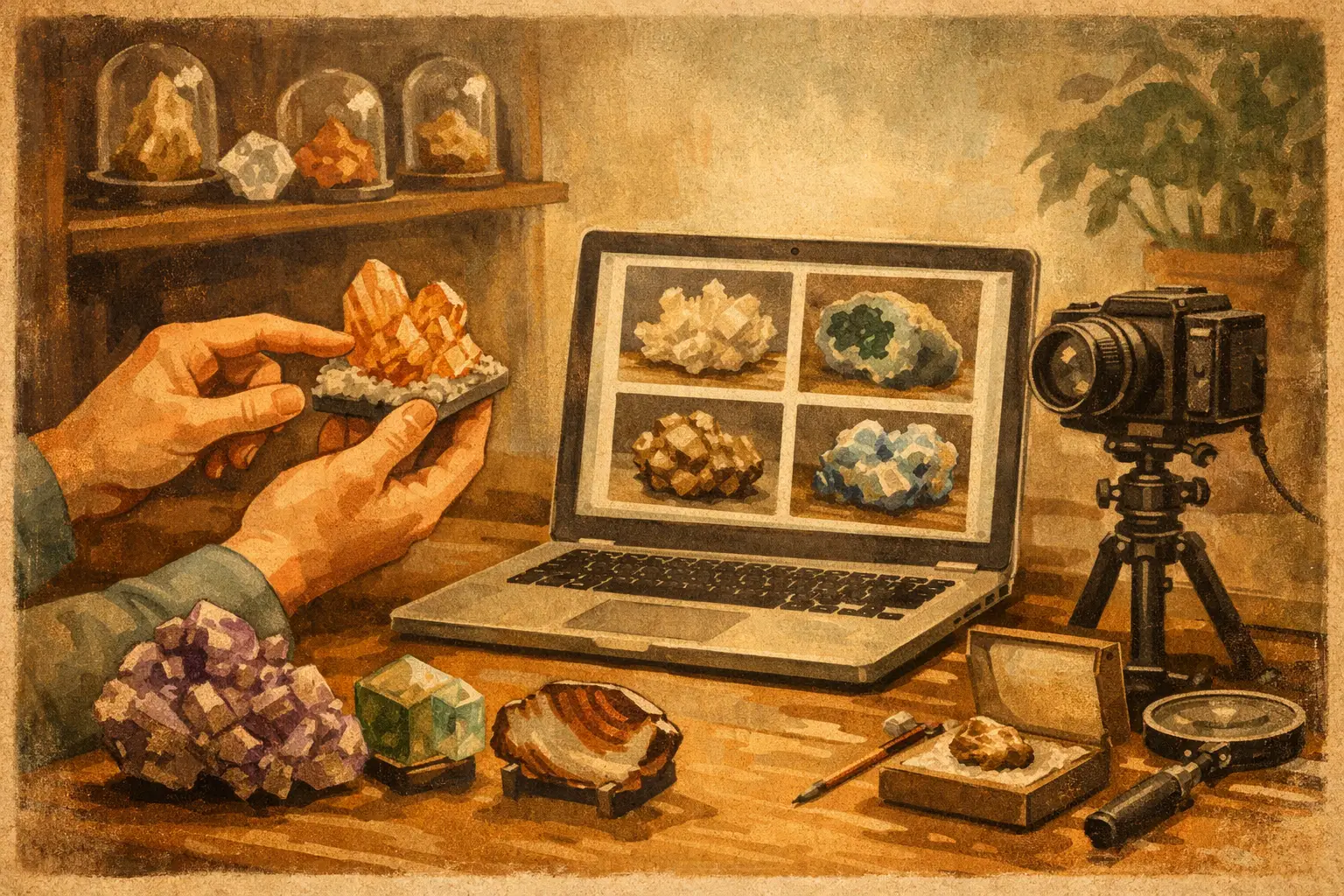
How to present minerals online so they look credible and professional? Photos, descriptions, metadata, and collection layout determine the reception.
The first photo of a specimen dictates everything. If the color is distorted, the scale unreadable, and the description ends at “beautiful mineral”, even a good specimen loses credibility. Therefore, the question of how to present minerals online is not solely about aesthetics. It concerns documentation, data organization, and whether the recipient - collector, buyer, researcher, or educator - can quickly assess what they are looking at.
In mineral collecting, digital presentation today serves as a display case, museum label, and catalog card simultaneously. A well-prepared publication should show not only the beauty of the specimen but also its identity: species, locality, dimensions, condition, systematic context, and characteristics important from a collector's perspective. The rarer or more complex the specimen, the greater the importance of precision.
How to Present Minerals Online to Build Trust
The most common mistake is treating a mineral like a common catalog product. Meanwhile, two specimens of the same species can differ in crystal habit, association, luster, transparency, damage, and collector's value. The presentation must therefore be specific, not general.
In practice, it is worth building each entry with four layers of information:
the visual layer, i.e., photos and any rotating views,
the identification layer, covering name, classification, and provenance,
the collector's layer, which describes the quality and character of the specimen,
the organizational layer, i.e., catalog number, labels, and place in the collection.
Only the combination of these elements yields a professional effect. A good photo alone will not replace data. A description without an image is also insufficient.
Mineral Photos Online - Less Effect, More Control
Photography is the entry point, but it should not distort the object. Overly aggressive processing, oversaturated colors, or a background with a strong color cast often improve the “attractiveness” of the image at the expense of reliability. For a collector, this is a warning sign.
Photos taken according to a repeatable standard work best. The viewer should be able to compare several specimens and see that each has been presented in a similar way. Such a standard usually includes:
a neutral, clean background,
lighting that shows relief and luster without blowouts,
several consistent shots, for example, front, back, side, and a close-up of a detail,
a photo with a scale or precisely stated dimensions,
focus set on the most important collector's features.
For small specimens and subtle growths, macrophotographs or microphotographs work well. However, the point is not to multiply spectacular shots, but to show what is not visible at a standard scale. If the value of the specimen results from tiny crystals, zoning, inclusions, or association with another mineral, a close-up ceases to be an addition - it becomes part of the documentation.
360-degree presentations are also gaining importance. They are not necessary for every specimen, but they are very helpful when the spatial form of the specimen is important, and individual frames do not convey the geometry. This is especially useful for massive specimens, aggregates with complex topography, and minerals whose aesthetics change depending on the angle of light.
Color and Scale Must Be Reliable
In online presentation, color is the area of greatest risk. Poor temperature lighting, automatic white balance, and aggressive contrast correction can easily alter perception. Therefore, it is better to strive for neutrality than for a “wow effect”. For a collector, the question of whether the specimen looks real is more important than whether it looks spectacular.
It is similar with scale. A photo without a reference point can be misleading. If you do not want to include a ruler in the frame, provide exact dimensions in millimeters and stick to a single scheme: length x width x height. This is a small detail, but it speaks to the cataloging standard.
Specimen Description Cannot Be an Advertisement
A well-written online mineral description resembles a condensed collector's card, not a sales text. It should be concise but precise. Instead of vague generalizations, it is better to provide verifiable information.
The basic description should include:
the mineral species name,
group or class, if it aids orientation,
locality in the fullest possible form,
dimensions and possibly mass,
growth habit or form,
matrix or associated minerals,
condition, including damage, repairs, or natural losses.
For a more advanced audience, information about genesis, typicality of the locality, or whether the specimen represents a characteristic habit for a given deposit is also useful. This does not have to be a long paragraph. Sometimes two well-chosen sentences make a greater difference than an extensive text.
How to Describe Condition
The condition of the specimen should be described objectively. If a crystal has a chipped corner, it is better to state it directly. If the luster is good on the main face, but weaker at the edges due to contact with the matrix, it is also worth noting. Such transparency does not lower the quality of the presentation - on the contrary, it builds trust.
In the collecting community, not only beauty but also honesty of documentation matters. A specimen beautifully photographed but described too generally raises more questions than one shown more modestly but precisely.
How to Present Minerals Online in an Organized System
A single entry can be excellent, yet the entire collection can still appear chaotic. The problem usually does not lie in the photos, but in the lack of a system. If you publish more than a few specimens, you need a consistent catalog structure.
It is best to start with fixed data fields. In practice, this means that each specimen should have the same set of metadata, even if not all fields are always filled. Such a set may include inventory number, species name, locality, acquisition date, source of origin, mineralogical class, size, collection status, and notes on display or conservation.
This solution has two advantages. Firstly, it improves public presentation because the viewer navigates a predictable layout. Secondly, it supports collection management. When, after a year, you want to filter all fluorites from a specific region or prepare labels for an exhibition, organized data saves a lot of time.
In the case of collecting platforms, such as Cabinet No. 40, the advantage of a well-designed system lies in combining the image with the catalog. The specimen then exists not as a solitary photo in a gallery, but as a collection record with its own identity, history, and place within the larger structure of the collection.
Gallery Layout Also Conveys Information
It is worth considering not only individual cards but also the way the entire collection is browsed. A collection can be presented by species, locality, chemical classes, color scheme, or status - for example, acquired, exchanged, sold, or currently displayed specimens. Each of these layouts corresponds to a different purpose.
If the goal is education, a systematic order works best. If it is sales or the presentation of a private collection, a division by aesthetics, size, or region of origin is often better. There is no single correct model. A good decision depends on whether you are creating an archive, an offer, a public gallery, or a tool for managing your collection.
Digital Label is Just as Important as the Photo
In the offline world, a label next to a specimen organizes perception. Online, it serves the same function, but in a more expanded form. Name, locality, and catalog number are the minimum. But it is worth thinking more broadly - as a museum caption extended with a data layer.
A well-designed digital label should be legible at first glance and accurate when expanded. A brief view might include the name, locality, and size. The full view might add classification, collector's notes, a map of origin, the specimen's history, and photographic documentation.
This is especially important when you present specimens publicly, share your collection with other collectors, or prepare materials for identification. Without a label, even the best gallery becomes just a collection of images.
What Not to Omit When Publishing
When preparing a specimen for publication, it is easy to focus on its appearance and overlook less spectacular elements. Yet these often determine the reception by an advanced user. Most often, information is missing about provenance, acquisition date, previous collection numbers, or the relationship between specimens from the same locality assemblage.
It is also worth remembering the consistency of nomenclature. If you use the full locality form once, do not abbreviate it in another entry unnecessarily. If you record mineral names according to one standard, stick to it consistently. A catalog looks professional when the logic of its entries is stable.
Finally, there is the simplest yet often neglected matter: regular updates. A collection is alive. Specimens change status, go on display, return to storage, get new photos, or more accurate identification. A good online presentation is not a one-time project, but an evolving archive.
So, if you want to display minerals online really well, think like a collection curator, not like the author of a random gallery. The image should attract attention, but it is the order of data that makes a specimen remembered and properly understood.