Diopside
Chemical formula: CaMgSi<sub>2</sub>O<sub>6</sub>
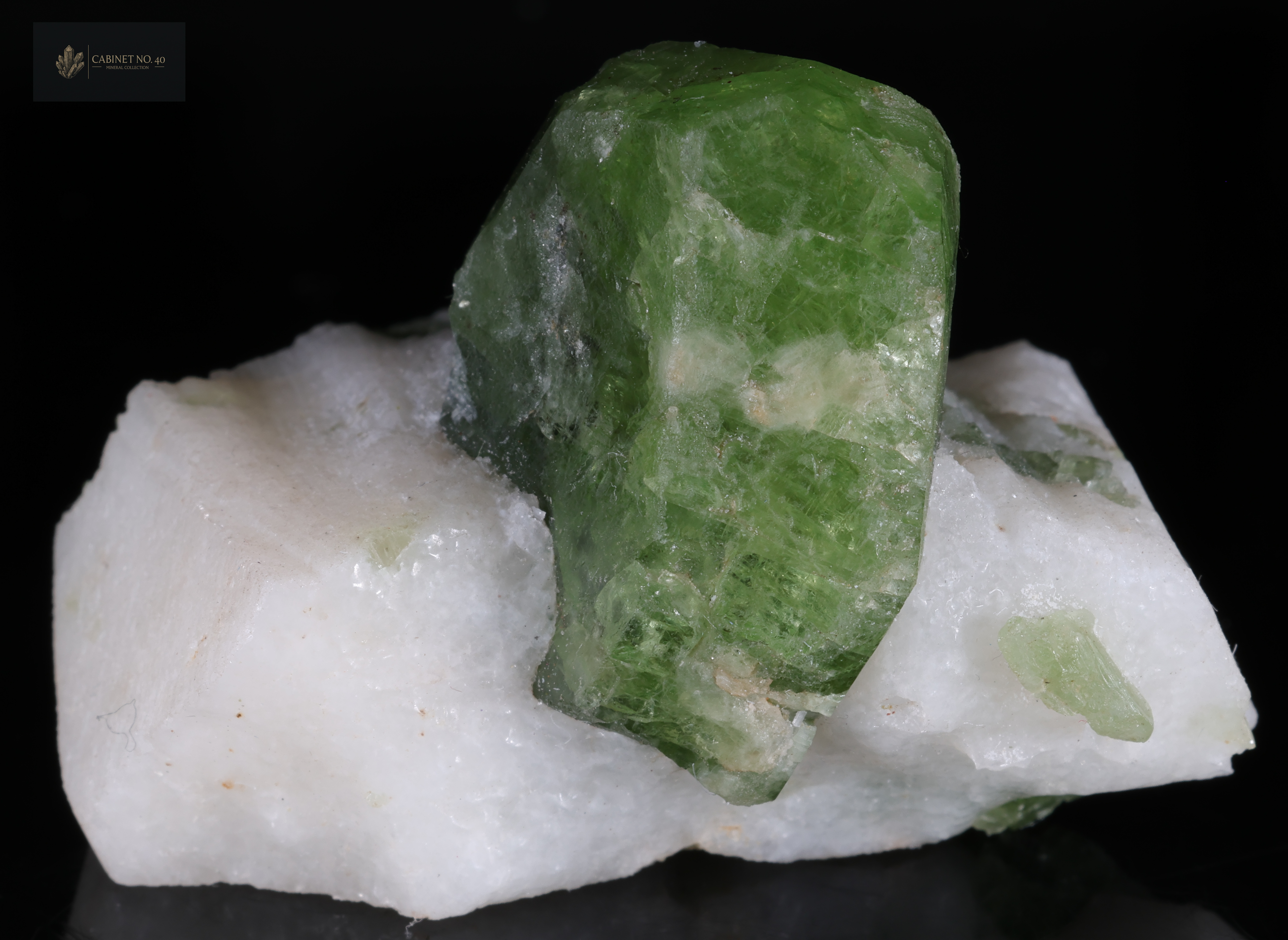
Diopside is a mineral from the pyroxene group, a calcium and magnesium silicate, often found in metamorphic and igneous rocks.
Properties
- Mohs hardness
- 5.5-6.5
- Luster
- Vitreous
- Streak
- White
- Density
- 3.22
- Cleavage
- on {110}
- Transparency
- Transparent,Opaque
- Crystal system
- Monoclinic
Diagnostic features
## Identification Diopside can be identified by its prismatic crystal habit, often with visible prismatic faces, and by its characteristic hardness in the range of 5.5-6.5 on the Mohs scale. Vitreous luster and a white streak are also helpful in identification. Its occurrence in metamorphic and igneous rocks is an important clue. ## Differentiation from similar minerals Diopside can be confused with other pyroxenes, such as aegirine or hedenbergite, as well as with amphiboles, especially tremolite or actinolite. It differs from amphiboles by the cleavage angle (pyroxenes have an angle of approximately 90 degrees, amphiboles approximately 120 degrees). Diopside differs from other pyroxenes by its chemical composition and specific formation conditions. ## Crystal forms Diopside forms prismatic crystals, often short-prismatic or elongated, with a square or octagonal cross-section. Twinning is common. It can also form granular or massive aggregates.
Geological environment
## Genesis Diopside is a typical mineral of metamorphic rocks, especially skarns, dolomitic marbles, and serpentinites, where it forms as a result of contact or regional metamorphism. It also occurs in some igneous rocks, such as basalts, gabbros, peridotites, and kimberlites, crystallizing from calcium- and magnesium-rich magma. ## Mineral associations Diopside often co-occurs with minerals such as calcite, dolomite, garnets (especially grossular), vesuvianite, wollastonite, forsterite, serpentine, tremolite, actinolite, plagioclase, and magnetite. ## Localities Known diopside localities are found in many places around the world. The Italian Alps, especially the Ala Valley in Piedmont, are a classic occurrence. Other important localities include Russia (Yakutia, Urals), Canada (Quebec, Ontario), USA (New York, California), Myanmar, Pakistan, Brazil, Madagascar, and Austria.
Rarity
Very Common
For collectors
## Quality criteria The most prized diopside specimens are those with intense, uniform color, especially emerald-green chromian diopside. Transparency, clarity (lack of inclusions), and well-formed, undamaged crystals are also important. Large, aesthetic specimens with distinct faces are particularly sought after. ## Popular localities The most prized chromian diopside specimens come from Yakutia in Russia. Other popular locations include Pakistan, where beautiful green crystals are found, and Myanmar, known for high-quality gem materials. The Italian Alps provide historical specimens.
Care and storage
## Cleaning Diopside can be cleaned with warm water and mild soap. Use a soft brush or cloth to remove impurities from the mineral's surface. After washing, rinse the specimen thoroughly with clean water and dry with a soft cloth. ## What to avoid Avoid using aggressive chemicals, such as acids or strong detergents, which can damage the surface of diopside. The mineral is sensitive to sudden temperature changes, which can lead to cracks. Prolonged exposure to direct sunlight can cause some colored varieties to fade. Additionally, due to its moderate hardness, diopside should be protected from scratches. ## Storage Diopside is best stored in separate, soft pouches or boxes lined with soft material to prevent scratching by harder minerals. Specimens should be stored at a stable temperature and humidity, away from direct sunlight.