SKU: S_00051
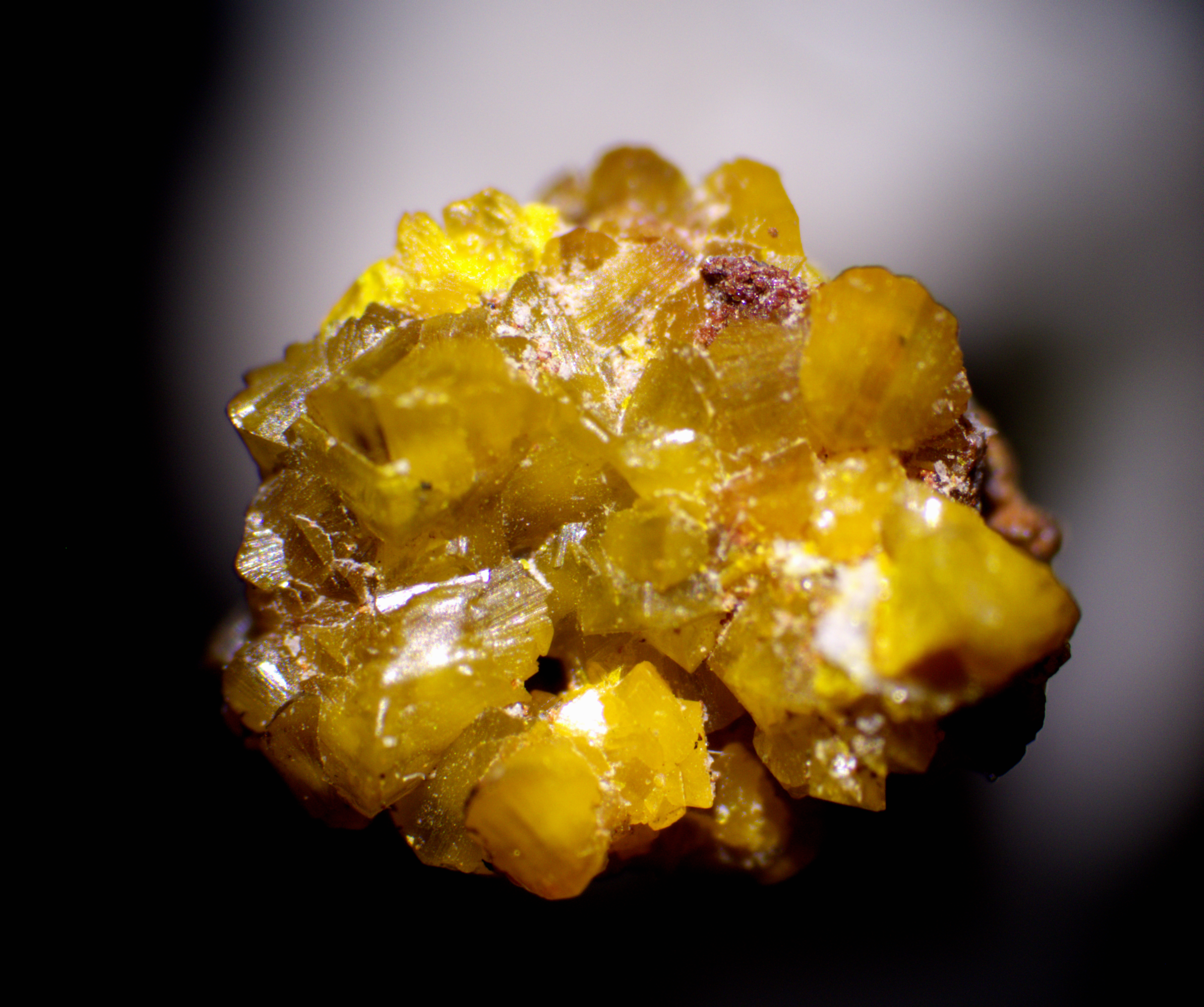
Specimen of the rare uranium-vanadium mineral, Francevillite, in micromount size, originating from its type locality. It is a compact cluster of tabular crystals with a saturated yellow-orange color and strong luster. Main Features: rare uranium mineral; Type Locality; saturated yellow-orange color; very good crystal morphology; historical collection 1060. Condition: Very good. The crystal cluster is dense and free from visible blemishes in the center. Under magnification, minor cloudiness and irregularities can be observed on the outer edges of the cluster, which are natural traces of separation from the host rock.
Price: 34 EUR (149 PLN)
Availability: In stock
Location: Mounana Mine, Franceville, Haut-Ogooué Province, Gabon
Size: 4 x 3 x 4 mm
Weight: 200 g
Chemical formula: Ba(UO₂)₂(VO₄)₂·5H₂O
Crystal system: Ortorombowy
Mohs hardness: 2-3
Characteristics Francevillite is a uranyl and barium vanadate mineral, characterized by an intense, usually lemon-yellow color. It most commonly occurs as small, radial aggregates, crusts, or as lamellar masses. Crystals are usually small, tabular, often forming radial or fan-shaped aggregates. Its presence often indicates secondary mineralization processes in the oxidation zones of uranium deposits. Physical Properties Francevillite has a Mohs hardness of 3. It exhibits a pearly to silky luster on cleavage surfaces and a dull luster on other surfaces. It is a translucent mineral. Its density is approximately 4.55 g/cm³. Colors and Varieties The typical color of francevillite is lemon-yellow, but it can also take on shades of yellowish-orange, orange, greenish-yellow, green, and even brown. Color changes are often associated with impurities of other elements or the degree of hydration. History and Name The mineral was discovered in 1957 in the Mounana uranium mine in Gabon. The name francevillite comes from the city of Franceville, located near its discovery site. It was described by J. Geffroy and J. Lajoinie. Uses Francevillite is a mineral primarily of collector's and scientific interest. Due to its uranium and vanadium content, it can be an indicator of the presence of these elements in deposits, but it is not a significant source for their industrial extraction.
Identification Francevillite can be identified by its characteristic lemon-yellow color, often forming radial or lamellar aggregates. An important diagnostic feature is its hardness (3 on the Mohs scale) and translucent nature. The streak is pale yellow. Distinguishing from Similar Minerals Francevillite can be confused with other secondary uranium minerals, such as carnotite or tyuyamunite, which also have a yellow coloration. It differs from carnotite by the presence of barium instead of potassium. Differences in chemical composition and crystallographic system are key for precise differentiation. Crystal Forms Francevillite crystals are typically tabular, often forming radial aggregates, crusts, or lamellar masses. These aggregates can be very fine, forming coatings on other minerals.
Genesis Francevillite forms in the oxidation zones of uranium deposits as a secondary mineral. It is formed by hydrothermal processes or weathering, where uranium, barium, and vanadium are mobilized and recrystallize in the presence of water. Mineral Associations Francevillite often co-occurs with other uranium minerals, such as uraninite, carnotite, tyuyamunite, as well as vanadium and barium minerals. It can be found in association with silicate minerals and iron oxides. Localities The most known and type locality for francevillite is the Mounana uranium mine in Gabon, where it was discovered. Other occurrences include the Democratic Republic of Congo, United States (Colorado, Utah), Australia, and Germany.
Quality Criteria The most prized francevillite specimens are those with intense, uniform color, well-formed crystals, and aesthetic, radial aggregates. The size of the specimen, its purity, and the absence of mechanical damage also affect its collector's value. Specimens on matrix are particularly sought after. Popular Localities The most sought-after francevillite specimens come from its discovery site - the Mounana mine in Gabon. They are valued for their typical color and mode of occurrence.
See mineralogical reference for Francevillite in the Knowledge Base →