White Wardite and Millisite from Clay Canyon, Utah (TL)

SKU: S_00063

Specimen from the historical, exhausted American locality Clay Canyon, which is the type locality for both wardite and millisite. Distinct crystals of white wardite have formed in the matrix cavity. Under magnification, the white crystals exhibit well-defined faces and sharp edges, representing a classic paragenesis from this famous deposit. Main Features: dual type locality (Type Locality for wardite and millisite); market legend (white wardite from Clay Canyon); distinct pseudo-octahedral morphology. Condition: Good. The main cluster of wardite crystals at the center of the specimen has retained sharp edges and shows no signs of significant mechanical damage.
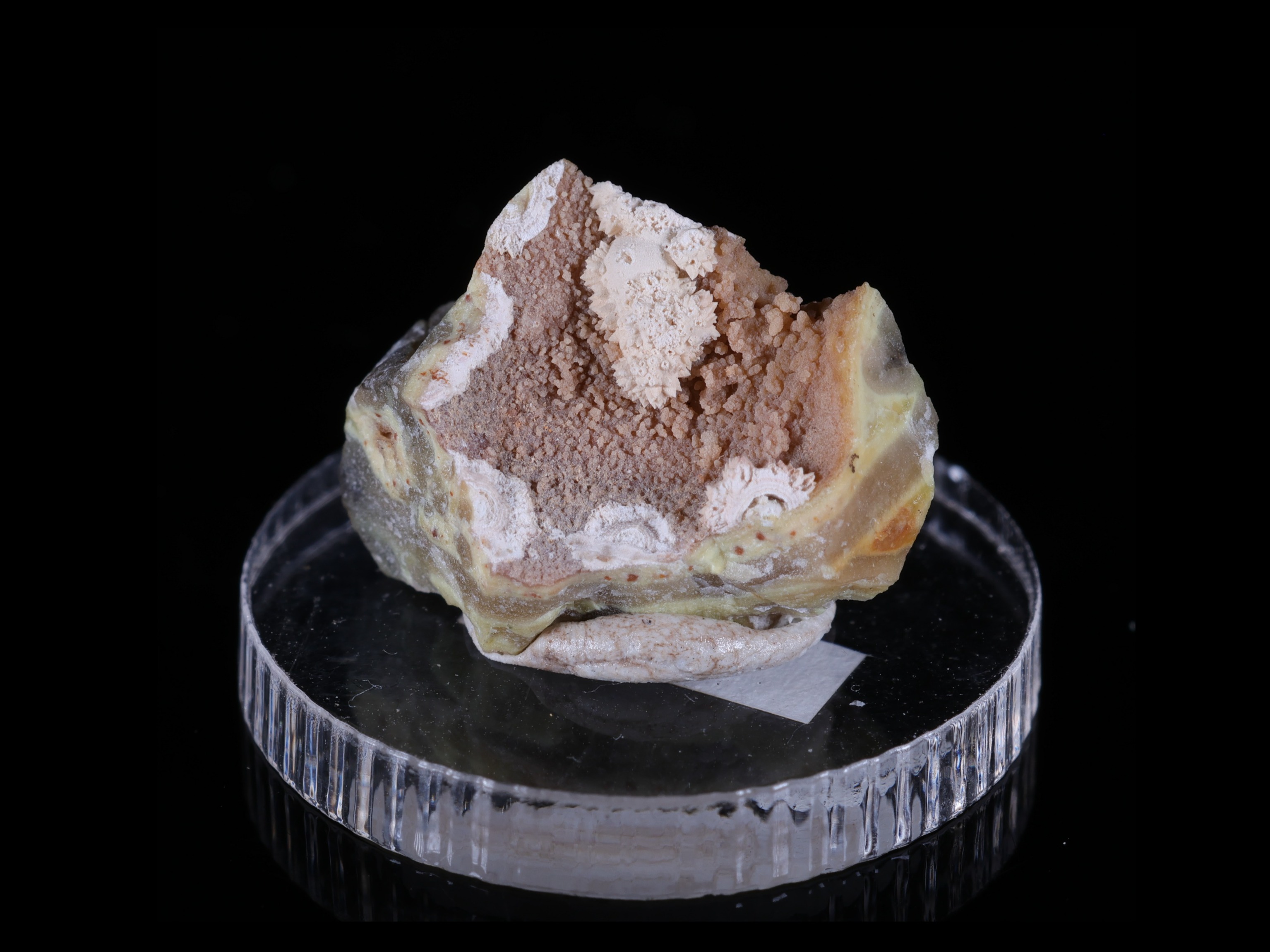
White Wardite and Millisite from Clay Canyon, Utah (TL)

Price: 69 EUR (299 PLN)

Availability: In stock

Location: Clay Canyon, Fairfield, Utah, USA

Size: 15 x 7 x 11 mm

Weight: 1.2 g

Chemical formula: NaAl₃(PO₄)₂(OH)₄·2H₂O

Crystal system: Tetragonalny

Mohs hardness: 5

Characteristics Wardite is a phosphate mineral that crystallizes in the tetragonal system. It often occurs as small, well-formed bipyramidal or prismatic crystals, as well as in radial, spherical, or botryoidal aggregates. Typical specimens are colorless, white, or delicately colored blue, green, yellowish-green, pale yellow, or brown. In transmitted light, wardite is colorless. Physical Properties The Mohs hardness of wardite is 5. This mineral exhibits perfect cleavage along the {001} plane. Its density is 2.81 g/cm³. Colors and Varieties Wardite occurs in colorless, white, and also delicate blue, green, yellowish-green, pale yellow, and brown hues. The coloration is often subtle and may be difficult to observe without proper lighting. History and Name Wardite was discovered and described in 1896. The mineral is named after Henry A. Ward, an American collector of minerals and meteorites. Applications Wardite has no industrial applications. It is a mineral valued primarily by collectors due to its rarity and the aesthetics of its crystals.

Diagnostic features

Identification Wardite can be identified by its tetragonal crystal habit, Mohs hardness of 5, and perfect cleavage. Its colors, ranging from colorless to delicate shades of blue, green, and yellow, are also characteristic. Differentiation from Similar Minerals Wardite can be confused with other phosphate minerals. It can be distinguished based on detailed crystallographic analysis, hardness, and chemical tests. Its tetragonal crystal system is a key diagnostic feature. Crystal Forms Wardite most often forms bipyramidal or prismatic crystals. It also occurs in radial, spherical, and botryoidal aggregates, often as coatings on other minerals.

Formation environment

Genesis Wardite is a secondary mineral, forming in the oxidation zones of phosphate deposits, often in pegmatites, as a result of hydrothermal alteration of other phosphate minerals. It also occurs in cavities within phosphate rocks. Mineral Associations Wardite often co-occurs with other phosphate minerals, such as wavellite, strengite, beraunite, rockbridgeite, as well as with quartz and kaolinite. Localities Known localities of wardite include the Palermo No. 1 mine in North Groton, New Hampshire, USA; the Big Chief mine in Keystone, South Dakota, USA; and the Hagendorf mine in Bavaria, Germany.

For the collector

Quality Criteria The most prized wardite specimens are those with well-formed, distinct crystals, with intense, though delicate, coloration and high transparency. Large, single crystals are rare and sought after. Specimens with aesthetic associations with other minerals are also highly valued. Popular Localities Particularly prized specimens come from the Palermo No. 1 mine in New Hampshire and the Big Chief mine in South Dakota, USA, where some of the best wardite crystals have been found.

See mineralogical reference for Wardite in the Knowledge Base →

View product →