Wardite
Chemical formula: NaAl<sub>3</sub>(PO<sub>4</sub>)<sub>2</sub>(OH)<sub>4</sub>·2H<sub>2</sub>O
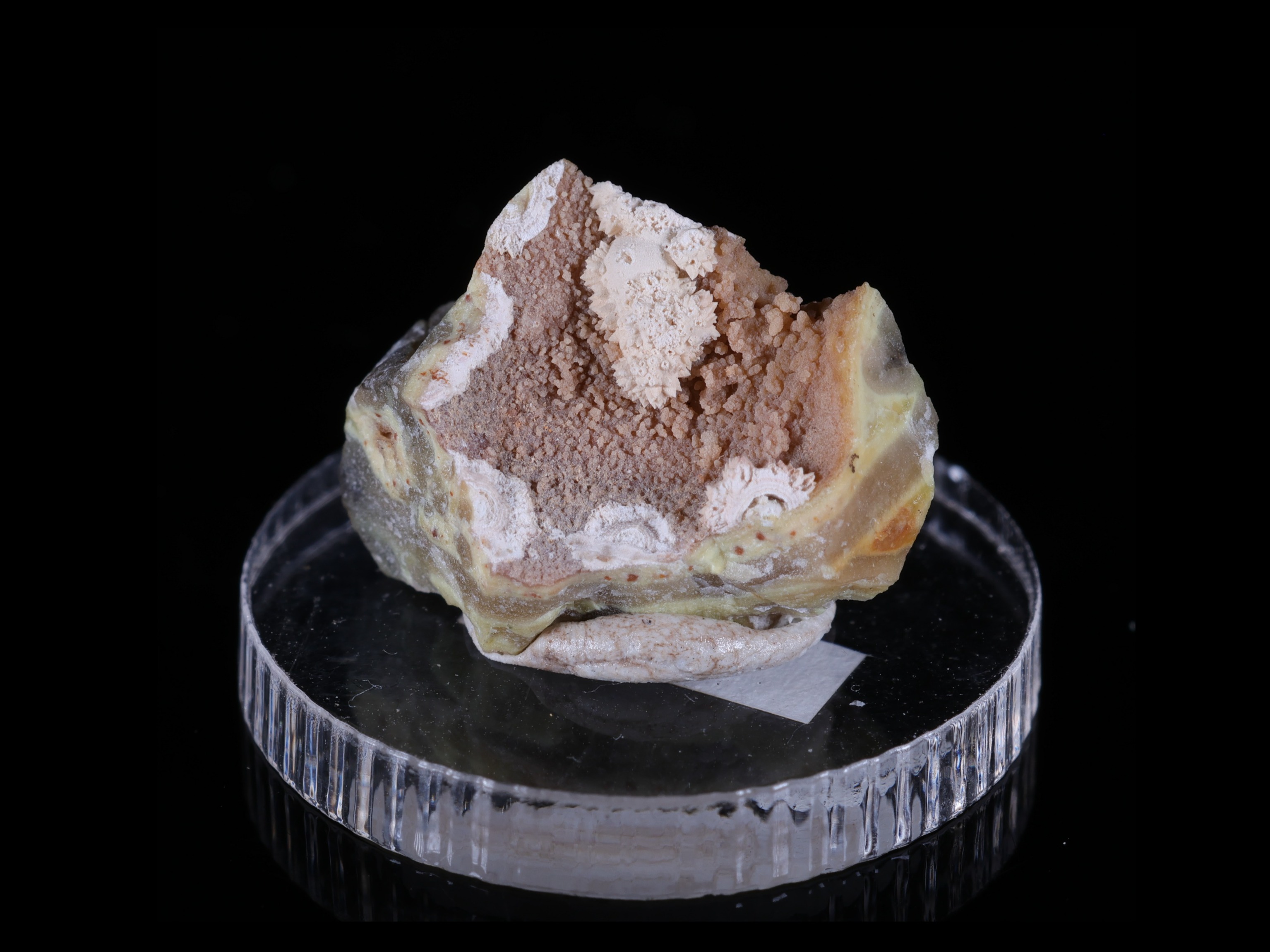
Wardite is a rare hydrated sodium aluminum phosphate, typically forming small, tetragonal crystals or radial aggregates.
Properties
- Mohs hardness
- 5
- Luster
- Szklisty do ziemistego
- Streak
- Biała
- Density
- 2.81
- Cleavage
- On {001}, perfect.
- Fracture
- Nierówny do muszlowego
- Transparency
- Transparent,Opaque
- Crystal system
- Tetragonal
Diagnostic features
## Identification Wardite can be identified by its tetragonal crystal habit, Mohs hardness of 5, and perfect cleavage. Its colors, ranging from colorless to delicate shades of blue, green, and yellow, are also characteristic. ## Differentiation from Similar Minerals Wardite can be confused with other phosphate minerals. It can be distinguished based on detailed crystallographic analysis, hardness, and chemical tests. Its tetragonal crystal system is a key diagnostic feature. ## Crystal Forms Wardite most often forms bipyramidal or prismatic crystals. It also occurs in radial, spherical, and botryoidal aggregates, often as coatings on other minerals.
Geological environment
## Genesis Wardite is a secondary mineral, forming in the oxidation zones of phosphate deposits, often in pegmatites, as a result of hydrothermal alteration of other phosphate minerals. It also occurs in cavities within phosphate rocks. ## Mineral Associations Wardite often co-occurs with other phosphate minerals, such as wavellite, strengite, beraunite, rockbridgeite, as well as with quartz and kaolinite. ## Localities Known localities of wardite include the Palermo No. 1 mine in North Groton, New Hampshire, USA; the Big Chief mine in Keystone, South Dakota, USA; and the Hagendorf mine in Bavaria, Germany.
Rarity
Rare
For collectors
## Quality Criteria The most prized wardite specimens are those with well-formed, distinct crystals, with intense, though delicate, coloration and high transparency. Large, single crystals are rare and sought after. Specimens with aesthetic associations with other minerals are also highly valued. ## Popular Localities Particularly prized specimens come from the Palermo No. 1 mine in New Hampshire and the Big Chief mine in South Dakota, USA, where some of the best wardite crystals have been found.
Care and storage
## Cleaning Wardite can be cleaned using a soft brush and lukewarm water. For more stubborn dirt, a mild soap solution can be used, followed by thorough rinsing with distilled water. ## What to Avoid Avoid using aggressive chemical agents that can damage the mineral's surface. Prolonged exposure to direct sunlight can lead to fading of delicate colors. The mineral is sensitive to sudden temperature changes. ## Storage Wardite specimens are best stored in closed display cases or boxes, away from dust and moisture. It is advisable to place them in a location with stable temperature and limited light exposure.