SKU: S_00019
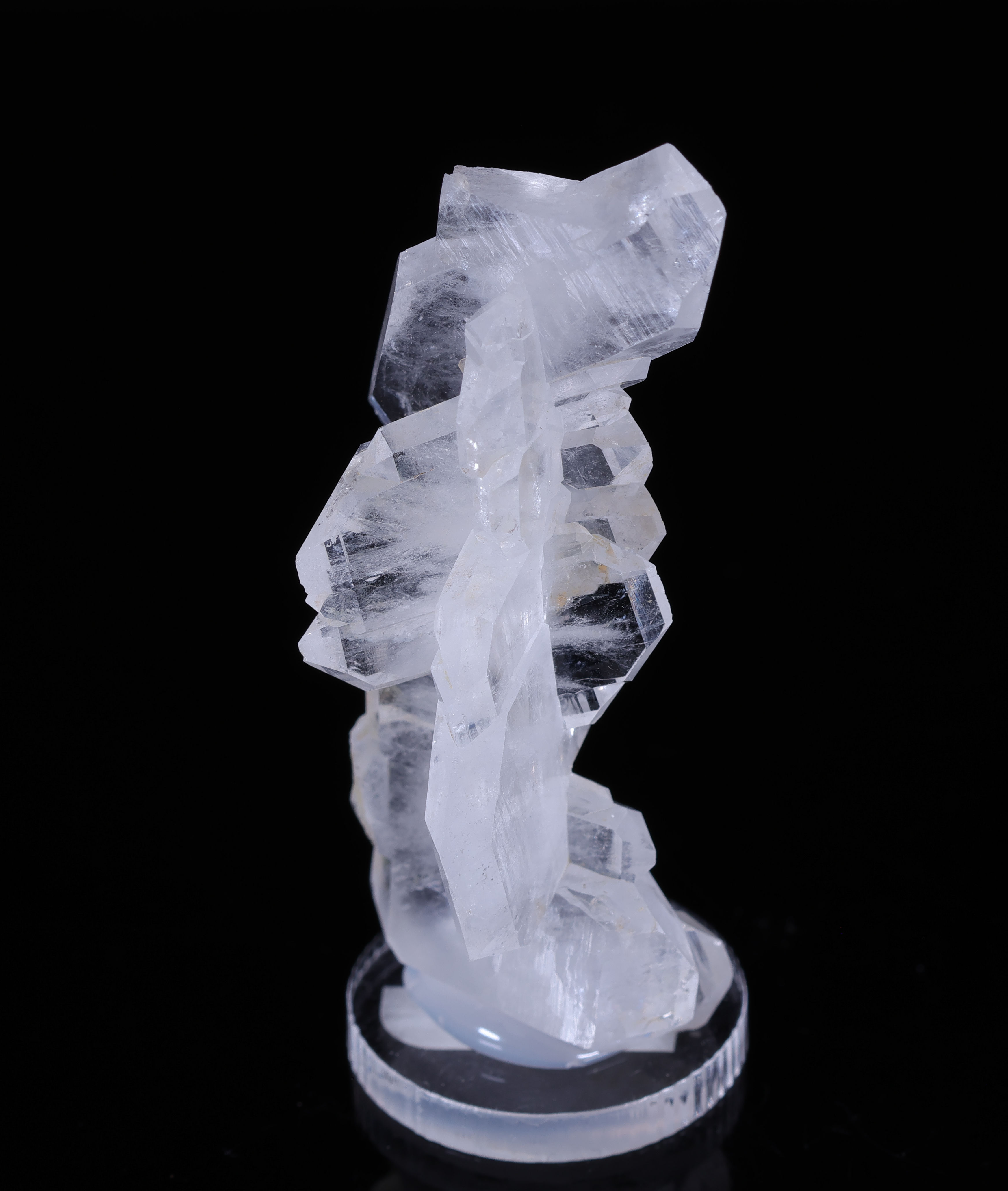
Aesthetic specimen of quartz in the faden variety. The characteristic feature of this specimen is the strongly flattened, tabular habit of the intergrown crystals and the clearly visible white "string" (faden) inside them. This structure is a record of multiple fracturing and healing of the crystal during its growth in an actively tectonic fissure. The specimen takes the form of a vertical cluster without matrix, characterized by good transparency and a strong, glassy luster. Main Features: quartz in the faden variety; distinct white growth zone; flattened, tabular habit of crystals; high transparency. Condition: Very good. The crystals are mostly intact, smooth, and clear.
Price: 18 EUR (79 PLN)
Availability: In stock
Location: Tole, Wana, Pakistan
Size: 60 x 32 x 20 mm
Weight: 9.6 g
Chemical formula: SiO₂
Crystal system: Trigonal
Mohs hardness: 7
Mineral group: Quartz Group
Characteristics Quartz is one of the most common minerals in the Earth's crust, forming a basic component of many igneous, metamorphic, and sedimentary rocks. Typical quartz specimens are characterized by hexagonal prismatic crystals terminated by pyramids, often forming crystal druses or intergrowths. It can occur in massive, granular, or cryptocrystalline forms. Physical Properties Quartz is characterized by a hardness of 7 on the Mohs scale. It has a vitreous luster and a white streak. This mineral is transparent to translucent. The density of quartz is 2.65 g/cm³. Colors and Varieties Quartz occurs in a wide range of colors, from colorless (rock crystal), through white (milky quartz), purple (amethyst), pink (rose quartz), yellow (citrine), brown (smoky quartz), to black (morion). Varieties such as chalcedony, agate, onyx, jasper, tiger's eye, and hawk's eye, which are cryptocrystalline forms of quartz, are also known. History and Name The name "quartz" probably comes from the Old German word "Quarz", which referred to hard minerals. Already in antiquity, quartz was valued and used for making jewelry, tools, and cult objects. Pliny the Elder, in his "Natural History", described quartz as ice that had fossilized forever. Applications Quartz has wide applications in industry. It is used in electronics for the production of quartz oscillators, in optics for making lenses and prisms, and also as a raw material for the production of glass, ceramics, and abrasives. Precious varieties of quartz, such as amethyst, citrine, and rose quartz, are popular gemstones and ornamental stones.
Identification Quartz can be identified by its hardness (scratches glass), vitreous luster, and typical crystal habit (hexagonal prisms terminated by pyramids). It often occurs as intergrowths or aggregates. Conchoidal fracture is also a characteristic feature. Distinguishing from Similar Minerals Quartz is sometimes confused with calcite, but calcite is much softer (hardness 3 on the Mohs scale) and reacts with hydrochloric acid. It can also be confused with topaz, which is harder (hardness 8) and has perfect cleavage. Varieties of quartz, such as amethyst or citrine, can be mistaken for synthetic counterparts, so it is important to pay attention to inclusions and natural imperfections. Crystal Forms Quartz most often forms prismatic crystals, terminated by two pyramids. Twinning is common. It can also form granular, massive, reniform, botryoidal aggregates, as well as cryptocrystalline forms.
Genesis Quartz is a mineral with a very wide spectrum of genesis. It forms in igneous rocks (granites, rhyolites), metamorphic rocks (gneisses, quartzites), and sedimentary rocks (sandstones, conglomerates). It crystallizes from hydrothermal solutions in veins and geodes. It is resistant to weathering, which is why it often occurs in river and marine sediments. Mineral Associations Quartz often co-occurs with many other minerals, depending on the geological environment. In granites, it is accompanied by feldspars and micas. In hydrothermal veins, it can occur with calcite, fluorite, barite, pyrite, and other ore minerals. In sedimentary rocks, it is often associated with clay minerals. Localities Quartz is a cosmopolitan mineral, occurring on all continents. Numerous localities of rock crystal are known in Brazil (Minas Gerais), USA (Arkansas), the Alps (Switzerland, France, Austria). Amethysts come from Brazil, Uruguay, Russia (Urals). Rose quartz occurs in Brazil, USA, Madagascar. In Poland, quartz is common, occurring, among others, in the Karkonosze Mountains, Izera Mountains, and Lower Silesia.
Quality Criteria The most valued quartz specimens are those with well-formed, transparent crystals, intense color (in the case of colored varieties), without visible damage and inclusions. The size of the crystals, their clarity, and the aesthetics of the intergrowths have a significant impact on their collector's value. Specimens with rare inclusions (e.g., rutile, tourmaline) are also highly sought after. Popular Localities The most valued quartz localities are those that provide specimens of exceptional quality and aesthetics. For rock crystal, these are Brazil and the Alps; for amethyst – Brazil and Uruguay; and for rose quartz – Brazil and Madagascar. Specimens from these localities often fetch high prices on the collector's market.
See mineralogical reference for Quartz in the Knowledge Base →