Quartz
Chemical formula: SiO<sub>2</sub>
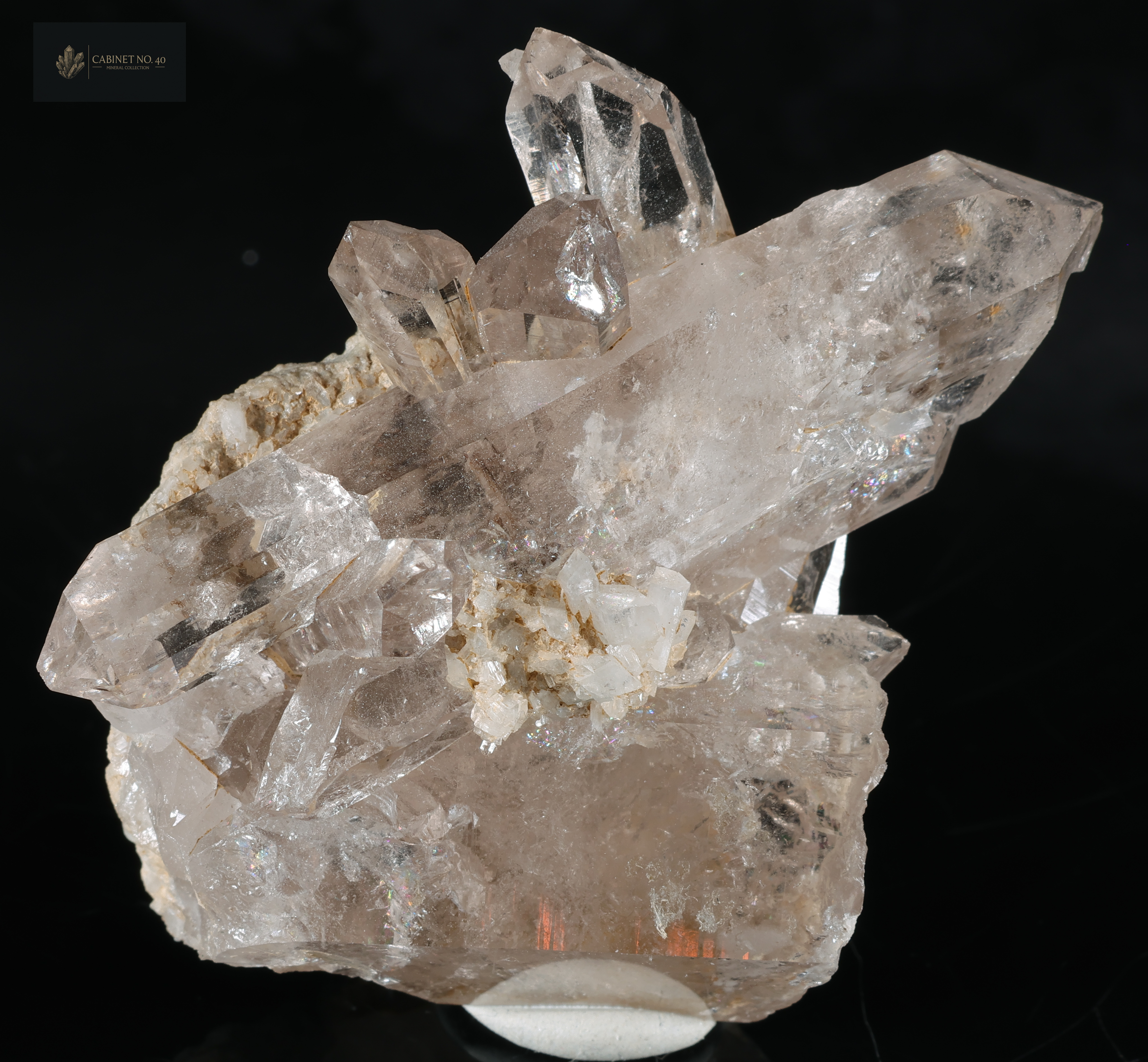
Quartz is a common mineral from the silicate group, a variety of silicon dioxide, occurring in many forms and colors.
Properties
- Mohs hardness
- 7
- Luster
- Vitreous
- Streak
- White
- Density
- 2.65
- Cleavage
- The rhombohedral cleavage r<mi>{10_11}</mi> is most often seen, there are at least six others reported.
- Fracture
- Muszlowy
- Transparency
- Transparent,Translucent
- Crystal system
- Trigonal
Diagnostic features
## Identification Quartz can be identified by its hardness (scratches glass), vitreous luster, and typical crystal habit (hexagonal prisms terminated by pyramids). It often occurs as intergrowths or aggregates. Conchoidal fracture is also a characteristic feature. ## Distinguishing from Similar Minerals Quartz is sometimes confused with calcite, but calcite is much softer (hardness 3 on the Mohs scale) and reacts with hydrochloric acid. It can also be confused with topaz, which is harder (hardness 8) and has perfect cleavage. Varieties of quartz, such as amethyst or citrine, can be mistaken for synthetic counterparts, so it is important to pay attention to inclusions and natural imperfections. ## Crystal Forms Quartz most often forms prismatic crystals, terminated by two pyramids. Twinning is common. It can also form granular, massive, reniform, botryoidal aggregates, as well as cryptocrystalline forms.
Geological environment
## Genesis Quartz is a mineral with a very wide spectrum of genesis. It forms in igneous rocks (granites, rhyolites), metamorphic rocks (gneisses, quartzites), and sedimentary rocks (sandstones, conglomerates). It crystallizes from hydrothermal solutions in veins and geodes. It is resistant to weathering, which is why it often occurs in river and marine sediments. ## Mineral Associations Quartz often co-occurs with many other minerals, depending on the geological environment. In granites, it is accompanied by feldspars and micas. In hydrothermal veins, it can occur with calcite, fluorite, barite, pyrite, and other ore minerals. In sedimentary rocks, it is often associated with clay minerals. ## Localities Quartz is a cosmopolitan mineral, occurring on all continents. Numerous localities of rock crystal are known in Brazil (Minas Gerais), USA (Arkansas), the Alps (Switzerland, France, Austria). Amethysts come from Brazil, Uruguay, Russia (Urals). Rose quartz occurs in Brazil, USA, Madagascar. In Poland, quartz is common, occurring, among others, in the Karkonosze Mountains, Izera Mountains, and Lower Silesia.
Rarity
Very Common
For collectors
## Quality Criteria The most valued quartz specimens are those with well-formed, transparent crystals, intense color (in the case of colored varieties), without visible damage and inclusions. The size of the crystals, their clarity, and the aesthetics of the intergrowths have a significant impact on their collector's value. Specimens with rare inclusions (e.g., rutile, tourmaline) are also highly sought after. ## Popular Localities The most valued quartz localities are those that provide specimens of exceptional quality and aesthetics. For rock crystal, these are Brazil and the Alps; for amethyst – Brazil and Uruguay; and for rose quartz – Brazil and Madagascar. Specimens from these localities often fetch high prices on the collector's market.
Care and storage
## Cleaning Quartz is a relatively hard and resistant mineral. For cleaning most specimens, warm water with mild soap and a soft brush are sufficient. After washing, rinse the mineral thoroughly with clean water and dry with a soft cloth. ## What to Avoid Avoid using strong chemical agents that can damage the mineral's surface or cause dulling. Quartz is resistant to most acids, except hydrofluoric acid. Some varieties of quartz, especially those with intense colors (e.g., amethyst), may fade under prolonged exposure to sunlight. ## Storage Quartz should be stored in a place protected from dust and direct sunlight. Due to its hardness, it is advisable to store it separately from softer minerals to avoid scratches.