SKU: B_20_0003
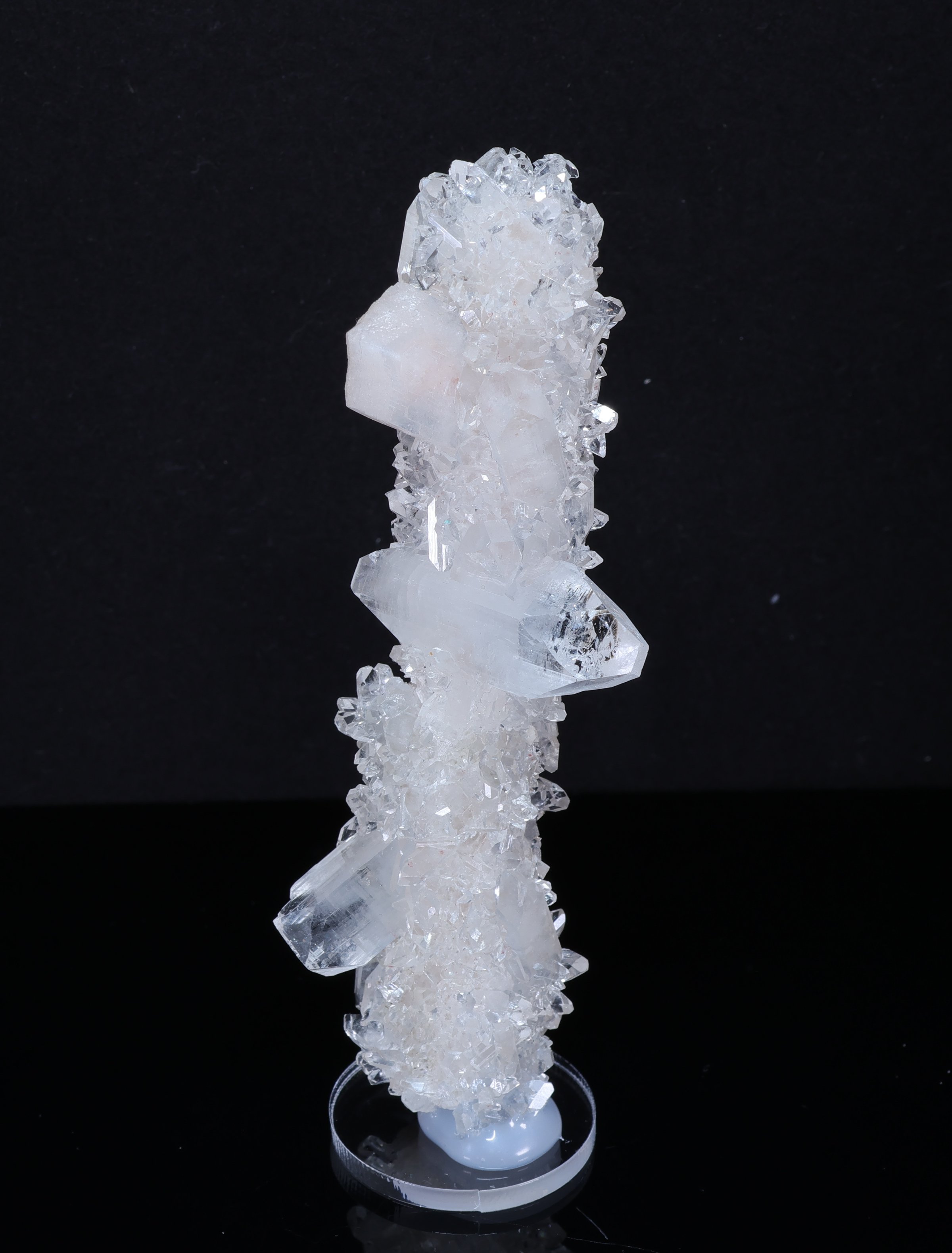
A very aesthetic specimen from Pakistan, formed in the shape of a slender stalactite. The main vertical core is entirely covered with fine, sparkling crystallization, on which distinct, glassy, and translucent crystals of apophyllite are set. Main Features: stalactite form; distinct, asymmetrically set crystals of apophyllite; strong luster of the main crystals. Condition: Very good.
Price: 5 EUR (20 PLN)
Availability: Sold out
Location: -, India
Size: 32 x 35 x 107 mm
Weight: 73.6 g
Chemical formula: KCa₄(Si₈O₂₀)(F,OH)·8H₂O
Mohs hardness: 4.5-5
Characteristics Apophyllite is a group of silicate minerals, including fluorapophyllite-(K), hydroxyapophyllite-(K), and fluorapophyllite-(Na). These minerals typically form tetragonal, pseudocubic crystals, often with distinct pyramidal or prismatic faces. They can also occur in granular, lamellar, or radial aggregates. They often form well-developed, transparent or translucent crystals that can reach considerable sizes. Physical Properties Apophyllite has a Mohs hardness of 4.5-5. The luster of the mineral is vitreous, often pearly on cleavage surfaces. It is transparent to translucent. The density of apophyllite typically ranges from 2.3-2.5 g/cm³. Colors and Varieties Apophyllite occurs in many colors, most commonly colorless, white, gray, greenish, pink, yellowish, or brown. Green color is often caused by the presence of vanadium impurities. Some varieties, especially those with intense green coloration, are particularly valued by collectors. History and Name The name apophyllite comes from the Greek words "apo" (away from) and "phyllon" (leaf), referring to the mineral's tendency to exfoliate into thin flakes when heated, due to water loss. The mineral was first described in 1806 by René Just Haüy. Uses Apophyllite has no significant industrial applications. It is a mineral valued mainly by collectors, due to its aesthetic crystals and variety of colors.
Identification Apophyllite can be identified by its characteristic crystal habit, often pseudocubic or prismatic, and vitreous to pearly luster. It often occurs in geodes and fissures in volcanic rocks. Perfect cleavage in one direction is also a diagnostic feature. Distinguishing from Similar Minerals Apophyllite can be confused with zeolites, such as stilbite or heulandite, due to similar occurrence environments and habits. However, apophyllite is distinguished by its perfect cleavage in one direction and different crystallographic system. In case of doubt, precise optical studies or X-ray diffraction can help in identification. Crystal Forms Apophyllite typically forms tetragonal crystals, often with pseudocubic, prismatic, or pyramidal habits. Crystal surfaces can be smooth or show delicate striations. It often occurs in radial, lamellar, or granular aggregates, forming beautiful clusters on the matrix.
Genesis Apophyllite forms mainly in hydrothermal environments, often in gas vesicles (geodes) and fissures in basalts, andesites, and other volcanic rocks. It can also occur in skarns and hydrothermal veins associated with granitoid intrusions. Mineral Associations Apophyllite often co-occurs with zeolites (such as stilbite, heulandite, chabazite), calcite, quartz, prehnite, and other secondary minerals formed in volcanic rocks. Localities Key apophyllite localities include India (especially the Deccan Traps, where large and well-formed crystals occur), Brazil, Mexico, Canada, USA, Iceland, Germany, and Italy.
Quality Criteria The most prized apophyllite specimens are characterized by well-formed, large, and transparent crystals with intense coloration (especially green or pink). The aesthetics of the aggregate, absence of mechanical damage, and the presence of interesting associations with other minerals are also important. Popular Localities The most sought-after apophyllite specimens come from India, especially from the Deccan region, where spectacular geodes with large, green crystals are found. Other valued localities include Brazil and Mexico, known for their diverse forms and colors.
See mineralogical reference for Apophyllite in the Knowledge Base →