SKU: S_00039
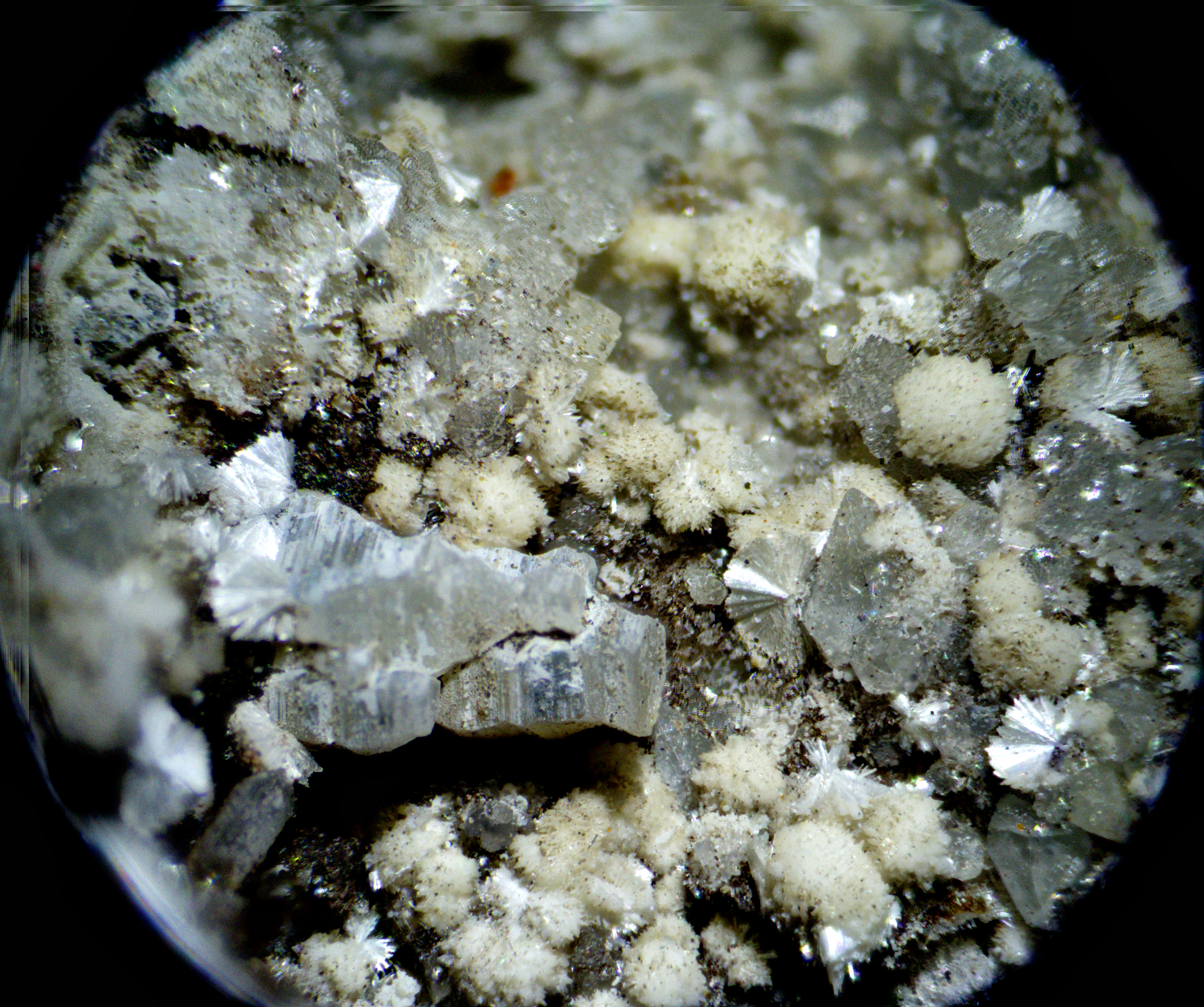
An extremely rare association of two unique mineral species - weloganite and dreserite - originating from their type locality. The specimen features characteristic, banded crystals of weloganite, accompanied by snow-white aggregates of dreserite. Main Features: type locality for both species; rare weloganite; closed, legendary location. Condition: Very good - the weloganite crystals have retained sharp edges and distinct structure, while the delicate dreserite is intact.
Price: 57 EUR (249 PLN)
Availability: In stock
Location: Francon Quarry, Canada
Size: 35 x 17 x 5 mm
Weight: 200 g
Chemical formula: BaFe²⁺₂[Si₄O₁₂](OH)₂·2H₂O
Crystal system: Jednoskośny
Mohs hardness: 3-4
Characteristics Dresserite is a carbonate mineral with a complex chemical composition, containing barium and aluminum. It most often occurs as radiating aggregates of acicular or platy crystals, forming spherulites or crusts. Dresserite specimens are usually small and white, which makes their identification difficult without specialized analysis. Its appearance can be delicate and silky. Physical Properties The Mohs hardness of dresserite is 2.5-3, meaning it is a relatively soft mineral. It is characterized by a vitreous or silky luster. It is transparent. The specific gravity of this mineral is 2.96. Colors and Varieties Dresserite primarily occurs in white. No colored or commercial varieties are known. History and Name Dresserite was discovered in 1968. The mineral is named after the Canadian mineralogist and geologist, Dr. Harry Dreger, who made significant contributions to the study of minerals from the Mont Saint-Hilaire region in Quebec, where dresserite was first found. Uses Dresserite has no industrial applications due to its rarity and small crystal size. It is exclusively a collector's mineral, valued by enthusiasts of rare species.
Identification Dresserite can be identified by its characteristic habit – radiating aggregates of acicular or platy crystals of white color. Vitreous to silky luster and low hardness (2.5-3 on the Mohs scale) are also diagnostic features. However, definitive identification requires laboratory analysis, such as X-ray diffraction. Distinguishing from Similar Minerals Due to its white color and radiating habit, dresserite can be confused with other white, fibrous minerals, such as some zeolites, calcite, or aragonite. It differs from calcite and aragonite by its chemical composition and lack of distinct cleavage. It differs from zeolites primarily in chemical composition and density. Crystal Forms Dresserite typically forms acicular or platy crystals that aggregate into radiating clusters, spherulites, or crusts. Individual crystals are usually very small and difficult to observe without magnification.
Genesis Dresserite is a secondary mineral that forms in low-temperature hydrothermal environments, often in alkaline pegmatites or altered igneous rocks. Its presence is associated with hydrothermal alteration processes, where solutions rich in barium and aluminum react with carbonates. Mineral Associations Dresserite often co-occurs with other rare carbonate minerals, such as dawsonite, strontianite, barite, as well as silicate minerals and zeolites, which are typical of hydrothermal environments. Localities The most famous locality for dresserite is Mont Saint-Hilaire in Quebec, Canada, where it was discovered. This is a classic locality for many rare alkaline minerals. Other occurrences are very few and usually limited to similar geological environments.
Quality Criteria The most prized dresserite specimens are those that exhibit well-formed, radiating crystal aggregates with an intensely white color and distinct luster. The size of the aggregates, their aesthetics, and the absence of mechanical damage are key factors influencing collector value. Specimens with rare mineral associations are also highly valued. Market Prices Dresserite prices vary widely and depend on the size, quality, and rarity of the specimen. Due to its rarity, even small, well-formed specimens can fetch prices from tens to hundreds of dollars. Larger and more aesthetic aggregates, especially those from Mont Saint-Hilaire, can be significantly more expensive. Popular Localities Mont Saint-Hilaire in Quebec, Canada, remains the most important and highly valued source of dresserite for collectors. Specimens from this locality are sought after for their historical significance and often exceptional quality.
See mineralogical reference for Dresserite in the Knowledge Base →