SKU: B_36_0029
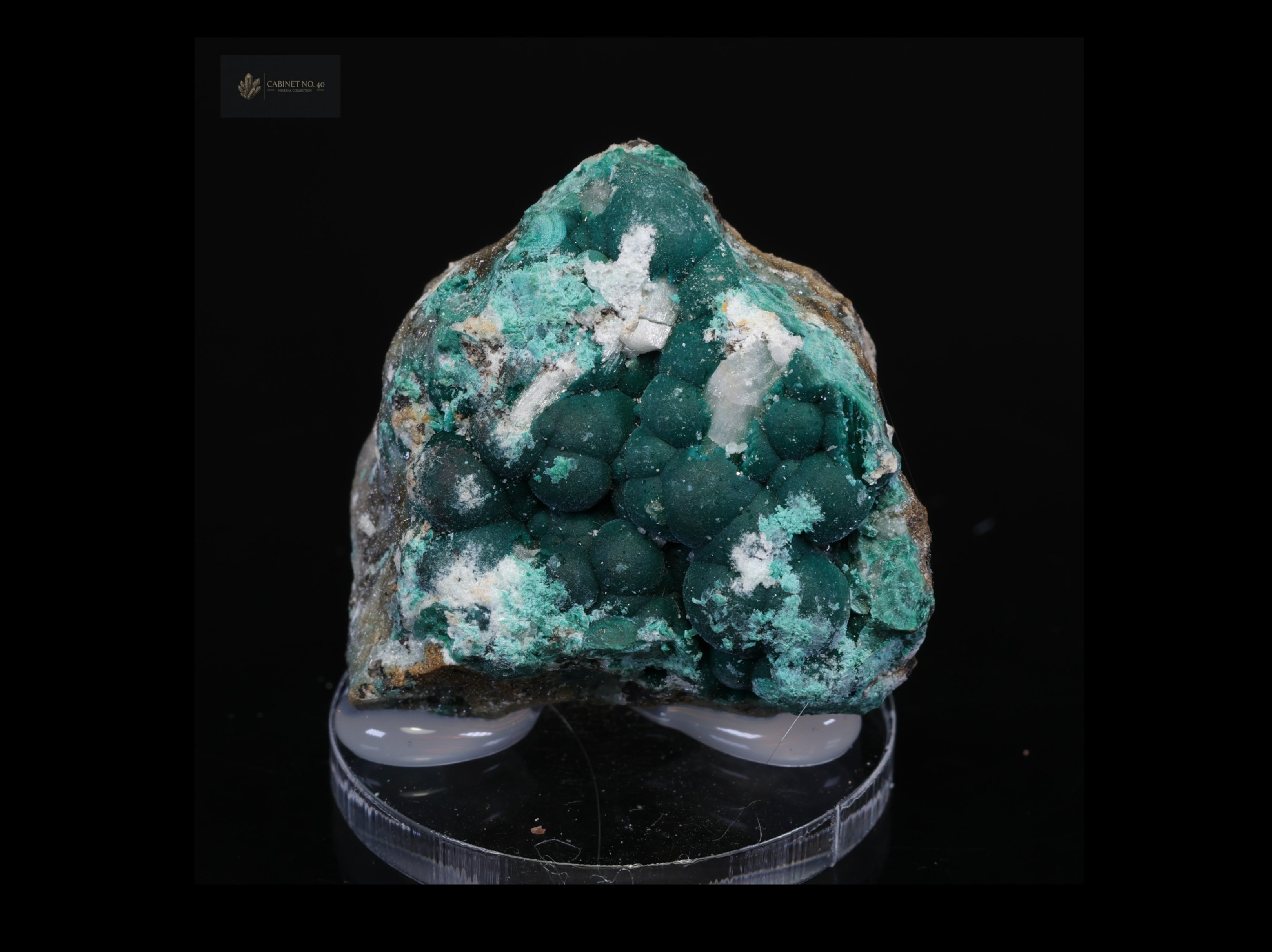
Aesthetic aggregation of rosasite with a deep, sea-green color, formed in the shape of characteristic botryoidal aggregates. Associated with small, white crystallizations. Main Features: Distinctive botryoidal habit; Deep, saturated color; Contrast with accompanying white minerals; Classic location. Condition: Average / Good.
Price: 9 EUR (39 PLN)
Availability: In stock
Location: Yanga Koubenza quarries, Mfouati, Mfouati District, Bouenza Department, Republic of the Congo
Size: 25 x 13 x 26 mm
Weight: 16.5 g
Chemical formula: (Cu,Zn)₂(CO₃)(OH)₂
Mohs hardness: 4.5-5
Characteristics Rosasite is a secondary copper and zinc carbonate mineral, often forming radial or spherical aggregates, growing on other minerals. Typical specimens appear as fine, fibrous or radial aggregates, often reniform in shape, which form coatings or incrustations on rock surfaces. Its color ranges from blue and blue-green to green, which gives it a distinctive appearance. Physical Properties Rosasite has a hardness of 4.5 on the Mohs scale. It has a vitreous to silky luster, and its streak is light blue. The mineral is translucent, and its density is approximately 4 g/cm³. Rosasite cleavage is visible in two directions, at right angles. Colors and Varieties The color of rosasite is usually blue, blue-green, or green. In transmitted light, it can be colorless to light blue. There are no specific commercial varieties, but the intensity and shade of color may vary depending on the chemical composition and impurities. History and Name Rosasite was discovered in 1908. The mineral's name comes from its discovery locality - the Rosas mine in Sardinia, Italy. It is a relatively young mineral in the history of mineralogy, with its description and classification occurring in the early 20th century. Applications Rosasite has no industrial applications. It is valued exclusively by mineral collectors due to its rarity, aesthetics, and attractive color.
Identification Rosasite can be identified by its characteristic blue-green color, radial or spherical aggregates, and vitreous or silky luster. It often occurs in the oxidation zones of copper and zinc deposits, which is an additional clue. Distinguishing from Similar Minerals Rosasite can be confused with other secondary copper minerals, such as azurite or malachite. It differs from azurite by its lighter, more greenish color and lack of distinct crystals. It differs from malachite in its shade of green and structure, as malachite often forms concentric bands. The streak of rosasite is light blue, which helps distinguish it from other minerals. Crystal Forms Rosasite most often occurs as radial, fibrous, or spherical aggregates, forming reniform masses. Single, small crystals are rarer.
Genesis Rosasite is a secondary mineral, formed in the oxidation zones of copper and zinc ore deposits. It forms as a result of chemical reactions between groundwater and primary minerals containing copper and zinc, in a carbonate-rich environment. Mineral Associations Rosasite often co-occurs with other secondary copper and zinc minerals, such as malachite, azurite, hemimorphite, smithsonite, aurichalcite, as well as calcite and quartz. Localities The most important rosasite localities include the Rosas mine in Sardinia, Italy, where it was discovered. Other known occurrences include Tsumeb in Namibia, Broken Hill in Australia, and some deposits in the United States (e.g., Arizona, New Mexico) and Mexico.
Quality Criteria The most prized rosasite specimens are characterized by an intense, uniform color (most often blue or blue-green), well-formed radial or spherical aggregates, and a lack of mechanical damage. The size of the specimen and its aesthetic arrangement on the matrix also influence its collector's value. Popular Localities The most sought-after specimens come from the Rosas mine in Sardinia, Italy, as well as from Tsumeb in Namibia, which is famous for its well-formed and aesthetic secondary mineral specimens.
See mineralogical reference for Rosasite in the Knowledge Base →