Translucent Cerussite on Matrix from Tsumeb Mine

SKU: S_00008

A classic, aesthetic specimen of cerussite from the legendary Tsumeb Mine. The dominant feature is a complex, nearly spherical cluster of intergrown cerussite crystals. Main Features: iconic location; complex, rich crystal growths; excellent contrast with the matrix; classic habit for this deposit. Condition: Very Good - the main cluster of crystals is intact, mostly with complete terminations. Due to the natural brittleness of cerussite and the lattice-like structure of the growths, edge damage may occur.
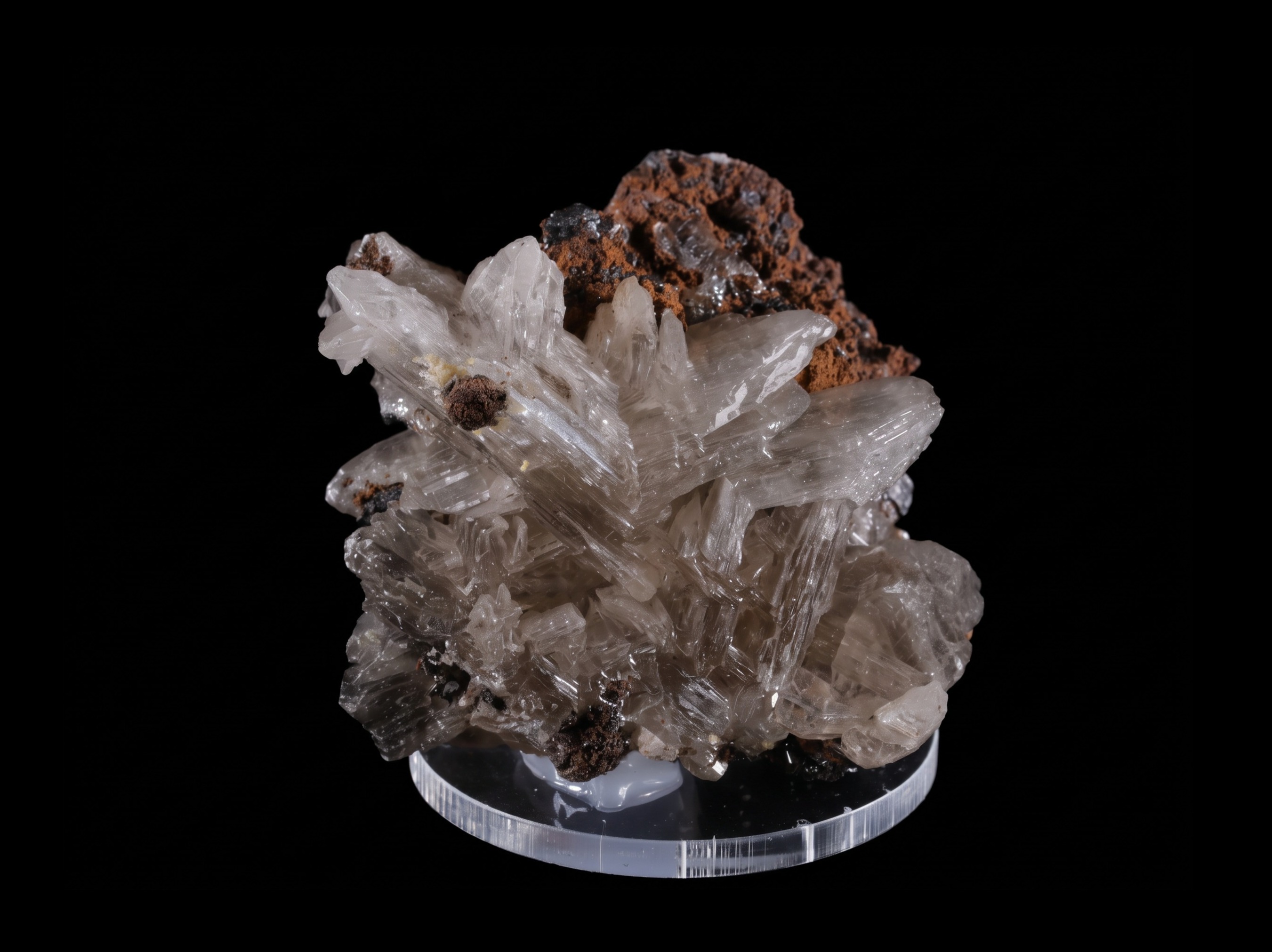
Translucent Cerussite on Matrix from Tsumeb Mine

Price: 191 EUR (829 PLN)

Availability: In stock

Location: Tsumeb Mine, Otavi Highlands, Namibia

Size: 60 x 55 x 45 mm

Weight: 200 g

Chemical formula: PbCO₃

Crystal system: Orthorhombic

Mohs hardness: 3.0–3.5

Characteristics Cerussite is a lead carbonate that typically forms prismatic, tabular, or acicular crystals, often as twins. It can also occur in granular, massive, fibrous, or radial aggregates. Typical specimens are transparent to translucent, with a distinct adamantine luster, which gives them a characteristic appearance. Physical Properties The Mohs hardness of cerussite is 3-3.5. It is characterized by an adamantine luster, and in the case of earthy varieties, a dull luster. It is transparent to translucent. The specific gravity of cerussite is high, at 6.53 g/cm³. It has distinct cleavage on the prism faces {110} and on {021}, as well as trace cleavage on {010} and {012}. Colors and Varieties Cerussite most commonly occurs as colorless, white, gray, blue, or green. In transmitted light, it is colorless. The color may be related to the presence of impurities, such as copper, which gives it a greenish or bluish tint. History and Name The name cerussite comes from the Latin word "cerussa," meaning white lead, which refers to its color and chemical composition. The mineral was first described in 1845 by Wilhelm Ritter von Haidinger. Uses Cerussite is an important lead ore, although its economic significance is less than that of galena. It is valued by collectors for its aesthetic crystal forms and high luster.

Diagnostic features

Identification Cerussite can be identified by its high density, characteristic adamantine luster, and hardness in the range of 3-3.5 on the Mohs scale. It often occurs as transparent or translucent crystals with prismatic or tabular habits. It reacts with hydrochloric acid, releasing carbon dioxide. Distinguishing from Similar Minerals Cerussite can be confused with anglesite (lead sulfate), which is also a lead mineral and has similar physical properties. However, anglesite has a lower density and slightly different cleavage. It differs from calcite by its much higher density and the absence of the rhombohedral cleavage characteristic of calcite. Crystal Forms Cerussite forms prismatic, tabular, acicular crystals, as well as twins, often in star or reticulated shapes. It also occurs in granular, massive, fibrous, and radial aggregates.

Formation environment

Genesis Cerussite is a secondary mineral, formed in the oxidation zones of lead deposits. It forms as a result of the weathering of galena (lead sulfide) in the presence of carbonates. This process occurs under conditions rich in oxygen and carbon dioxide. Mineral Associations Cerussite often co-occurs with other secondary lead minerals, such as galena, anglesite, pyromorphite, mimetite, wulfenite, as well as with limonite, calcite, and quartz. Localities Known cerussite localities include Tsumeb in Namibia, where large, well-formed crystals are found. Other important sites include Broken Hill in Australia, Mibladen in Morocco, Stříbro in the Czech Republic, as well as numerous deposits in the United States (e.g., Arizona and Colorado) and Europe (e.g., Germany and the United Kingdom).

For the collector

Quality Criteria The most prized cerussite specimens are those with well-formed, transparent crystals with a distinct adamantine luster. Large sizes, interesting twinning, and unusual colors (e.g., blue or green) increase their collector's value. Specimens with rare mineral associations are also sought after. Popular Localities The most sought-after cerussite specimens come from Tsumeb in Namibia, known for exceptionally large and aesthetic crystals. Other valued localities include Broken Hill in Australia and Mibladen in Morocco, which provide specimens of various forms and colors.

See mineralogical reference for Cerussite in the Knowledge Base →

View product →