SKU: S_00093
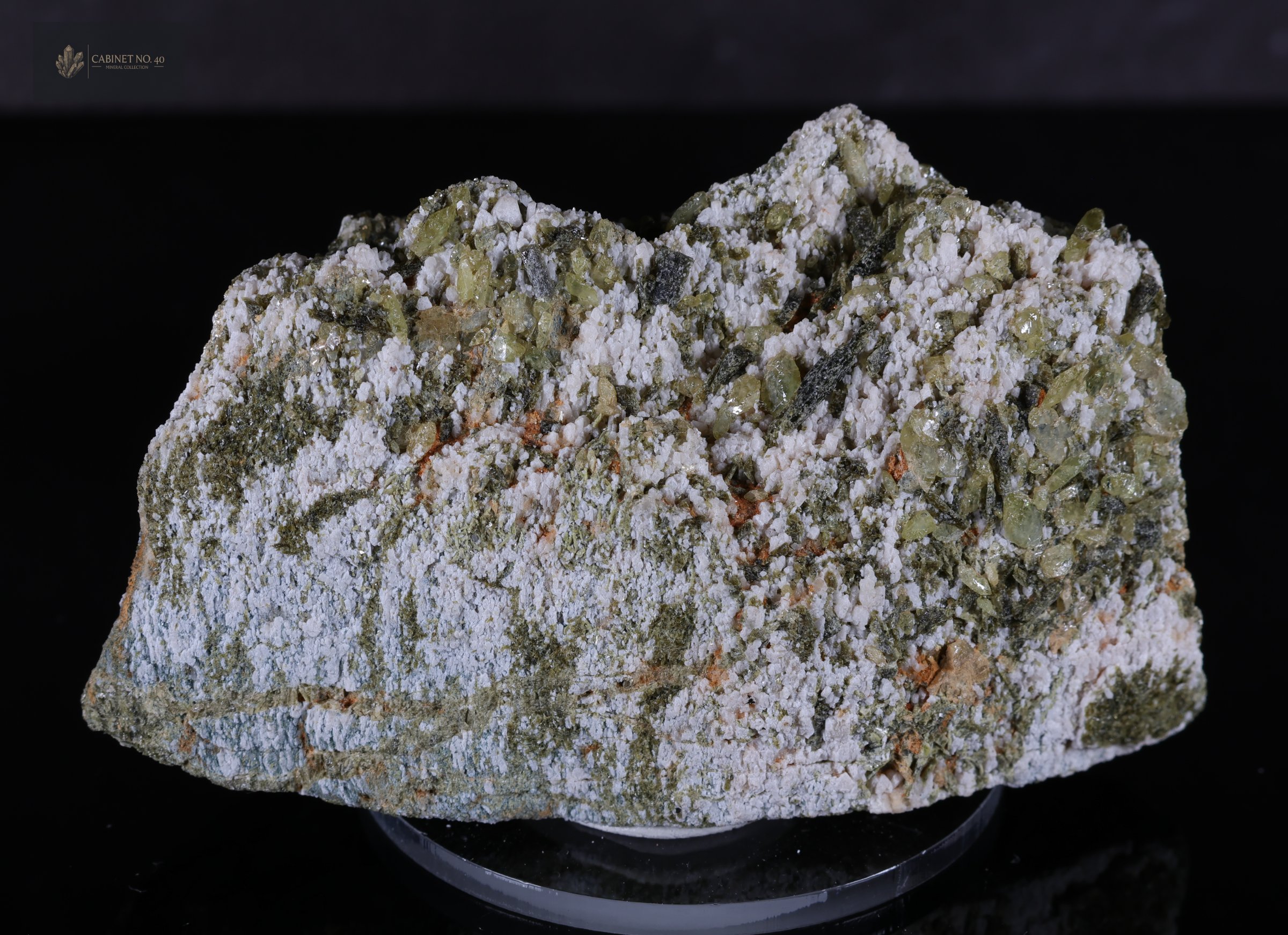
Aesthetic and rich specimen of titanite, originating from the renowned location Capelinha in Brazil. Numerous yellow-green titanite crystals with characteristic habit and vitreous luster are set on a light, crystalline albite matrix. Accompanying them is dark green epidote, which creates a distinct color contrast with the white substrate. Main Features: habit of titanite crystals; strong color contrast of yellow, green, and white; classic location Capelinha; rich mineral association; ex coll. Christian Bley. Condition: Good.
Price: 85 EUR (369 PLN)
Availability: In stock
Location: Capelinha, Minas Gerais, Brazil
Size: 81 x 47 x 38 mm
Weight: 168 g
Chemical formula: CaTiSiO₅
Crystal system: Monoclinic
Mohs hardness: 5.0–5.5
Characteristics Titanite, commonly called sphene, is a calcium titanium silicate mineral that often forms well-developed crystals with a wedge-shaped or tabular habit. Typical titanite specimens are characterized by a strong luster, which can be adamantine or resinous, and distinct light dispersion, giving it a "fire" effect similar to diamond. This mineral is often transparent to translucent, allowing for the observation of its internal reflections. Physical Properties The Mohs hardness of titanite is 5-5.5, making it a mineral of moderate hardness. It has good cleavage along the {110} planes. The specific gravity of titanite is 3.48. Its streak is white, and its fracture is conchoidal to uneven. The mineral exhibits strong light dispersion, which is one of its most characteristic optical features. Colors and Varieties Titanite occurs in a wide range of colors, including brown, green, yellow, orange, pinkish-red, black, beige, gray, colorless, and grayish-blue and bluish. The color is often associated with the presence of trace element impurities. Varieties with intense colors and high transparency are valued in jewelry. History and Name The name "titanite" comes from the element titanium, which is a key chemical component of the mineral. The alternative name "sphene" comes from the Greek word "sphenos," meaning wedge, which refers to the typical shape of the mineral's crystals. Titanite was discovered in 1795. Uses Due to its dispersion and luster, transparent varieties of titanite are used as gemstones in jewelry. It is also a source of titanium, although this is not its primary industrial application.
Identification Titanite can be identified by its characteristic adamantine to resinous luster, strong light dispersion, and typical wedge-shaped crystal habit. The color, although variable, often includes shades of brown, green, and yellow. A hardness of 5-5.5 on the Mohs scale is also a diagnostic feature. Distinguishing from Similar Minerals Titanite can be confused with some garnets, zircon, or diamond due to its strong luster and dispersion. However, garnets typically do not exhibit cleavage, and zircon has a higher hardness. Diamond is much harder and has a different crystallization. The wedge shape of titanite crystals is also characteristic and helps distinguish it from other minerals. Crystal Forms Titanite most commonly occurs as well-formed crystals with a wedge-shaped, tabular, or prismatic habit. It also often forms granular or massive aggregates.
Genesis Titanite forms in various geological environments, most commonly in igneous rocks such as syenites, diorites, and granites, as well as in pegmatites. It also occurs in metamorphic rocks such as gneisses, schists, and skarns, where it forms as a result of contact or regional metamorphism. It can also be present in hydrothermal veins. Mineral Associations Titanite often co-occurs with minerals such as quartz, orthoclase, albite, biotite, hornblende, epidote, garnet, calcite, and other titanium minerals like rutile and ilmenite. Localities Known localities of titanite include the Alps (Switzerland, Austria, Italy), where high-quality gemological specimens are found. Other important localities include Russia (Urals), Canada (Ontario), USA (New York, California), Brazil, Mexico, Pakistan, and Madagascar.
Quality Criteria The most prized titanite specimens are characterized by intense and uniform color, high transparency, and distinct light dispersion. Large, well-formed crystals with an ideal wedge-shaped habit are particularly sought after. The absence of inclusions and fractures also increases the value of the specimen. Popular Localities The most prized titanite specimens come from the Alps, especially Switzerland and Austria, where crystals of exceptional color and clarity are found. Other popular localities include Madagascar, Pakistan, and Brazil, known for producing large and aesthetic specimens.
See mineralogical reference for Titanite in the Knowledge Base →