Titanite
Chemical formula: CaTi<sup>4+</sup>SiO<sub>5</sub>
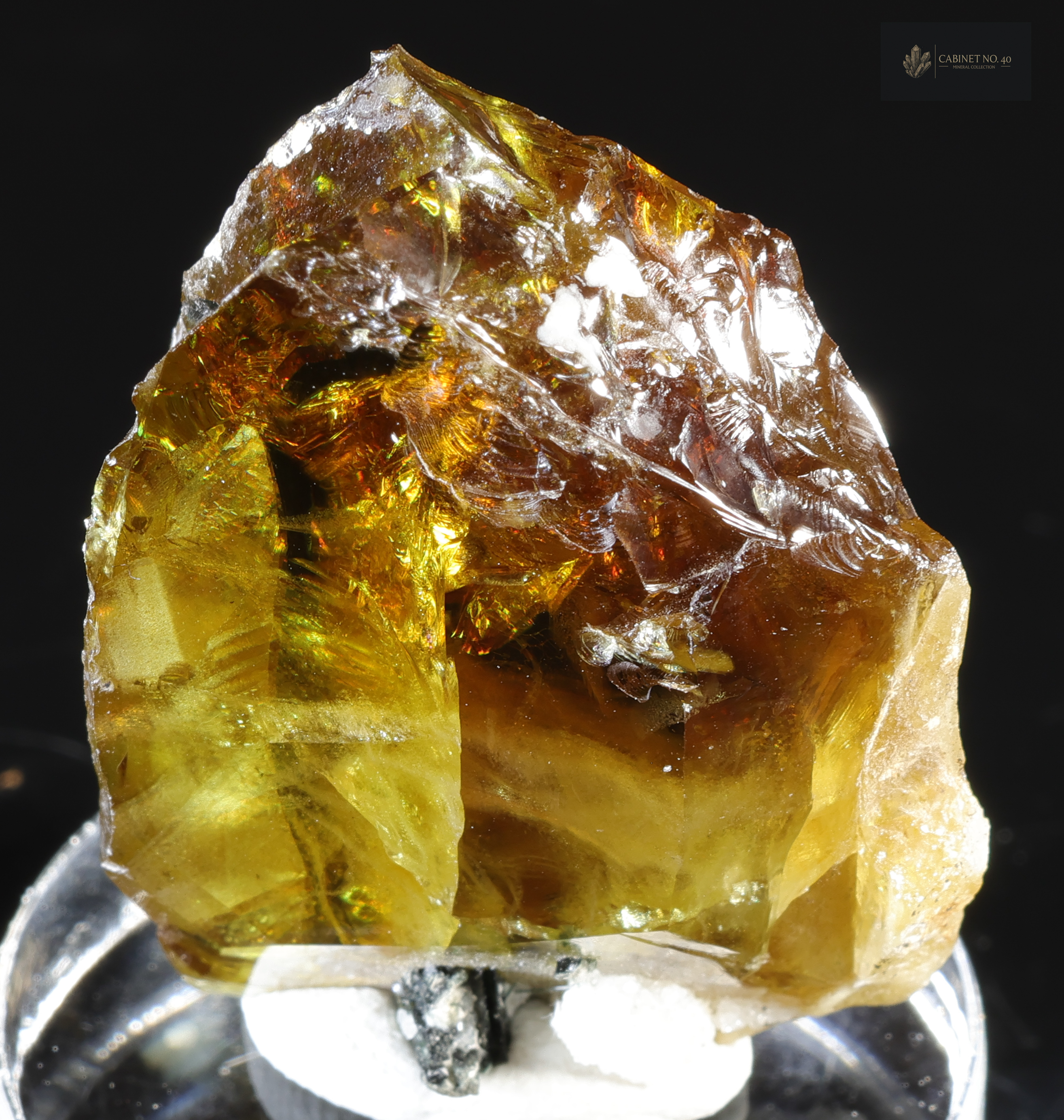
Titanite, also known as sphene, is a calcium titanium silicate mineral characterized by a strong adamantine to resinous luster and distinct light dispersion.
Properties
- Mohs hardness
- 5-5.5
- Luster
- Adamantine to resinous
- Streak
- White
- Density
- 3.48
- Cleavage
- Good on {110}
- Fracture
- Conchoidal to uneven
- Transparency
- Transparent,Translucent
- Crystal system
- Monoclinic
Diagnostic features
## Identification Titanite can be identified by its characteristic adamantine to resinous luster, strong light dispersion, and typical wedge-shaped crystal habit. The color, although variable, often includes shades of brown, green, and yellow. A hardness of 5-5.5 on the Mohs scale is also a diagnostic feature. ## Distinguishing from Similar Minerals Titanite can be confused with some garnets, zircon, or diamond due to its strong luster and dispersion. However, garnets typically do not exhibit cleavage, and zircon has a higher hardness. Diamond is much harder and has a different crystallization. The wedge shape of titanite crystals is also characteristic and helps distinguish it from other minerals. ## Crystal Forms Titanite most commonly occurs as well-formed crystals with a wedge-shaped, tabular, or prismatic habit. It also often forms granular or massive aggregates.
Geological environment
## Genesis Titanite forms in various geological environments, most commonly in igneous rocks such as syenites, diorites, and granites, as well as in pegmatites. It also occurs in metamorphic rocks such as gneisses, schists, and skarns, where it forms as a result of contact or regional metamorphism. It can also be present in hydrothermal veins. ## Mineral Associations Titanite often co-occurs with minerals such as quartz, orthoclase, albite, biotite, hornblende, epidote, garnet, calcite, and other titanium minerals like rutile and ilmenite. ## Localities Known localities of titanite include the Alps (Switzerland, Austria, Italy), where high-quality gemological specimens are found. Other important localities include Russia (Urals), Canada (Ontario), USA (New York, California), Brazil, Mexico, Pakistan, and Madagascar.
Rarity
Very Common
For collectors
## Quality Criteria The most prized titanite specimens are characterized by intense and uniform color, high transparency, and distinct light dispersion. Large, well-formed crystals with an ideal wedge-shaped habit are particularly sought after. The absence of inclusions and fractures also increases the value of the specimen. ## Popular Localities The most prized titanite specimens come from the Alps, especially Switzerland and Austria, where crystals of exceptional color and clarity are found. Other popular localities include Madagascar, Pakistan, and Brazil, known for producing large and aesthetic specimens.
Care and storage
## Cleaning Titanite can be cleaned with a soft cloth or brush, using lukewarm water with mild soap. After washing, rinse the mineral thoroughly with clean water and dry it. Avoid strong rubbing to prevent scratching the surface. ## What to Avoid Avoid contact of titanite with chemicals such as acids, bases, or strong detergents, which can damage its surface. The mineral is sensitive to sudden temperature changes and prolonged exposure to direct sunlight, which can affect its color. Due to its moderate hardness, it should be protected from scratches. ## Storage Titanite is best stored separately from other, harder minerals to prevent scratches. Ideal storage is in a soft pouch, a box lined with soft material, or in a display case with controlled humidity and temperature. Exposure should be in a location where it will not be exposed to direct sunlight.