SKU: S_00061
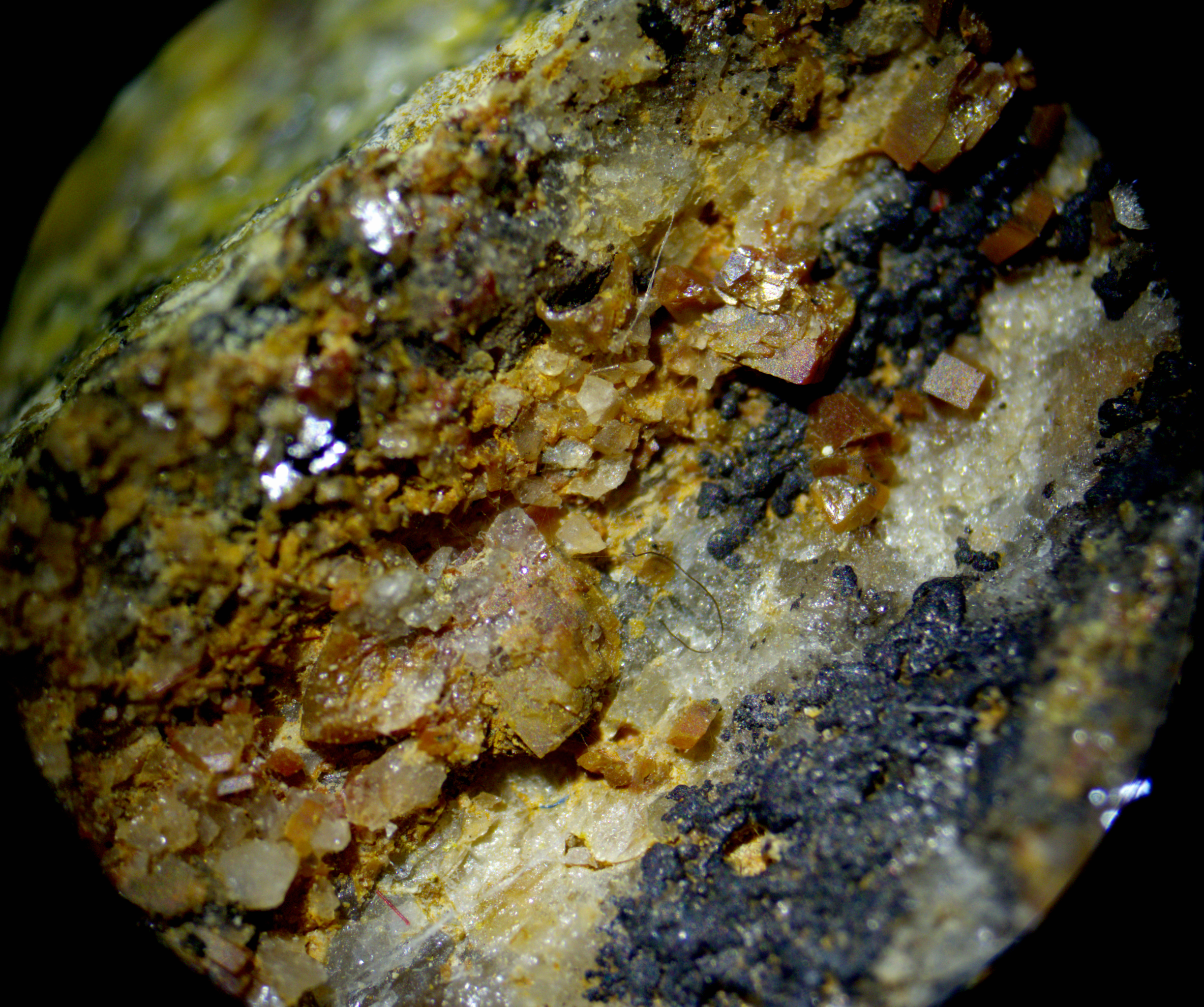
An exceptionally rare association of two bismuth vanadates originating from their type locality - the historic Schneeberg region. The specimen exhibits characteristic small, reddish-brown crystals of pucherite with a strong luster. It is accompanied by schumacherite in the form of yellow, crystalline clusters and coatings. Main Features: dual type locality; rare bismuth vanadates; a classic from Schneeberg; distinct crystalline forms visible under magnification. Condition: Very Good - the rare minerals are securely embedded in the cavities and pores of the matrix.
Price: 78 EUR (339 PLN)
Availability: In stock
Location: Schneeberg, Germany
Size: 12 x 35 x 15 mm
Weight: 200 g
Chemical formula: BiVO₄
Mohs hardness: 3.5-4
Characteristics Pucherite is a bismuth vanadate mineral that typically occurs as small, tabular or prismatic crystals. It often forms radial aggregates or crusts. Its color ranges from reddish-brown, through dark reddish-brown, greenish-brown, orange, to yellowish-brown. In transmitted light, it exhibits a yellowish-brown color. Pucherite crystals are usually small, which makes specimens with well-formed shapes prized by collectors. Physical Properties Pucherite has a Mohs hardness of 4. It exhibits perfect cleavage along the {001} plane. Its streak is yellow. This mineral can be transparent, translucent, or opaque, depending on the thickness and purity of the specimen. The luster of pucherite is typically adamantine to vitreous. Colors and Varieties The color of pucherite is variable, encompassing shades from reddish-brown to yellowish-brown, with possible admixtures of green or orange. No specific commercial or color varieties are distinguished, however, the intensity and uniformity of the color affect its collector's value. History and Name Pucherite was discovered in 1871. The mineral's name comes from its first discovery locality – the Pucher mine in Schemnitz (now Banská Štiavnica) in Slovakia. It was described by Gustav Tschermak. Uses Pucherite has no industrial applications due to its rarity and small occurrence sizes. It is a mineral of purely collectible and scientific importance, used for mineralogical and geological research.
Identification Pucherite can be identified by its characteristic color (from reddish-brown to yellowish-brown), yellow streak, and typical crystal forms, often tabular or prismatic. Its occurrence in association with other bismuth and vanadium minerals can also be an indicator. Distinguishing from Similar Minerals Pucherite can be confused with other minerals of similar color, such as vanadinite or descloizite. It is distinguished from vanadinite by the absence of lead in its chemical composition and usually different crystal forms. Descloizite has a similar chemical composition but typically forms different crystals and has different cleavage. Crystal Forms Pucherite most often forms small, tabular or prismatic crystals. Radial aggregates, crusts, or granular aggregates are also common. Crystals are usually small, but well-formed specimens are prized.
Genesis Pucherite is a secondary mineral, formed in the oxidation zones of hydrothermal deposits rich in bismuth and vanadium. It forms as a result of weathering processes and transformations of primary minerals containing these elements. Mineral Associations Pucherite often co-occurs with other bismuth minerals, such as native bismuth, bismuthinite, bismite, and with vanadium minerals, such as vanadinite. It can also be found in association with quartz, muscovite, and iron minerals. Localities Key pucherite localities include the Pucher mine in Banská Štiavnica, Slovakia (type locality), Schneeberg in Saxony (Germany), Broken Hill in New South Wales (Australia), and some locations in the USA, e.g., in Arizona and Nevada.
Quality Criteria The most prized pucherite specimens are those with well-formed, distinct crystals, of intense and uniform color. The size of the crystals, their transparency, and the absence of mechanical damage also affect their collector's value. Specimens with aesthetic mineral associations are particularly sought after. Popular Localities The most prized pucherite specimens come from the type locality – Banská Štiavnica in Slovakia, as well as from the Schneeberg region in Germany and Broken Hill in Australia. Specimens from these localities often feature well-formed crystals and intense color.
See mineralogical reference for Pucherite in the Knowledge Base →