Pucherite
Chemical formula: Bi<sup>3+</sup>V<sup>5+</sup>O<sub>4</sub>
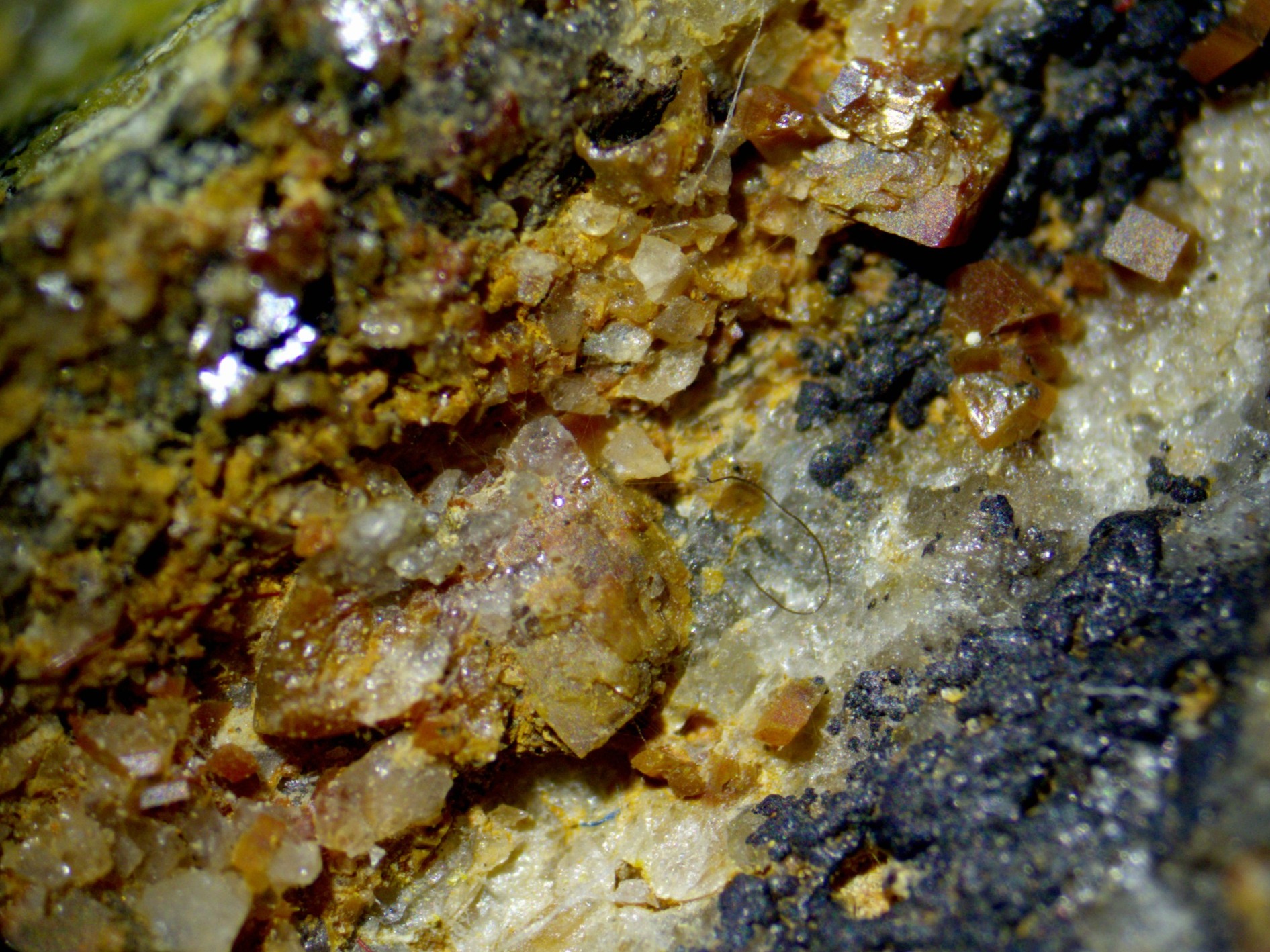
Pucherite is a rare bismuth vanadate mineral, forming small, often tabular crystals with a characteristic yellowish-brown coloration.
Properties
- Mohs hardness
- 4
- Luster
- Diamentowy do szklistego
- Streak
- Yellow
- Density
- 0
- Cleavage
- On {001}, perfect
- Fracture
- Nierówny
- Transparency
- Transparent,Translucent,Opaque
- Crystal system
- Orthorhombic
Diagnostic features
## Identification Pucherite can be identified by its characteristic color (from reddish-brown to yellowish-brown), yellow streak, and typical crystal forms, often tabular or prismatic. Its occurrence in association with other bismuth and vanadium minerals can also be an indicator. ## Distinguishing from Similar Minerals Pucherite can be confused with other minerals of similar color, such as vanadinite or descloizite. It is distinguished from vanadinite by the absence of lead in its chemical composition and usually different crystal forms. Descloizite has a similar chemical composition but typically forms different crystals and has different cleavage. ## Crystal Forms Pucherite most often forms small, tabular or prismatic crystals. Radial aggregates, crusts, or granular aggregates are also common. Crystals are usually small, but well-formed specimens are prized.
Geological environment
## Genesis Pucherite is a secondary mineral, formed in the oxidation zones of hydrothermal deposits rich in bismuth and vanadium. It forms as a result of weathering processes and transformations of primary minerals containing these elements. ## Mineral Associations Pucherite often co-occurs with other bismuth minerals, such as native bismuth, bismuthinite, bismite, and with vanadium minerals, such as vanadinite. It can also be found in association with quartz, muscovite, and iron minerals. ## Localities Key pucherite localities include the Pucher mine in Banská Štiavnica, Slovakia (type locality), Schneeberg in Saxony (Germany), Broken Hill in New South Wales (Australia), and some locations in the USA, e.g., in Arizona and Nevada.
Rarity
Rare
For collectors
## Quality Criteria The most prized pucherite specimens are those with well-formed, distinct crystals, of intense and uniform color. The size of the crystals, their transparency, and the absence of mechanical damage also affect their collector's value. Specimens with aesthetic mineral associations are particularly sought after. ## Popular Localities The most prized pucherite specimens come from the type locality – Banská Štiavnica in Slovakia, as well as from the Schneeberg region in Germany and Broken Hill in Australia. Specimens from these localities often feature well-formed crystals and intense color.
Care and storage
## Cleaning Gentle cleaning of pucherite can be done with a soft brush and lukewarm water. For more stubborn dirt, distilled water can be used. Avoid vigorous rubbing to prevent damage to the delicate crystals. ## What to Avoid Avoid contact of pucherite with acids and other aggressive chemical substances, which can damage the mineral's surface. Prolonged exposure to direct sunlight may potentially affect the intensity of its color. It is also important to avoid sudden temperature changes. ## Storage Pucherite is best stored in enclosed display cases or boxes, away from dust and moisture. Due to its relatively low hardness, avoid contact with harder minerals that could scratch its surface. Specimens with well-formed crystals should be displayed in a way that minimizes the risk of mechanical damage.