SKU: B_27_0015
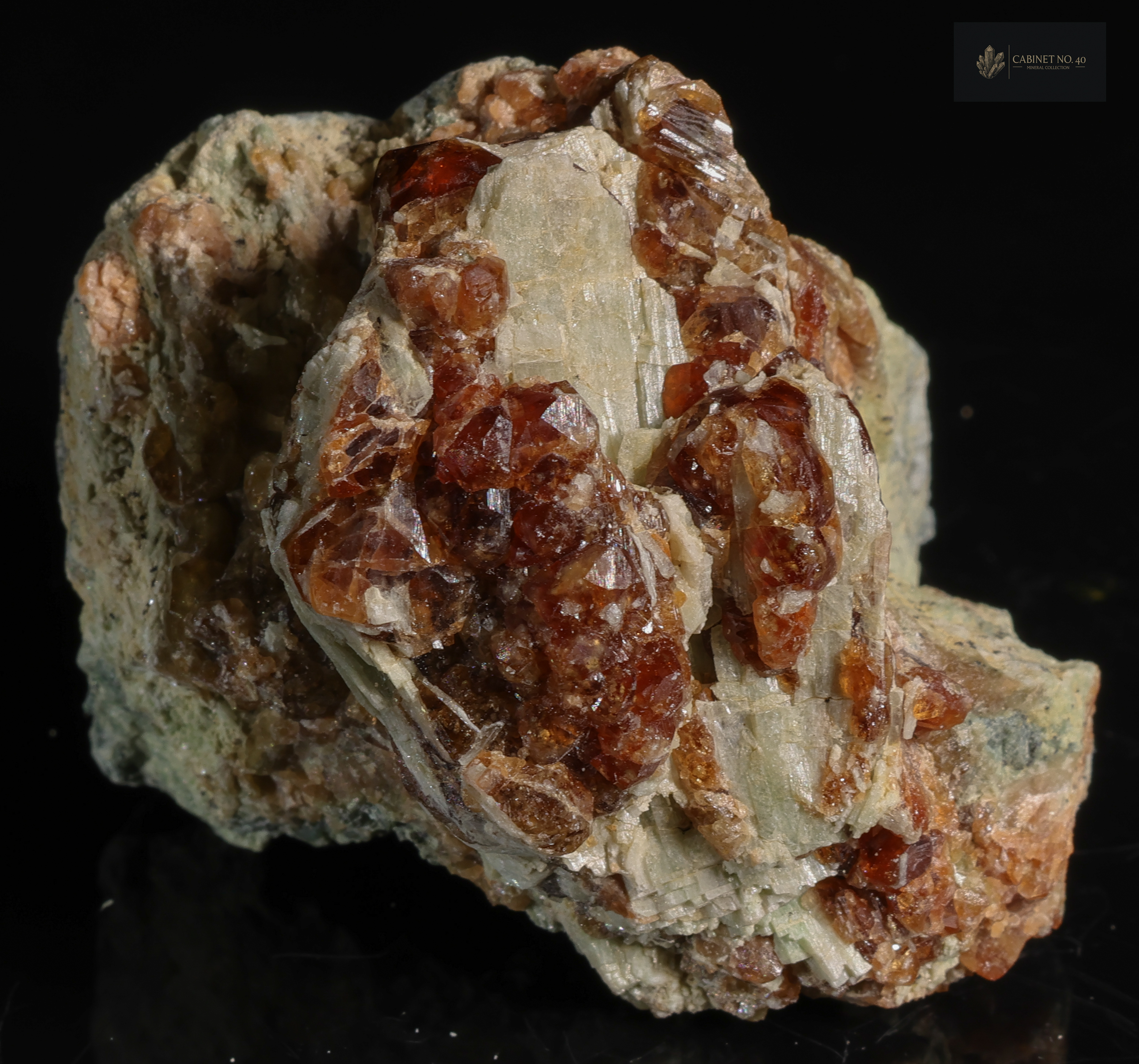
Spessartine forms orange-brown, transparent crystals with a glassy luster, embedded in a light gray, matte rock composed mainly of quartz and feldspar. The crystals are visible on the surface of the rock as well as in the fracture.
Price: 32 EUR (139 PLN)
Availability: In stock
Location: Gilgit-Baltistan, Pakistan
Size: 40 x 35 x 36 mm
Weight: 60.4 g
Chemical formula: Mn₃Al₂(SiO₄)₃
Crystal system: Cubic
Mohs hardness: 7.0–7.5
Characteristics Spessartine is a mineral belonging to the garnet group, silicates with a complex structure. Typical spessartine specimens are characterized by an intense color, ranging from orange to reddish-orange. It often forms isometric crystals with a rhombic dodecahedral or deltoidal icositetrahedral habit, which can be embedded in the host rock or occur as loose grains. Its surface is often smooth and vitreous, enhancing its visual appeal. Physical Properties Spessartine is characterized by a high Mohs hardness, ranging from 7 to 7.5, making it a scratch-resistant mineral. It has a vitreous luster, and its transparency ranges from transparent to translucent, especially in the case of gem-quality specimens. The density of spessartine is approximately 4.12-4.18 g/cm³, which is typical for garnets. Colors and Varieties The most characteristic colors of spessartine are shades of orange, reddish-orange, and also reddish-brown. The intensity of the color depends on the manganese content. Some varieties may show subtle color changes depending on the lighting, although this is not as pronounced as in other garnets, e.g., alexandrite. No specific commercial varieties are distinguished beyond the general term "spessartine" for gem-quality specimens. History and Name The name spessartine comes from Spessart, a mountain range in Bavaria, Germany, where this mineral was first described in 1832. Its discovery is attributed to the mineralogist F. von Kobell. Spessartine was known and used as an ornamental stone earlier, but its scientific classification occurred only in the 19th century. Applications Spessartine is a valuable gemstone, used in jewelry for rings, necklaces, and other ornaments. Its attractive color and high hardness make it a durable and desirable material. Specimens of high clarity and intense color are particularly sought after by collectors.
Identification Spessartine can be identified by its characteristic orange to reddish-orange color and vitreous luster. It often occurs as isometric crystals with forms typical of garnets, such as the rhombic dodecahedron or deltoidal icositetrahedron. Its high hardness (7-7.5 on the Mohs scale) is also a diagnostic feature. Distinguishing from Similar Minerals Spessartine can be confused with other garnets, such as almandine or pyrope, but its unique orange-red color is usually sufficient for distinction. It differs from zircon by the absence of strong dispersion and lower density. It differs from tourmaline by its isometric crystallographic system and lack of distinct pleochroism. Crystal Forms Spessartine most often forms well-developed crystals with a rhombic dodecahedral or deltoidal icositetrahedral habit. Spessartine aggregates can be granular, massive, or form crusts. Crystals can be single or twinned, often embedded in the host rock.
Genesis Spessartine forms mainly in metamorphic rocks, especially in manganese schists and quartzites, where it occurs in association with other manganese minerals. It can also crystallize in manganese-rich granitic pegmatites, where it often forms large, well-developed crystals. It is less commonly found in some volcanic rocks. Mineral Associations Spessartine often co-occurs with quartz, orthoclase, muscovite, biotite, tourmaline, topaz, beryl, and other manganese minerals such as rhodonite or braunite. In pegmatites, it can be associated with minerals such as cleavelandite (a variety of albite) and schorl. Localities Known deposits of spessartine occur in many places around the world. The most important include: Spessart in Germany (type locality), Brazil (especially Minas Gerais state), Sri Lanka, India (Orissa), Madagascar (where large, high-quality crystals are found), Namibia (Kunene region), Nigeria, Pakistan, Tanzania (especially the Arusha region), and the United States (San Diego County, California).
Quality Criteria The most prized spessartine specimens are those with an intense, pure orange-red color, high transparency, and minimal inclusions. Large, well-formed crystals with distinct faces and sharp edges are particularly sought after by collectors. Specimens on matrix, especially with aesthetically arranged crystals, are also highly valued. Popular Localities The most prized spessartine specimens come from Madagascar, where large, transparent crystals of beautiful color are found. Other important sources include Namibia, Nigeria, and Brazil, which supply high-quality gem-quality stones and collector's specimens.
See mineralogical reference for Spessartine Garnet in the Knowledge Base →