Spessartine Garnet
Chemical formula: Mn₃Al₂(SiO₄)₃
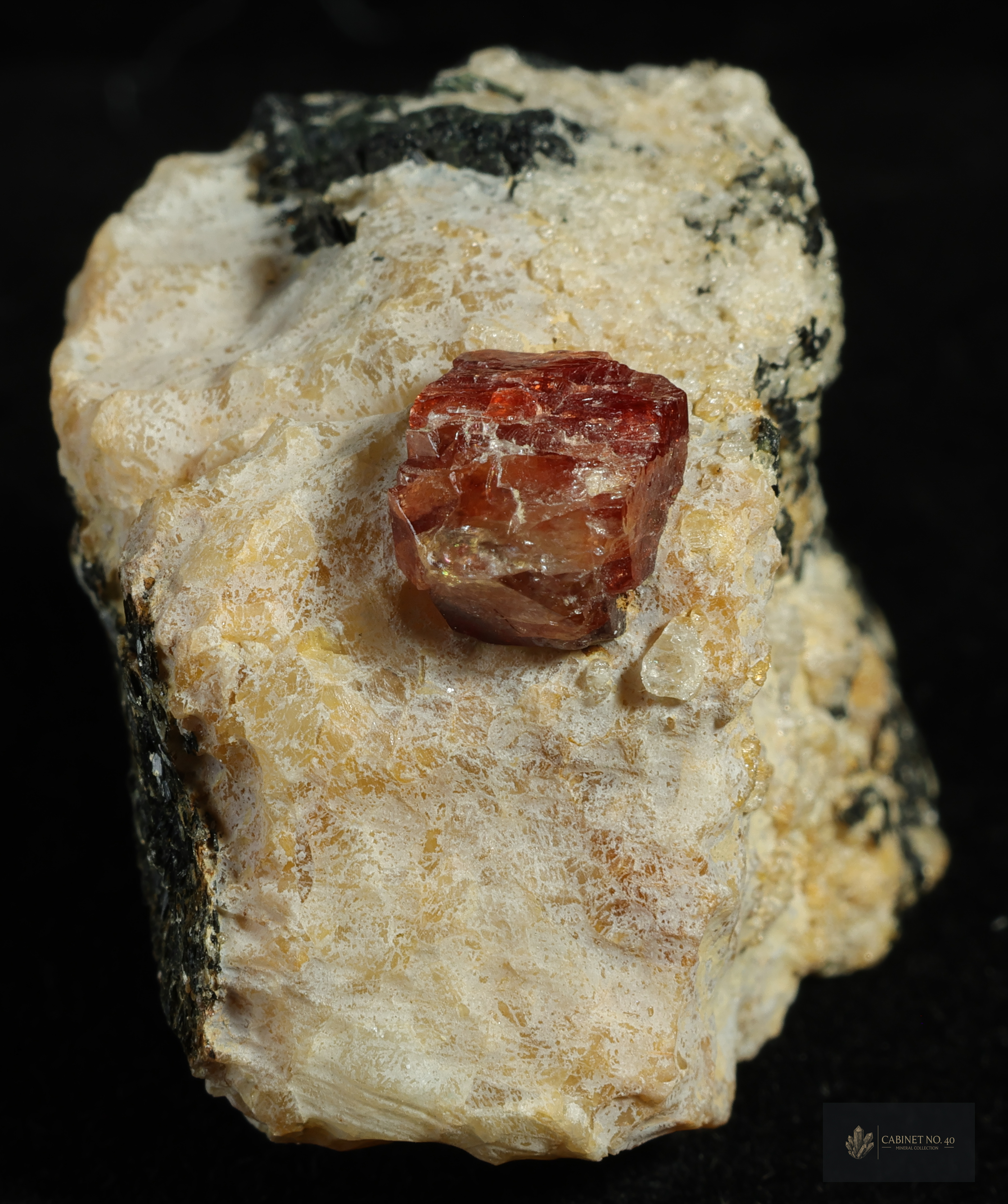
Spessartine is a manganese-aluminum mineral from the garnet group, valued for its orange-red colors and often occurring as well-formed crystals.
Properties
- Mohs hardness
- 7-7.5
- Luster
- Szklisty
- Streak
- Biała
- Density
- 4.12-4.18
- Cleavage
- Brak
- Fracture
- Muszlowy do nierównego
- Transparency
- Przezroczysty do przeświecającego
- Crystal system
- Regularny
Diagnostic features
## Identification Spessartine can be identified by its characteristic orange to reddish-orange color and vitreous luster. It often occurs as isometric crystals with forms typical of garnets, such as the rhombic dodecahedron or deltoidal icositetrahedron. Its high hardness (7-7.5 on the Mohs scale) is also a diagnostic feature. ## Distinguishing from Similar Minerals Spessartine can be confused with other garnets, such as almandine or pyrope, but its unique orange-red color is usually sufficient for distinction. It differs from zircon by the absence of strong dispersion and lower density. It differs from tourmaline by its isometric crystallographic system and lack of distinct pleochroism. ## Crystal Forms Spessartine most often forms well-developed crystals with a rhombic dodecahedral or deltoidal icositetrahedral habit. Spessartine aggregates can be granular, massive, or form crusts. Crystals can be single or twinned, often embedded in the host rock.
Geological environment
## Genesis Spessartine forms mainly in metamorphic rocks, especially in manganese schists and quartzites, where it occurs in association with other manganese minerals. It can also crystallize in manganese-rich granitic pegmatites, where it often forms large, well-developed crystals. It is less commonly found in some volcanic rocks. ## Mineral Associations Spessartine often co-occurs with quartz, orthoclase, muscovite, biotite, tourmaline, topaz, beryl, and other manganese minerals such as rhodonite or braunite. In pegmatites, it can be associated with minerals such as cleavelandite (a variety of albite) and schorl. ## Localities Known deposits of spessartine occur in many places around the world. The most important include: Spessart in Germany (type locality), Brazil (especially Minas Gerais state), Sri Lanka, India (Orissa), Madagascar (where large, high-quality crystals are found), Namibia (Kunene region), Nigeria, Pakistan, Tanzania (especially the Arusha region), and the United States (San Diego County, California).
Rarity
Not very common
For collectors
## Quality Criteria The most prized spessartine specimens are those with an intense, pure orange-red color, high transparency, and minimal inclusions. Large, well-formed crystals with distinct faces and sharp edges are particularly sought after by collectors. Specimens on matrix, especially with aesthetically arranged crystals, are also highly valued. ## Popular Localities The most prized spessartine specimens come from Madagascar, where large, transparent crystals of beautiful color are found. Other important sources include Namibia, Nigeria, and Brazil, which supply high-quality gem-quality stones and collector's specimens.
Care and storage
## Cleaning Spessartine can be cleaned using a soft brush and lukewarm water with mild soap. The mineral should be thoroughly rinsed under running water to remove any soap residue, then dried with a soft cloth. Ultrasonic cleaners can also be used, but with caution, especially for specimens with inclusions or fractures. ## What to Avoid Avoid contact of spessartine with strong acids and bases, which can damage the mineral's surface. Although it is a hard mineral, it should be protected from strong impacts that can cause fractures. Prolonged exposure to direct sunlight is not recommended, as it may lead to slight fading of color in some cases, although this is rare for spessartine. Avoid sudden temperature changes. ## Storage Spessartine is best stored in separate soft fabric pouches or compartmentalized jewelry boxes to prevent scratching by harder minerals. A dry and stable environment, away from extreme temperatures and humidity, is ideal. Gem-quality specimens should be stored separately from other stones to avoid mutual damage.