SKU: S-0121_3-XX
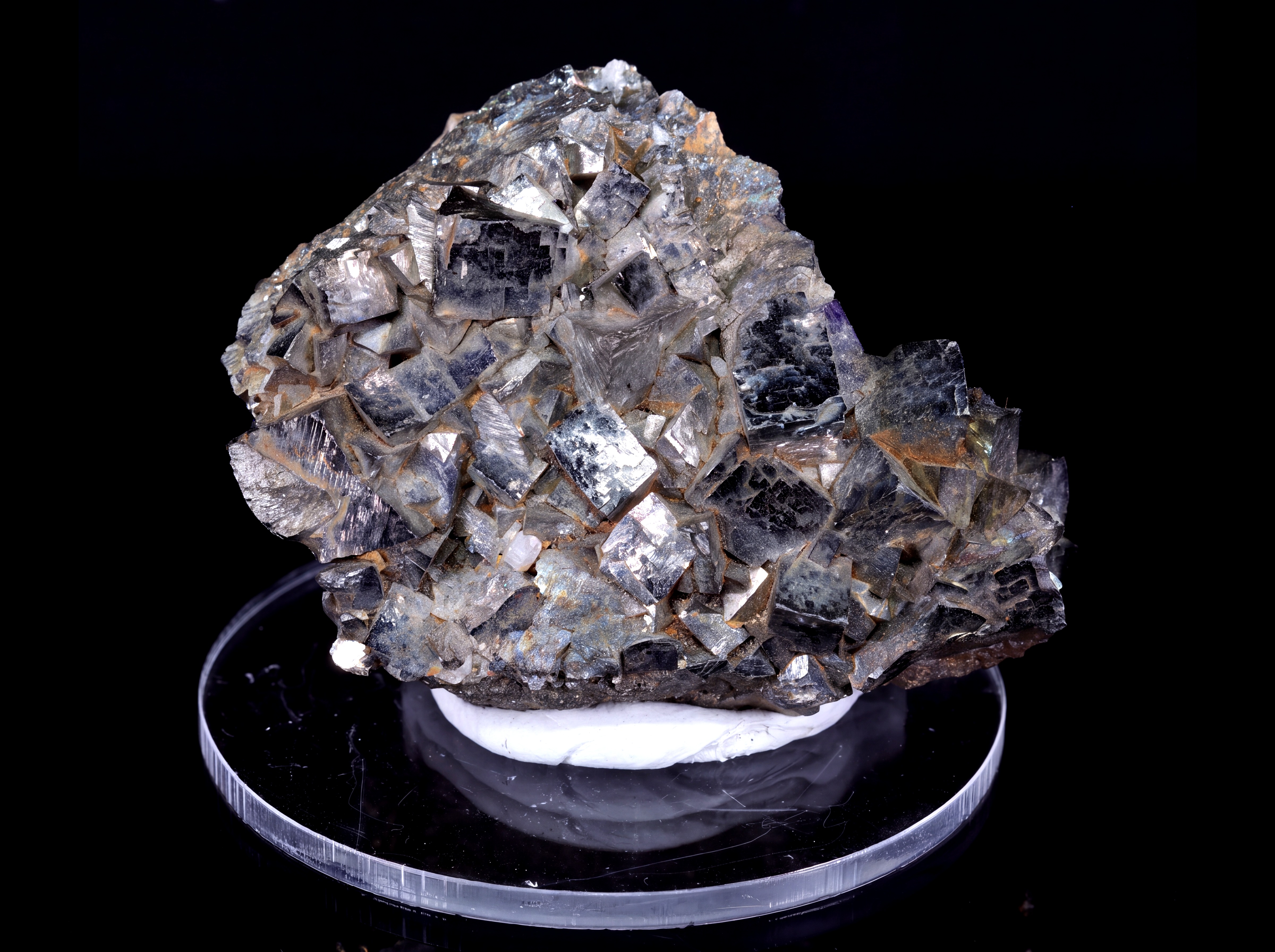
A solid, very densely crystallized specimen of arsenopyrite from the classic Balkan mining region of Trepča. This specimen showcases a rich accumulation of sharp, blocky, and rhombohedral crystals of this iron and arsenic sulfide. The crystals exhibit a strong, bright metallic luster and typical, distinct striations on some faces. Main Features: blocky/rhombohedral crystal habit; strong metallic luster; distinct striations on faces; historical location. Condition: Good.
Price: 16 EUR (69 PLN)
Availability: In stock
Location: Trepča, Mitrovica, Kosovo
Size: 63 x 22 x 47 mm
Weight: 115.8 g
Chemical formula: FeAsS
Crystal system: monoclinic
Mohs hardness: 5,5–6
Mineral group: Pyrite Group
Rarity: Uncommon
Characteristics Arsenopyrite is a sulfide mineral, chemically a sulfosalt of iron and arsenic. Typical specimens are silvery-white to steel-gray, often with a delicate yellowish tint. The surface of the mineral has a distinct metallic luster. Arsenopyrite crystals occur in prismatic, acicular, or tabular forms, often forming twins, especially characteristic star-shaped or cross-shaped twins. Aggregates can be granular, massive, or radial. Physical Properties The Mohs hardness of arsenopyrite ranges from 5.5 to 6. This mineral is characterized by a metallic luster. It is opaque. The specific gravity of arsenopyrite is approximately 6.07 g/cm³. Colors and Varieties Arsenopyrite primarily occurs in silvery-white to steel-gray, sometimes with a slight yellowish tarnish. There are no significant color varieties or commercial varieties. History and Name The name arsenopyrite comes from the mineral's chemical composition, indicating the presence of arsenic and its resemblance to pyrite. The mineral was described in 1847. Uses Arsenopyrite is an important source of arsenic, which is used in industry for the production of alloys, pesticides, and in electronics. It also serves as an indicator of gold occurrence in some deposits.
Identification Arsenopyrite can be identified by its metallic luster, silvery-white to steel-gray color, and characteristic hardness (5.5-6 on the Mohs scale). It often occurs as prismatic or tabular crystals, as well as in twinned forms, especially star-shaped twins. The streak of arsenopyrite is grayish-black. Distinguishing from Similar Minerals Arsenopyrite is sometimes confused with pyrite, but pyrite has a brighter, brassy-yellow color and higher hardness (6-6.5). From marcasite, which has a similar composition, arsenopyrite differs in its crystallographic system (monoclinic for arsenopyrite, orthorhombic for marcasite) and more stable form. It can also be confused with cobaltite, which, however, has a pinkish hue. Crystal Forms Arsenopyrite forms prismatic, acicular, tabular, and also isometric crystals. Twinning is common, especially star-shaped or cross-shaped penetration twins. Aggregates can be granular, massive, radial, or columnar.
Genesis Arsenopyrite is a hydrothermal mineral, forming in high-temperature hydrothermal veins, often associated with magmatic intrusions. It also occurs in metamorphic rocks such as gneisses, crystalline schists, and skarns, as well as in some contact-metasomatic deposits. It can form under reducing conditions. Mineral Associations Arsenopyrite often co-occurs with other sulfides, such as pyrite, chalcopyrite, galena, and sphalerite. It is frequently accompanied by quartz, calcite, tourmaline, as well as gold and silver minerals. Localities Significant arsenopyrite deposits are found worldwide. Important localities include: Freiberg in Germany, Panasqueira in Portugal, Huanzala in Peru, Morococha in Bolivia, as well as numerous occurrences in Canada (e.g., Cobalt, Ontario), Sweden (e.g., Boliden), and the United States (e.g., Leadville, Colorado).
Quality Criteria The most prized arsenopyrite specimens are well-formed, distinct crystals with an intense metallic luster and a silvery-white color. Specimens with characteristic star-shaped or cross-shaped twins are particularly sought after. Crystal size, clarity, and absence of mechanical damage also influence collector value. Popular Localities High-quality collector specimens of arsenopyrite come from localities such as Freiberg in Germany, Panasqueira in Portugal, Huanzala in Peru, and from some mines in Canada and Sweden.
See mineralogical reference for Arsenopyrite in the Knowledge Base →