Arsenopyrite
Chemical formula: Fe<sup>3+</sup>(AsS)<sup>3-</sup>
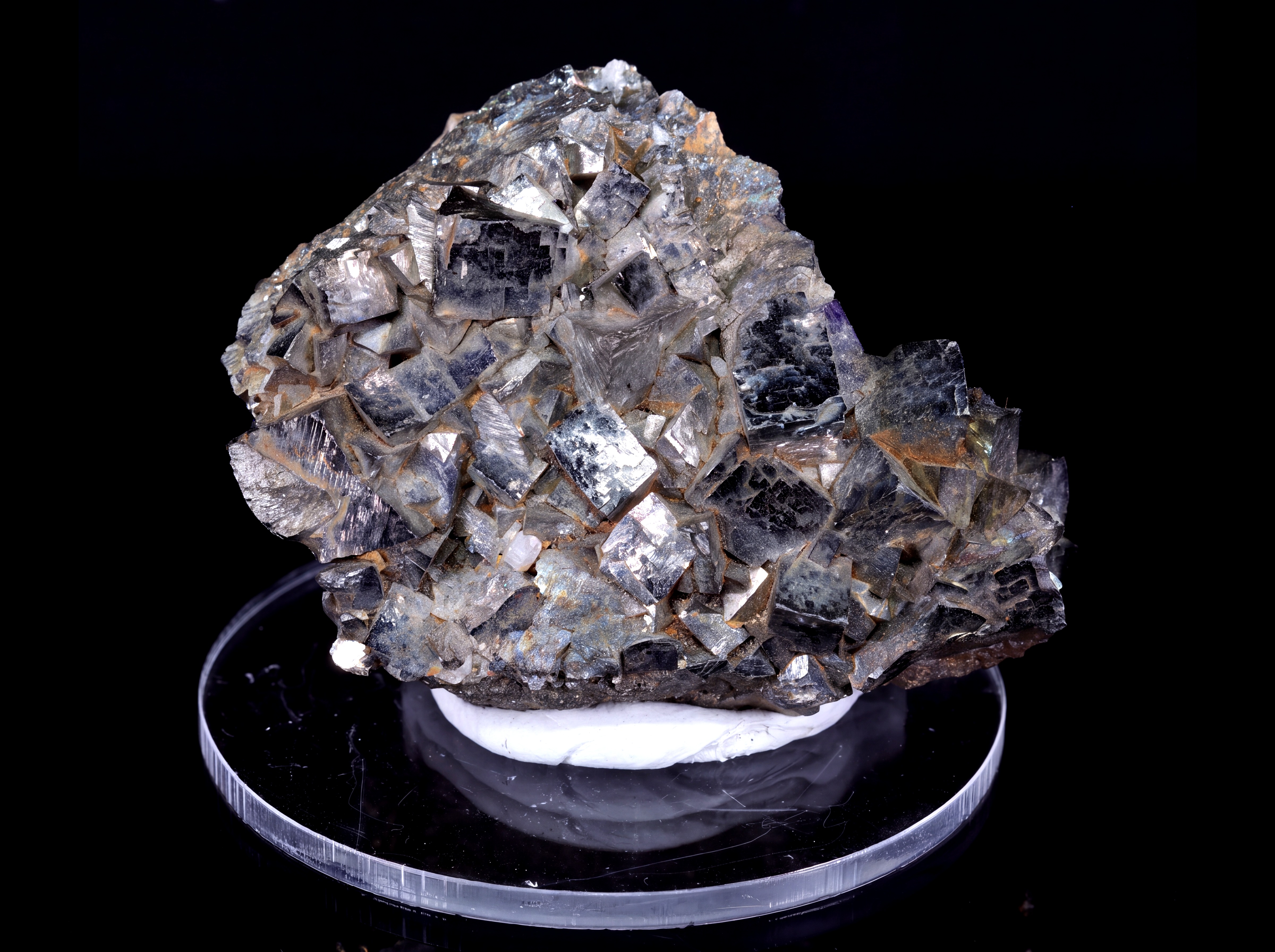
Arsenopyrite is a sulfide mineral, a sulfosalt of iron and arsenic, characterized by a metallic luster and a silvery-white color.
Properties
- Mohs hardness
- 5.5-6
- Luster
- Metallic.
- Streak
- Gray-black
- Density
- 6.07
- Cleavage
- Distinct on {001}; {010} in traces
- Fracture
- Nierówny do muszlowego
- Transparency
- Opaque
- Crystal system
- Monoclinic
Diagnostic features
## Identification Arsenopyrite can be identified by its metallic luster, silvery-white to steel-gray color, and characteristic hardness (5.5-6 on the Mohs scale). It often occurs as prismatic or tabular crystals, as well as in twinned forms, especially star-shaped twins. The streak of arsenopyrite is grayish-black. ## Distinguishing from Similar Minerals Arsenopyrite is sometimes confused with pyrite, but pyrite has a brighter, brassy-yellow color and higher hardness (6-6.5). From marcasite, which has a similar composition, arsenopyrite differs in its crystallographic system (monoclinic for arsenopyrite, orthorhombic for marcasite) and more stable form. It can also be confused with cobaltite, which, however, has a pinkish hue. ## Crystal Forms Arsenopyrite forms prismatic, acicular, tabular, and also isometric crystals. Twinning is common, especially star-shaped or cross-shaped penetration twins. Aggregates can be granular, massive, radial, or columnar.
Geological environment
## Genesis Arsenopyrite is a hydrothermal mineral, forming in high-temperature hydrothermal veins, often associated with magmatic intrusions. It also occurs in metamorphic rocks such as gneisses, crystalline schists, and skarns, as well as in some contact-metasomatic deposits. It can form under reducing conditions. ## Mineral Associations Arsenopyrite often co-occurs with other sulfides, such as pyrite, chalcopyrite, galena, and sphalerite. It is frequently accompanied by quartz, calcite, tourmaline, as well as gold and silver minerals. ## Localities Significant arsenopyrite deposits are found worldwide. Important localities include: Freiberg in Germany, Panasqueira in Portugal, Huanzala in Peru, Morococha in Bolivia, as well as numerous occurrences in Canada (e.g., Cobalt, Ontario), Sweden (e.g., Boliden), and the United States (e.g., Leadville, Colorado).
Rarity
Very Common
For collectors
## Quality Criteria The most prized arsenopyrite specimens are well-formed, distinct crystals with an intense metallic luster and a silvery-white color. Specimens with characteristic star-shaped or cross-shaped twins are particularly sought after. Crystal size, clarity, and absence of mechanical damage also influence collector value. ## Popular Localities High-quality collector specimens of arsenopyrite come from localities such as Freiberg in Germany, Panasqueira in Portugal, Huanzala in Peru, and from some mines in Canada and Sweden.
Care and storage
## Cleaning Arsenopyrite is a relatively hard mineral, but it contains arsenic, so caution should be exercised. Specimens can be gently cleaned with a dry, soft cloth or a soft brush to remove dust. For heavier soiling, a small amount of water can be used, but prolonged soaking should be avoided. ## What to Avoid Avoid contact of arsenopyrite with acids, which can react with the mineral and release toxic arsenic compounds. Aggressive cleaning agents or strong detergents are not recommended. Prolonged exposure to moisture can lead to oxidation of the mineral's surface. Due to the arsenic content, always wash hands after handling the mineral. ## Storage Arsenopyrite is best stored in a dry place, away from moisture and direct sunlight, which could affect its surface. It is advisable to store it in closed display cases or containers to limit contact with air and dust. Due to the toxicity of arsenic, specimens should be stored out of reach of children and pets.