SKU: T-0220_4-CN
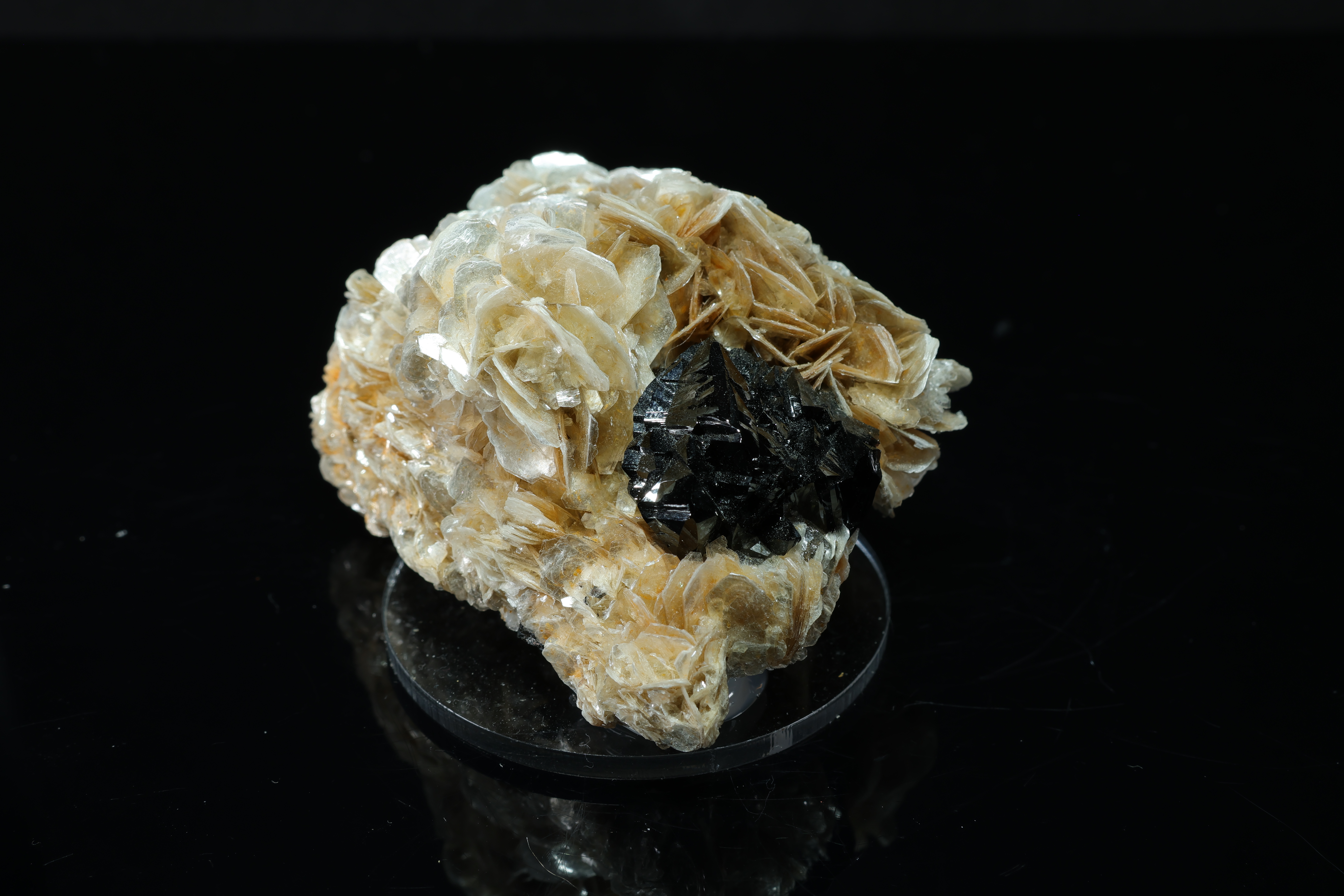
Cassiterite is distinguished by its deep black color and intense diamond luster. The main, twinned crystal of tin oxide rests in a light muscovite matrix, whose fine flakes create a bright, contrasting background. The sharp edges of the mineral and preserved faces give the composition a compact structure. Main features: strong diamond luster; distinct twinning of the crystal; high contrast with the light muscovite matrix; origin from the classic location of Xuebaoding; ex coll K.Urbanik. Condition: Very good.
Price: 230 EUR (999 PLN)
Availability: In stock
Location: Xuebaoding, Sichuan, China
Size: 72 x 52 x 40 mm
Weight: 200 g
Chemical formula: SnO₂
Crystal system: Tetragonal
Mohs hardness: 6–7
Mineral group: Hematite Group
Rarity: Rare
Characteristics Cassiterite is tin oxide, SnO₂, and is the most important source of this metal. It usually occurs as well-formed crystals with a prismatic or bipyramidal habit, often with visible twinning. Cassiterite aggregates can be granular, massive, or radial. The color of the mineral is variable, from black, through brown, yellow, red, to white or colorless, although the latter are rare. It often has a vitreous or adamantine luster, which gives it a characteristic appearance. Physical Properties Cassiterite is characterized by a Mohs hardness of 6-7, which makes it relatively scratch-resistant. Its density is high, approximately 6.98 g/cm³, which is a diagnostic feature. The luster of cassiterite is usually adamantine, sometimes metallic. The mineral can be transparent, translucent, or opaque. Colors and Varieties Cassiterite occurs in a wide range of colors, from black, through various shades of brown, yellow, red, to white and colorless. Dark varieties are most commonly found. No specific commercial varieties are distinguished, but color and transparency affect its collector's value. History and Name The name cassiterite comes from the Greek word "kassiteros," meaning tin. This mineral has been known and used since antiquity as the main source of tin. It was formally described in 1832, but its importance to humanity dates back thousands of years, being a key component of bronze. Applications Cassiterite is the primary ore of tin, a metal with wide industrial applications. Tin is used in the production of alloys (e.g., bronze, solder), protective coatings (tinplate), as well as in electronics and chemistry. High-quality and aesthetically pleasing cassiterite specimens are valued by mineral collectors.
Identification Cassiterite can be identified by its high density, which is noticeable even in small specimens. Its adamantine or metallic luster and a Mohs hardness of 6-7 are also characteristic. The color, although variable, is often dark, brown, or black. The streak of cassiterite is white, grayish, or brownish-white. Distinguishing from Similar Minerals Cassiterite is sometimes confused with tourmaline, rutile, ilmenite, or other dark minerals. It differs from tourmaline by its higher density and the absence of tourmaline's characteristic triangular cross-section. It differs from rutile by its streak color (rutile has a brown to black streak) and often by its crystal habit. Ilmenite is usually less lustrous and has a black streak. Crystal Forms Cassiterite often forms prismatic or bipyramidal crystals with a tetragonal system. Twinning is common, especially geniculate twinning. It can also occur as granular, massive, radial, or reniform aggregates, especially in alluvial deposits.
Genesis Cassiterite primarily forms in high-temperature hydrothermal veins associated with granites, in pegmatites and greisens. It is also an accessory mineral in some igneous rocks. Due to its resistance to weathering and high density, it often concentrates in secondary deposits, i.e., in river sands and gravels (placer deposits). Mineral Associations Cassiterite often co-occurs with quartz, muscovite, topaz, fluorite, wolframite, scheelite, arsenopyrite, pyrite, and other ore minerals. Localities Important cassiterite deposits are found in Bolivia (Potosí), China (Yunnan, Guangxi), Malaysia, Indonesia (Bangka and Belitung islands), Australia (Tasmania), Nigeria, Russia (Far East), and Cornwall in the United Kingdom.
Quality Criteria The most prized cassiterite specimens are well-formed, large, and transparent crystals with intense color and strong luster. Crystals with visible twinning are particularly sought after. The purity of the mineral and the absence of mechanical damage also affect its collector's value. Specimens with aesthetic mineral associations are also highly valued. Popular Localities The most prized cassiterite specimens come from Bolivia, especially from the Potosí region, where large, well-formed crystals are found. Other important localities include China, Australia, and Cornwall in the United Kingdom, known for historical and contemporary discoveries of high-quality specimens.
See mineralogical reference for Cassiterite in the Knowledge Base →