SKU: P_26-6_52
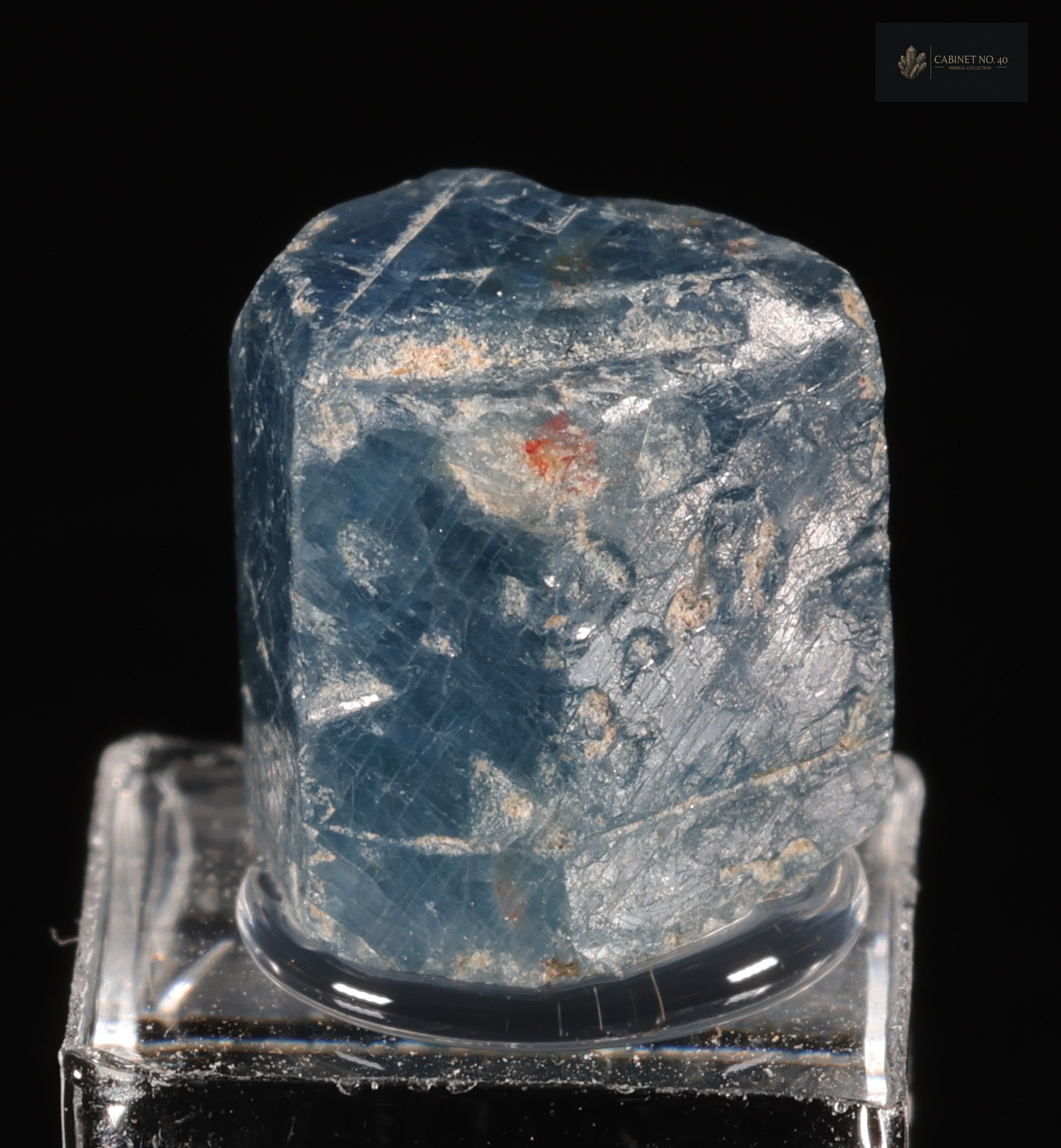
A sapphire with a blue to grayish-blue color, exhibiting visible color zoning. The crystal has a prismatic form, with distinct, albeit irregular, side walls, and is partially transparent, with numerous internal inclusions. Main features: prismatic crystal; blue to grayish-blue color; visible color zoning; partially transparent. Condition: Very good.
Price: 7 EUR (29 PLN)
Availability: Reserved
Location: Kashmir sapphire mines, Pádar, Kishtwar district, Jammu and Kashmir, India
Size: 8 x 8 x 8 mm
Weight: 2 g
Characteristics Sapphire is a variety of corundum (aluminum oxide), characterized by high hardness and a vitreous luster. A typical sapphire specimen is usually a blue crystal, often columnar or barrel-shaped, with visible growth zones. The blue color results from the presence of trace amounts of iron and titanium in the crystal structure. Gem-quality specimens are usually transparent, while opaque or translucent specimens are also found in collections. Physical Properties Sapphire has a hardness of 9 on the Mohs scale, making it one of the hardest minerals, second only to diamond. It has a vitreous luster, and its density is approximately 3.95-4.03 g/cm³. It is transparent to translucent, and its fracture is conchoidal to uneven. It does not exhibit cleavage, although parting may occur. Colors and Varieties The most well-known are blue sapphires, but this mineral occurs in a wide range of colors, such as pink, yellow, green, purple, orange, and even black. All varieties of corundum other than red (ruby) are called sapphires. A particularly prized variety is the padparadscha sapphire, with a rare orange-pink color. There are also star sapphires, which exhibit asterism – a light effect in the form of a six-rayed star, caused by the presence of rutile. History and Name The name "sapphire" comes from the Greek word "sappheiros", meaning "blue stone". This mineral was known and valued in antiquity, and its history is closely linked to the cultures of the Middle East and Asia. Sapphires were used as ornaments, talismans, and in insignia of power. Many legends and beliefs attributed magical properties to sapphires, such as protection from evil or bringing wisdom. Applications The main application of sapphire is in jewelry, where it is valued as a gemstone for making jewelry. Due to its hardness, synthetic sapphire is used in industry, among other things, for the production of scratch-resistant watch glasses, optical components, and in electronics as substrates for semiconductors.
Identification Sapphire can be identified by its high hardness (it scratches most minerals except diamond), vitreous luster, and characteristic coloration. It often exhibits pleochroism, which is a change in color depending on the viewing angle. Occurrence in the form of hexagonal prisms is also a diagnostic feature. Distinguishing from Similar Minerals Sapphire can be confused with other blue minerals, such as tanzanite, spinel, benitoite, or kyanite. It is distinguished from tanzanite by its higher hardness and lack of distinct cleavage. Spinel has a different crystal structure (isometric) and usually does not exhibit pleochroism. Kyanite has lower hardness and distinct cleavage. Crystal Forms Sapphire crystallizes in the trigonal system, most often forming hexagonal prisms, often terminated by pyramids. Aggregates can be granular or massive. Barrel-shaped crystals also occur.
Genesis Sapphire forms in igneous rocks, such as pegmatites and basalts, and in metamorphic rocks, such as marbles and gneisses. It can also occur in alluvial secondary deposits, where it is mined from river sediments. Mineral Associations Sapphire often co-occurs with other minerals, such as garnet, spinel, zircon, rutile, muscovite, biotite, and feldspar. Locations The most important sapphire deposits are found in Sri Lanka, Burma (Myanmar), Thailand, Australia, Madagascar, Tanzania, the United States (Montana), and Kashmir (India), from where some of the most prized, velvety blue sapphires originate.
Quality Criteria The most important quality criteria for sapphires are color, clarity, cut, and carat weight. The most desirable sapphires have an intense, deep, velvety blue color, without visible inclusions. Clarity is assessed under a 10x loupe. A well-executed cut maximizes the stone's brilliance and color. Larger, high-quality stones are significantly more valuable. Popular Localities The most prized sapphires come from Kashmir, Burma (Myanmar), and Sri Lanka. Kashmir sapphires are known for their unique, velvety blue hue. Sri Lankan sapphires are characterized by a wide range of colors, and Burma produces stones with an intense, pure blue color.
See mineralogical reference for Sapphire in the Knowledge Base →