SKU: K-0195_3-PK
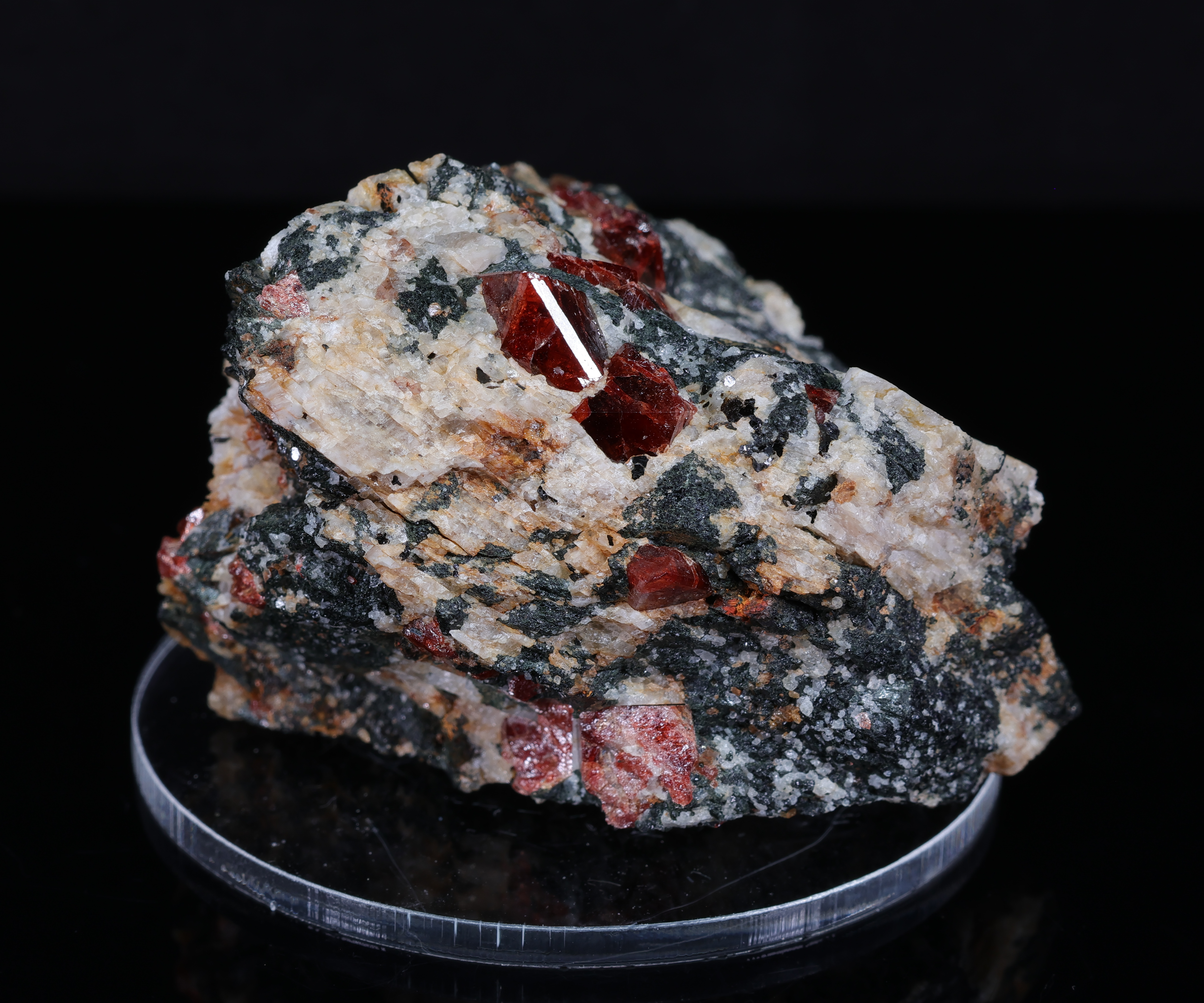
The specimen features well-formed zircon crystals with a deep reddish-brown color, set on a contrasting dark matrix. The crystals are characterized by a distinct luster and sharp edges. Main Features: reddish-brown zircon; contrasting matrix; sharp edges; ex coll. K. Urbanik. Condition: Good - the main crystal is complete, while the others show visible edge damage.
Price: 50 EUR (219 PLN)
Availability: In stock
Location: -, Pakistan
Size: 61 x 50 x 40 mm
Weight: 156 g
Chemical formula: ZrSiO₄
Crystal system: tetragonal
Mohs hardness: 7
Mineral group: Zircon Group
Rarity: Uncommon
Characteristics Zircon is a zirconium silicate, often occurring as small, well-formed crystals. Typical specimens are prismatic crystals terminated by pyramids, often with a distinct luster. It can occur in igneous, metamorphic, and sedimentary rocks, where it is resistant to weathering, allowing for its accumulation in sediments. Physical Properties This mineral is characterized by a hardness of 7.5 on the Mohs scale, which makes it scratch-resistant. It has an adamantine luster, giving it an attractive appearance. Its density is 4.6, and its streak is white. Zircon can be transparent, translucent, or opaque. Colors and Varieties Zircon occurs in a wide range of colors, including colorless, yellow, gray, reddish-brown, green, brown, and black, rarely blue. Colorless and blue varieties are particularly prized in jewelry. Some varieties can be heat-treated to change or enhance their color. History and Name The name "zircon" likely comes from the Persian word "zargun," meaning "gold-colored," referring to the color of some varieties. The mineral was described in 1783. Zircon has been known since antiquity, and its varieties have been used as gemstones. Applications Zircon is an important source of metallic zirconium, used in the nuclear industry due to its low neutron absorption. It is also used in ceramics, refractories, and as an abrasive material. Transparent varieties of zircon are prized gemstones in jewelry, often used as diamond imitations.
Identification Zircon can be identified by its high hardness, adamantine luster, and characteristic crystal habit, often prismatic with pyramidal terminations. The coloration is highly variable, but colorless, brown, and reddish hues are common. Distinguishing from Similar Minerals Zircon is sometimes confused with diamond, garnet, spinel, or sapphire due to similar luster and hardness. It differs from diamond by its lower hardness and lack of perfect cleavage. It differs from garnets and spinels by its crystallographic system and other optical properties. It differs from sapphire by its hardness and density. Crystal Forms Zircon most commonly occurs as tetragonal crystals with a columnar or isometric habit. Crystals are usually bipyramidal, often with visible prismatic faces. It can also form granular aggregates.
Genesis Zircon is an accessory mineral, commonly found in many types of igneous rocks, especially in granites, syenites, and pegmatites. It also occurs in metamorphic rocks, such as gneisses and schists, and in sedimentary rocks as a component of zircon sands, due to its resistance to weathering. Mineral Associations Zircon often co-occurs with quartz, feldspar, biotite, muscovite, hornblende, garnet, ilmenite, and rutile. In sediments, it can be found with other heavy minerals. Localities Significant zircon deposits are found in Australia, Brazil, India, Russia, South Africa, Sri Lanka, Thailand, and the USA. In Poland, zircon occurs in the granites of the Karkonosze and Tatra Mountains, as well as in river sands.
Quality Criteria The most prized zircon specimens are those with large, well-formed, transparent crystals of intense and uniform color. Specimens embedded in the host rock are also highly valued. Clarity and lack of inclusions are important criteria for jewelry stones. Market Prices Zircon prices are highly variable and depend on the size, color, clarity, and cut of the stone. High-quality, cut jewelry stones can fetch prices from tens to hundreds of dollars per carat, especially those in rare colors, such as blue. Popular Localities The most prized zircon specimens come from Sri Lanka, Burma (Myanmar), Cambodia, Vietnam, Tanzania, and Madagascar. They are also known from Norway and Russia.
See mineralogical reference for Zircon in the Knowledge Base →