Zircon
Chemical formula: Zr<sup>4+</sup>SiO<sub>4</sub>
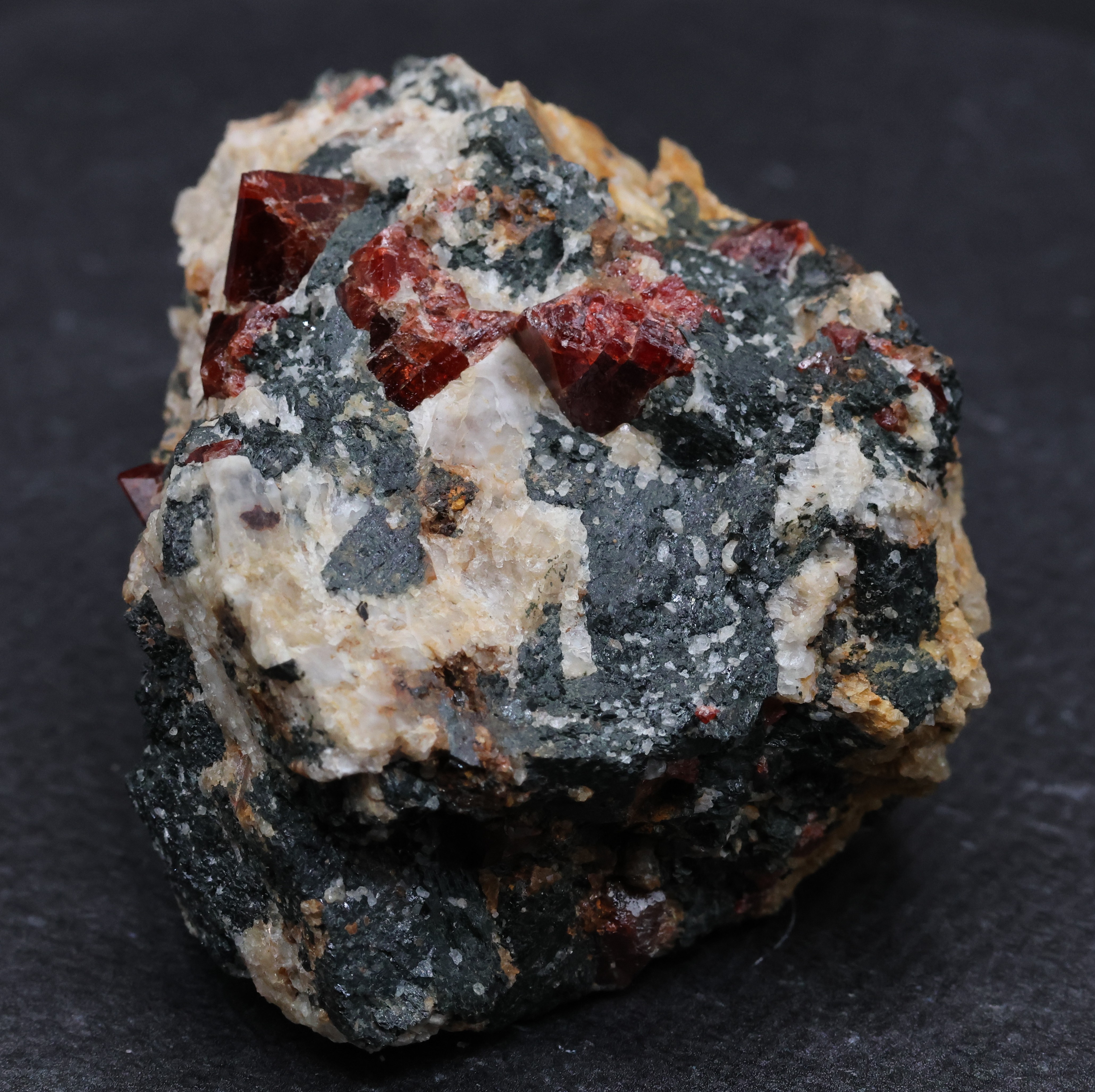
Zircon is a common mineral from the silicate group, valued in jewelry and industry due to its physical and chemical properties.
Properties
- Mohs hardness
- 7.5
- Luster
- Adamantine
- Streak
- White
- Density
- 4.6
- Cleavage
- Indistinct on {110}{111}
- Fracture
- Muszlowy do nierównego
- Transparency
- Transparent,Translucent,Opaque
- Crystal system
- Tetragonal
Diagnostic features
## Identification Zircon can be identified by its high hardness, adamantine luster, and characteristic crystal habit, often prismatic with pyramidal terminations. The coloration is highly variable, but colorless, brown, and reddish hues are common. ## Distinguishing from Similar Minerals Zircon is sometimes confused with diamond, garnet, spinel, or sapphire due to similar luster and hardness. It differs from diamond by its lower hardness and lack of perfect cleavage. It differs from garnets and spinels by its crystallographic system and other optical properties. It differs from sapphire by its hardness and density. ## Crystal Forms Zircon most commonly occurs as tetragonal crystals with a columnar or isometric habit. Crystals are usually bipyramidal, often with visible prismatic faces. It can also form granular aggregates.
Geological environment
## Genesis Zircon is an accessory mineral, commonly found in many types of igneous rocks, especially in granites, syenites, and pegmatites. It also occurs in metamorphic rocks, such as gneisses and schists, and in sedimentary rocks as a component of zircon sands, due to its resistance to weathering. ## Mineral Associations Zircon often co-occurs with quartz, feldspar, biotite, muscovite, hornblende, garnet, ilmenite, and rutile. In sediments, it can be found with other heavy minerals. ## Localities Significant zircon deposits are found in Australia, Brazil, India, Russia, South Africa, Sri Lanka, Thailand, and the USA. In Poland, zircon occurs in the granites of the Karkonosze and Tatra Mountains, as well as in river sands.
Rarity
Very Common
For collectors
## Quality Criteria The most prized zircon specimens are those with large, well-formed, transparent crystals of intense and uniform color. Specimens embedded in the host rock are also highly valued. Clarity and lack of inclusions are important criteria for jewelry stones. ## Market Prices Zircon prices are highly variable and depend on the size, color, clarity, and cut of the stone. High-quality, cut jewelry stones can fetch prices from tens to hundreds of dollars per carat, especially those in rare colors, such as blue. ## Popular Localities The most prized zircon specimens come from Sri Lanka, Burma (Myanmar), Cambodia, Vietnam, Tanzania, and Madagascar. They are also known from Norway and Russia.
Care and storage
## Cleaning Zircon is a relatively hard mineral, but it should be cleaned gently. A soft brush and lukewarm water with mild soap can be used. After washing, rinse the specimen thoroughly with clean water and dry with a soft cloth. ## What to Avoid Avoid contact with strong acids, which can damage the mineral's surface. Prolonged exposure to intense sunlight can, in some cases, lead to color change. Avoid sudden temperature changes. ## Storage Zircon is best stored separately from other, harder minerals to prevent scratching. Storage in a soft pouch or a box lined with soft material is ideal. Jewelry specimens should be stored in boxes, away from dust and moisture.