Realgar with yellow aurypigment coating from Romania

SKU: P_26-1_20

A small specimen of realgar presenting as a cluster of orange, needle-like crystals that cover a significant portion of the gray matrix. Realgar forms dense aggregates. Between the orange crystals, a light yellow coating (aurypigment) is visible, which is a product of the oxidation of realgar, contrasting with the color of the mineral. Main features: dense clusters of orange, needle-like realgar crystals; presence of light yellow aurypigment coating contrasting with the color of realgar. Condition: Good, with no visible mechanical damage.
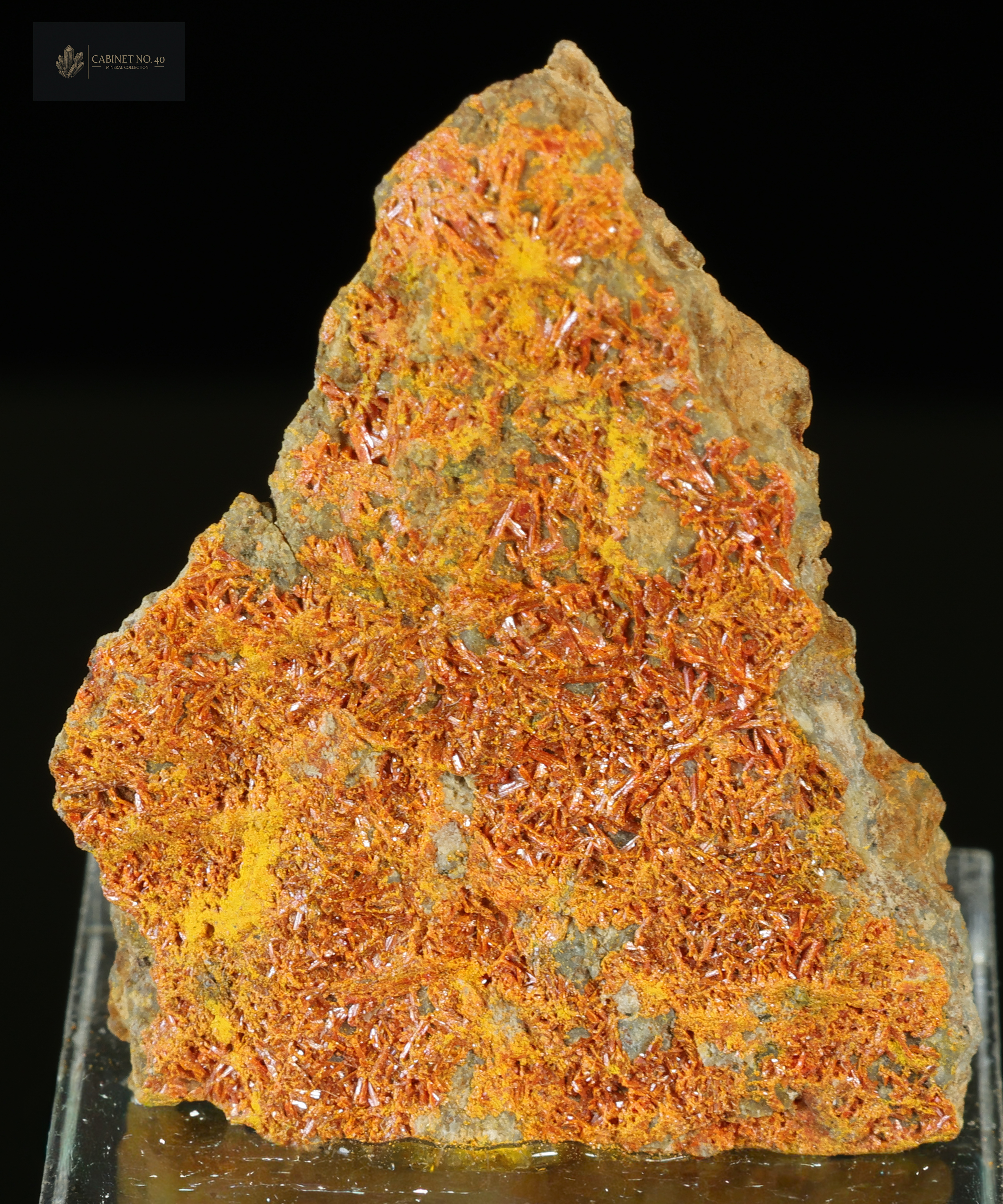
Realgar with yellow aurypigment coating from Romania

Price: 14 EUR (59 PLN)

Availability: In stock

Location: Breiner Mine (Brainer Mine; Breiner deposit), Băiuț, Maramureș County, Romania

Size: 27 x 35 x 10 mm

Weight: 200 g

Chemical formula: PbCrO₄

Crystal system: Monoclinic

Mohs hardness: 2.5–3.0

Rarity: Rare

Characteristics Realgar is a sulfide mineral, whose name comes from the Arabic "rahj al-ghar", meaning "powder of the mine". It usually occurs as granular, massive aggregates, coatings, or crusts, but can also form beautiful, columnar or acicular crystals. Its color ranges from dark red to orange-red, making it easily recognizable. The mineral's surface often exhibits a vitreous or adamantine luster. Physical Properties Realgar is characterized by a low hardness on the Mohs scale, ranging from 1.5-2, which means it is soft and easily scratched. It has good cleavage in one direction, and less distinct cleavage in others. The density of realgar is 3.56 g/cm³. It is transparent to translucent, and its streak is orange-red to red. Colors and Varieties The dominant color of realgar is intense red, often with an orange tint. This mineral does not form significant color varieties, but its color may vary slightly depending on the location and formation conditions. History and Name The name "realgar" is derived from the Arabic "rahj al-ghar", which can be translated as "powder of the cave" or "powder of the mine", referring to its occurrence in deposits. This mineral was known and used in antiquity, mainly as a pigment. It was described in 1747. Uses Realgar was historically used as a pigment in painting, known as "royal red", but due to its toxicity and light instability, its use has been abandoned. Currently, it is primarily of collector's interest. It is also used in pyrotechnics to produce light effects.

Diagnostic features

Identification Realgar can be identified by its characteristic, intense orange-red color, vitreous or adamantine luster, and low hardness. Its streak is orange-red to red. It often occurs in association with orpiment, which is yellow. Distinguishing from Similar Minerals Realgar is sometimes confused with cinnabar, which also has a red color. However, cinnabar is harder (2-2.5 on the Mohs scale), has a higher density (8.1 g/cm³), and a different streak (red). Realgar can be distinguished from orpiment (As₂S₃) by color – realgar is red, orpiment is yellow. Crystal Forms Realgar forms monoclinic crystals, often columnar or acicular. It also occurs as massive, granular aggregates, crusts, and coatings. Aggregates can be radial or fibrous.

Formation environment

Genesis Realgar is a hydrothermal mineral, forming in low-temperature hydrothermal veins, often in association with other arsenic and sulfur minerals. It also occurs in hot spring deposits and as a sublimation product near volcanoes and fumaroles. Mineral Associations Realgar often co-occurs with orpiment (As₂S₃), stibnite, galena, pyrite, marcasite, barite, calcite, and quartz. Localities Known localities for realgar include Romania (Baia Mare), Switzerland (Binntal), United States (Nevada, Utah), China (Hunan), Japan, and Peru.

For the collector

Quality Criteria The most prized realgar specimens are well-formed, transparent or translucent crystals with an intense, deep orange-red color. The purity of the specimen, absence of mechanical damage, and absence of signs of oxidation (yellow orpiment coatings) are also important. Popular Localities Particularly valued realgar specimens come from the Getchell mine in Nevada (USA), where large, well-formed crystals have been found. Other important localities include Baia Mare in Romania and Binntal in Switzerland.

See mineralogical reference for Realgar in the Knowledge Base →

View product →