Realgar
Chemical formula: AsS
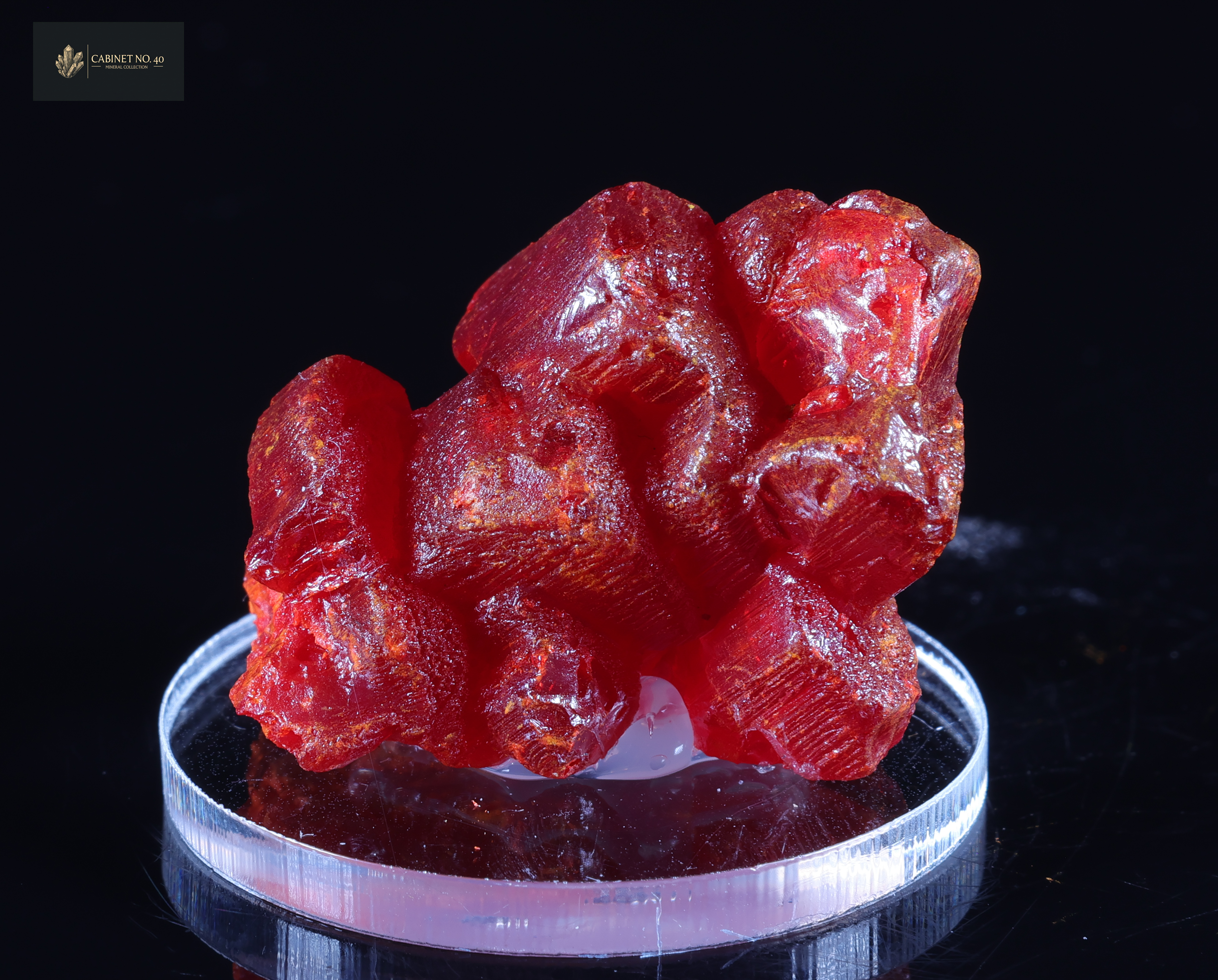
Realgar is a sulfide mineral characterized by an intense, orange-red color and vitreous luster, often occurring as crystals or massive aggregates.
Properties
- Mohs hardness
- 1.5-2
- Luster
- Adamantine
- Streak
- Orange-red to red
- Density
- 3.56
- Cleavage
- Good on {010}, less good on {100}, <mi>{_101}</mi>, {120}, {110}
- Fracture
- Nierówny
- Transparency
- Transparent
- Crystal system
- Monoclinic
Diagnostic features
## Identification Realgar can be identified by its characteristic, intense orange-red color, vitreous or adamantine luster, and low hardness. Its streak is orange-red to red. It often occurs in association with orpiment, which is yellow. ## Distinguishing from Similar Minerals Realgar is sometimes confused with cinnabar, which also has a red color. However, cinnabar is harder (2-2.5 on the Mohs scale), has a higher density (8.1 g/cm³), and a different streak (red). Realgar can be distinguished from orpiment (As₂S₃) by color – realgar is red, orpiment is yellow. ## Crystal Forms Realgar forms monoclinic crystals, often columnar or acicular. It also occurs as massive, granular aggregates, crusts, and coatings. Aggregates can be radial or fibrous.
Geological environment
## Genesis Realgar is a hydrothermal mineral, forming in low-temperature hydrothermal veins, often in association with other arsenic and sulfur minerals. It also occurs in hot spring deposits and as a sublimation product near volcanoes and fumaroles. ## Mineral Associations Realgar often co-occurs with orpiment (As₂S₃), stibnite, galena, pyrite, marcasite, barite, calcite, and quartz. ## Localities Known localities for realgar include Romania (Baia Mare), Switzerland (Binntal), United States (Nevada, Utah), China (Hunan), Japan, and Peru.
Rarity
Common
For collectors
## Quality Criteria The most prized realgar specimens are well-formed, transparent or translucent crystals with an intense, deep orange-red color. The purity of the specimen, absence of mechanical damage, and absence of signs of oxidation (yellow orpiment coatings) are also important. ## Popular Localities Particularly valued realgar specimens come from the Getchell mine in Nevada (USA), where large, well-formed crystals have been found. Other important localities include Baia Mare in Romania and Binntal in Switzerland.
Care and storage
## Cleaning Realgar is a delicate and toxic mineral, so it should be handled with care. For cleaning, it is best to use a dry, soft brush or paintbrush to remove dust. Avoid contact with water, as this can accelerate the oxidation and decomposition of the mineral. ## What to Avoid Realgar is sensitive to light, which causes its gradual transformation into yellow, non-toxic orpiment (As₂S₃) and other arsenic compounds. Exposure to direct sunlight and strong artificial lighting should be avoided. The mineral is also sensitive to high temperatures and humidity. Due to its arsenic content, realgar is toxic, so direct skin contact and inhalation of dust should be avoided. Always wash hands thoroughly after contact with the mineral. ## Storage Realgar should be stored in a dark, dry, and cool place, preferably in a tightly sealed container to limit light and air exposure. It is advisable to place it in a box lined with soft material to prevent mechanical damage. Collector specimens are often stored in special display cases with limited light access.