SKU: P_26-6_57
An elongated crystal of kunzite with a light pink color, featuring visible inclusions of darker minerals. The surface of the crystal is uneven, with distinct longitudinal grooves and cracks, indicating its natural formation and partial rounding. The crystal is translucent, with local clarities and cloudiness. Main features: light pink color; elongated shape; translucent; visible inclusions of darker minerals. Condition: Very good.
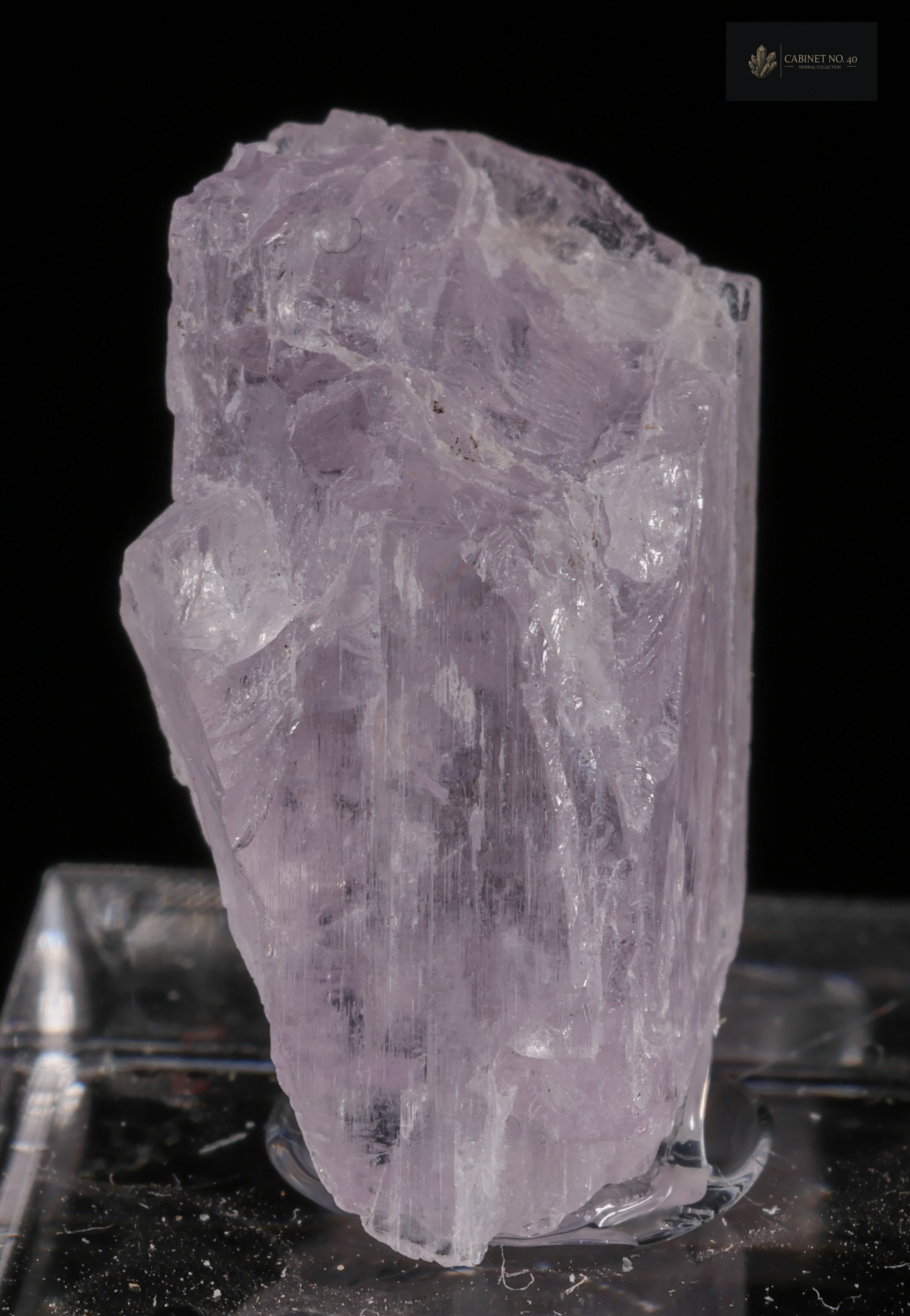
Price: 16 EUR (69 PLN)
Availability: In stock
Location: Laghman, Afghanistan
Size: 12 x 12 x 17 mm
Weight: 6 g
Chemical formula: LiAlSi₂O₆
Mohs hardness: 6.5–7.0
Characteristics Kunzite is a variety of spodumene, a mineral belonging to the pyroxene group. It occurs as elongated, tabular crystals, often with distinct striations parallel to the longer axis. Its characteristic features include pleochroism, which is a change in color depending on the viewing angle, and phosphorescence after exposure to ultraviolet light. Physical Properties The Mohs hardness of kunzite is 6.5-7. The luster is vitreous. This mineral is transparent to translucent. It has perfect cleavage in two directions, which makes it susceptible to mechanical damage. Colors and Varieties Kunzite occurs in shades of pink, lilac, purple, and sometimes colorless. The intensity of the color can vary, from delicate pastels to deep, saturated tones. The color of kunzite is often unstable and can fade under sunlight. The green variety of spodumene is hiddenite, while the yellow variety is triphane. History and Name The name kunzite comes from the surname of George Frederick Kunz, an American gemologist who first described this mineral in 1902. It was discovered in California, and its beauty quickly gained recognition in the world of jewelry. Applications Kunzite is a valued gemstone, used for making jewelry such as rings, necklaces, and earrings. Large, clear crystals are also sought after by mineral collectors.
Identification Kunzite can be identified by its characteristic pink or lilac color, vitreous luster, and elongated, often striated crystals. An important diagnostic feature is also its pleochroism. Distinguishing from Similar Minerals Kunzite can be confused with other pink minerals, such as morganite (a variety of beryl) or rose quartz. It is distinguished from morganite by its crystallographic system (monoclinic for kunzite, hexagonal for morganite) and cleavage. It differs from quartz in hardness and cleavage (quartz has no distinct cleavage). Crystal Forms Kunzite forms elongated, tabular crystals, often with distinct striations parallel to the c-axis. Aggregates can be radial or massive.
Genesis Kunzite forms in granitic pegmatites, especially those rich in lithium. It crystallizes in the final stages of magma solidification, in the presence of rare elements. Mineral Associations Kunzite often co-occurs with other pegmatitic minerals such as quartz, albite, muscovite, tourmaline, beryl, and lepidolite. Locations Significant deposits of kunzite are found in Brazil (Minas Gerais), Afghanistan (Nuristan), Pakistan (Gilgit-Baltistan), USA (California, San Diego County), Madagascar, and Russia (Siberia).
Quality Criteria The most valued kunzite specimens are those with intense, uniform pink or lilac color, high transparency, and clarity. The size and perfection of the crystals, as well as the absence of mechanical damage, are also important. Popular Localities Specimens from Afghanistan and Brazil are particularly sought after by collectors, known for their large and well-formed crystals with beautiful color.
See mineralogical reference for Kunzite in the Knowledge Base →