Kunzite
Chemical formula: LiAlSi₂O₆
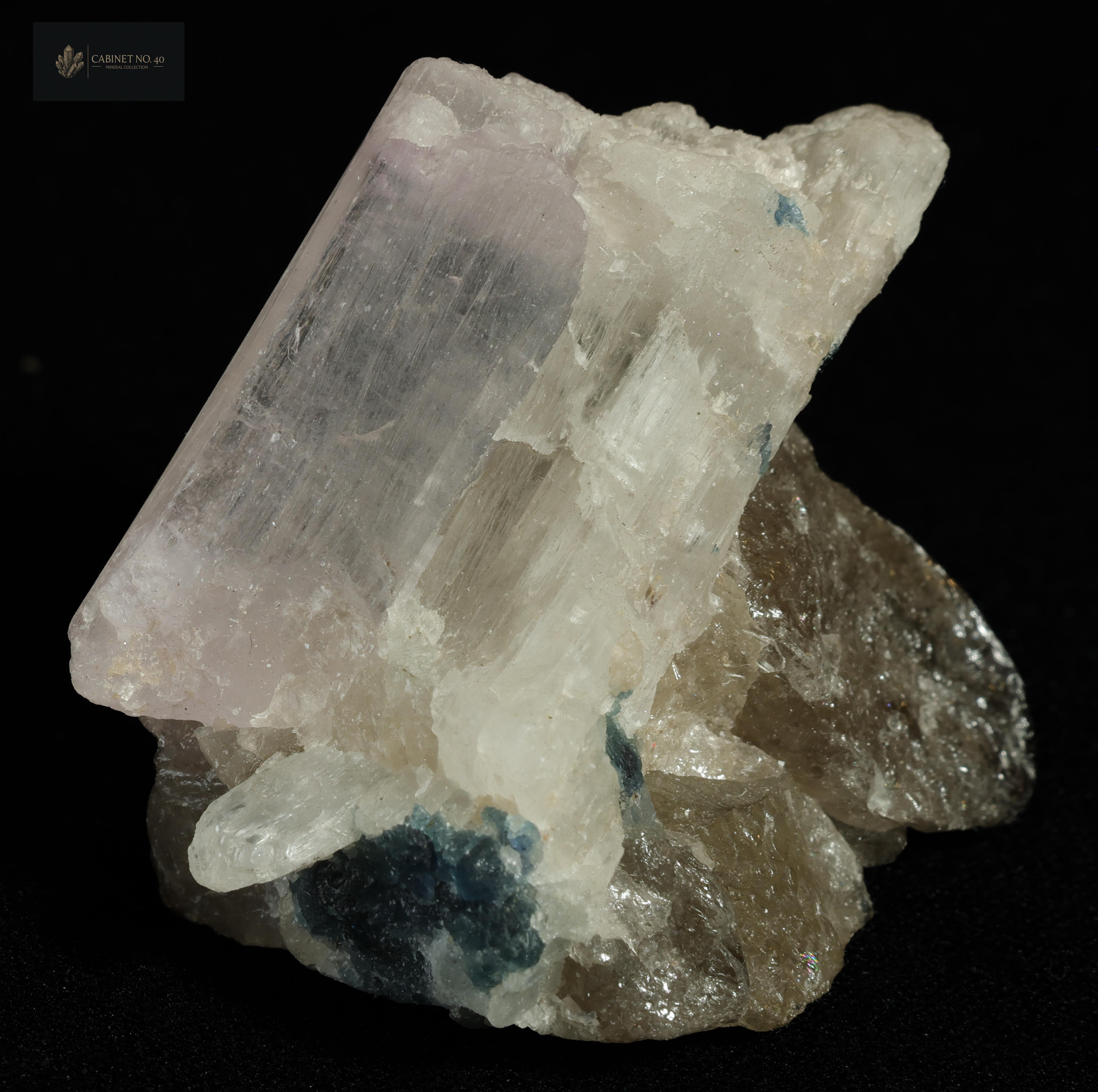
Kunzite is a transparent, pink or lilac variety of spodumene, valued in jewelry and collecting for its colorful crystals.
Properties
- Mohs hardness
- 6.5-7
- Luster
- Vitreous
- Streak
- White
- Density
- 0
- Cleavage
- Perfect on {100} and {110}
- Fracture
- Uneven to subconchoidal
- Transparency
- Transparent to translucent
- Crystal system
- Monoclinic
Diagnostic features
## Identification Kunzite can be identified by its characteristic pink or lilac color, vitreous luster, and elongated, often striated crystals. An important diagnostic feature is also its pleochroism. ## Distinguishing from Similar Minerals Kunzite can be confused with other pink minerals, such as morganite (a variety of beryl) or rose quartz. It is distinguished from morganite by its crystallographic system (monoclinic for kunzite, hexagonal for morganite) and cleavage. It differs from quartz in hardness and cleavage (quartz has no distinct cleavage). ## Crystal Forms Kunzite forms elongated, tabular crystals, often with distinct striations parallel to the c-axis. Aggregates can be radial or massive.
Geological environment
## Genesis Kunzite forms in granitic pegmatites, especially those rich in lithium. It crystallizes in the final stages of magma solidification, in the presence of rare elements. ## Mineral Associations Kunzite often co-occurs with other pegmatitic minerals such as quartz, albite, muscovite, tourmaline, beryl, and lepidolite. ## Locations Significant deposits of kunzite are found in Brazil (Minas Gerais), Afghanistan (Nuristan), Pakistan (Gilgit-Baltistan), USA (California, San Diego County), Madagascar, and Russia (Siberia).
Rarity
Rare
For collectors
## Quality Criteria The most valued kunzite specimens are those with intense, uniform pink or lilac color, high transparency, and clarity. The size and perfection of the crystals, as well as the absence of mechanical damage, are also important. ## Popular Localities Specimens from Afghanistan and Brazil are particularly sought after by collectors, known for their large and well-formed crystals with beautiful color.
Care and storage
## Cleaning Kunzite should be cleaned gently, using a soft cloth or brush and lukewarm water with a small amount of mild soap. After washing, it should be thoroughly rinsed with clean water and dried. ## What to Avoid Kunzite is sensitive to high temperatures, sudden temperature changes, and strong chemicals, which can damage its surface or change its color. Avoid prolonged exposure to direct sunlight, as this can cause color fading. Due to its perfect cleavage, kunzite is prone to cracks and chips, so it should be protected from impacts. ## Storage Kunzite is best stored in a separate, soft pouch or box to prevent scratches from other, harder minerals. An ideal place is cool, dry, and dark, away from sources of light and heat.