SKU: S_00142
A rare and extremely aesthetic specimen of ephesite from the classic South African location of Gloucester Farm. The specimen is in the form of a crystalline, three-dimensional cluster composed of fine, intensely raspberry-pink, platy crystals with a distinct luster. The specimen comes from the historic collection of Burton Ford. Main Features: intense raspberry-pink color; accumulation of platy crystals; rare species from the mica group; historical provenance; miniature format. Condition: Very good.
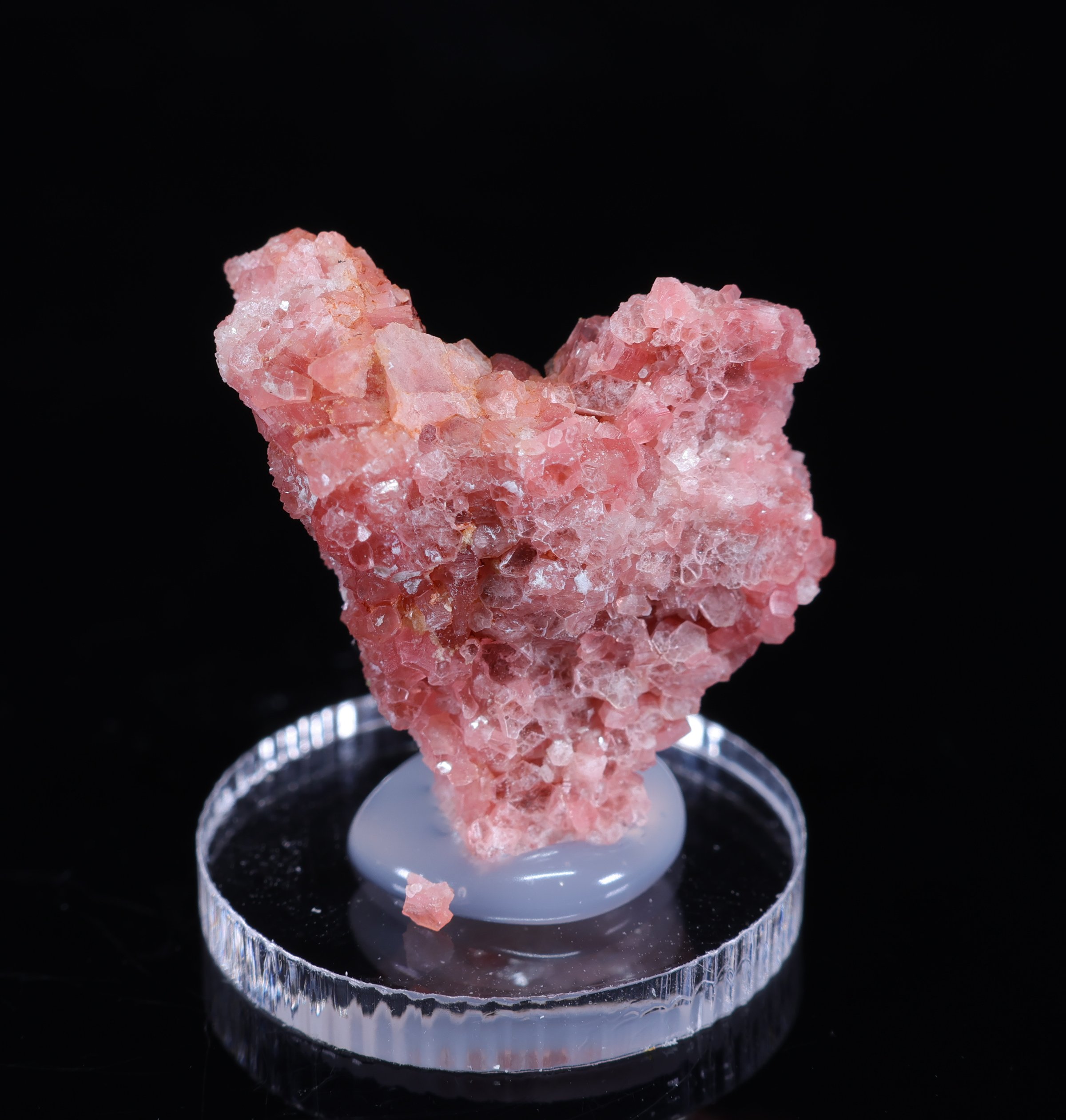
Price: 64 EUR (279 PLN)
Availability: In stock
Location: Gloucester Farm, Postmasburg, Northern Cape Province, South Africa
Size: 17 x 21 x 10 mm
Weight: 3 g
Chemical formula: NaLiAl₂(Si₂Al₂)O₁₀(OH)₂
Mohs hardness: 3.5-4.5
Characteristics Ephesite is a mineral from the mica group, typically forming small, platy or scaly aggregates. Its typical color is pink, often with a violet hue, which gives it a distinctive appearance. This mineral occurs in clusters, less frequently in well-formed crystals, which are usually small. Its appearance resembles other micas, with distinct cleavage and a pearly luster on cleavage surfaces. Physical Properties Ephesite is characterized by a Mohs hardness of 3.5-4.5, making it a relatively soft mineral. It possesses excellent cleavage in one direction, which is typical for micas. The specific gravity of ephesite is approximately 2.984 g/cm³. It is a translucent mineral, and its luster is pearly to vitreous. Colors and Varieties The most common color of ephesite is pink, often with delicate shades of violet. This color is one of its main diagnostic features. There are no significant color varieties or commercial names for this mineral. History and Name Ephesite was discovered in 1851. The mineral's name comes from the location of its first discovery, Ephesus, an ancient city in Asia Minor, now located in Turkey. The description of the mineral and its naming took place after the analysis of samples from this location. Uses Ephesite has no significant industrial applications due to its rarity and lack of specific properties that would distinguish it from other minerals. It is primarily a mineral of collector's and scientific importance, valued by mineralogists and collectors of rare specimens.
Identification Ephesite can be identified by its characteristic pink color, platy habit, and excellent cleavage, which allows the mineral to be easily split into thin lamellae. The pearly luster on cleavage surfaces is also a diagnostic feature. Its occurrence in association with other minerals typical of metamorphic rocks, such as kyanite or dumortierite, may also indicate ephesite. Distinguishing from Similar Minerals Ephesite can be confused with other micas, especially muscovite or lepidolite, due to similar habit and cleavage. It differs from muscovite by its pink color and the presence of lithium in its composition. From lepidolite, which is also pink and contains lithium, ephesite differs in chemical composition and crystallographic system. Accurate differentiation requires chemical analysis or X-ray diffraction. Crystal Forms Ephesite most often occurs as small, platy or scaly crystals, forming aggregates. Single, well-formed crystals, which are usually small, are less common. Ephesite aggregates often have a radial or fan-like habit.
Genesis Ephesite is a secondary mineral, formed under conditions of regional metamorphism, especially in rocks rich in aluminum and lithium. It often occurs in crystalline schists, gneisses, and pegmatites. Its presence is an indicator of specific pressure and temperature conditions during metamorphic processes. Mineral Associations Ephesite often co-occurs with other metamorphic minerals, such as kyanite, dumortierite, tourmaline, muscovite, paragonite, and quartz. These associations are typical for rocks with a high degree of metamorphism. Localities The most important confirmed localities of ephesite include areas in Turkey (Ephesus, from which the name originates), as well as in Australia (e.g., Wodgina in Western Australia), where it occurs in pegmatites. Other localities include Brazil, Russia, and the United States, although specimens from these places are usually less significant.
Quality Criteria The most valued ephesite specimens are those characterized by an intense, uniform pink color, well-formed platy crystals, and the absence of mechanical damage. Large, aesthetic aggregates with a distinct pearly luster are particularly sought after. The purity of the mineral and the absence of visible inclusions of other minerals are also important. Popular Localities The most prized ephesite specimens come from Turkey (Ephesus) and Australia, especially from the Wodgina region, where specimens with good crystallization and intense color are found.
See mineralogical reference for Ephesite in the Knowledge Base →