SKU: K-0063_2-MA
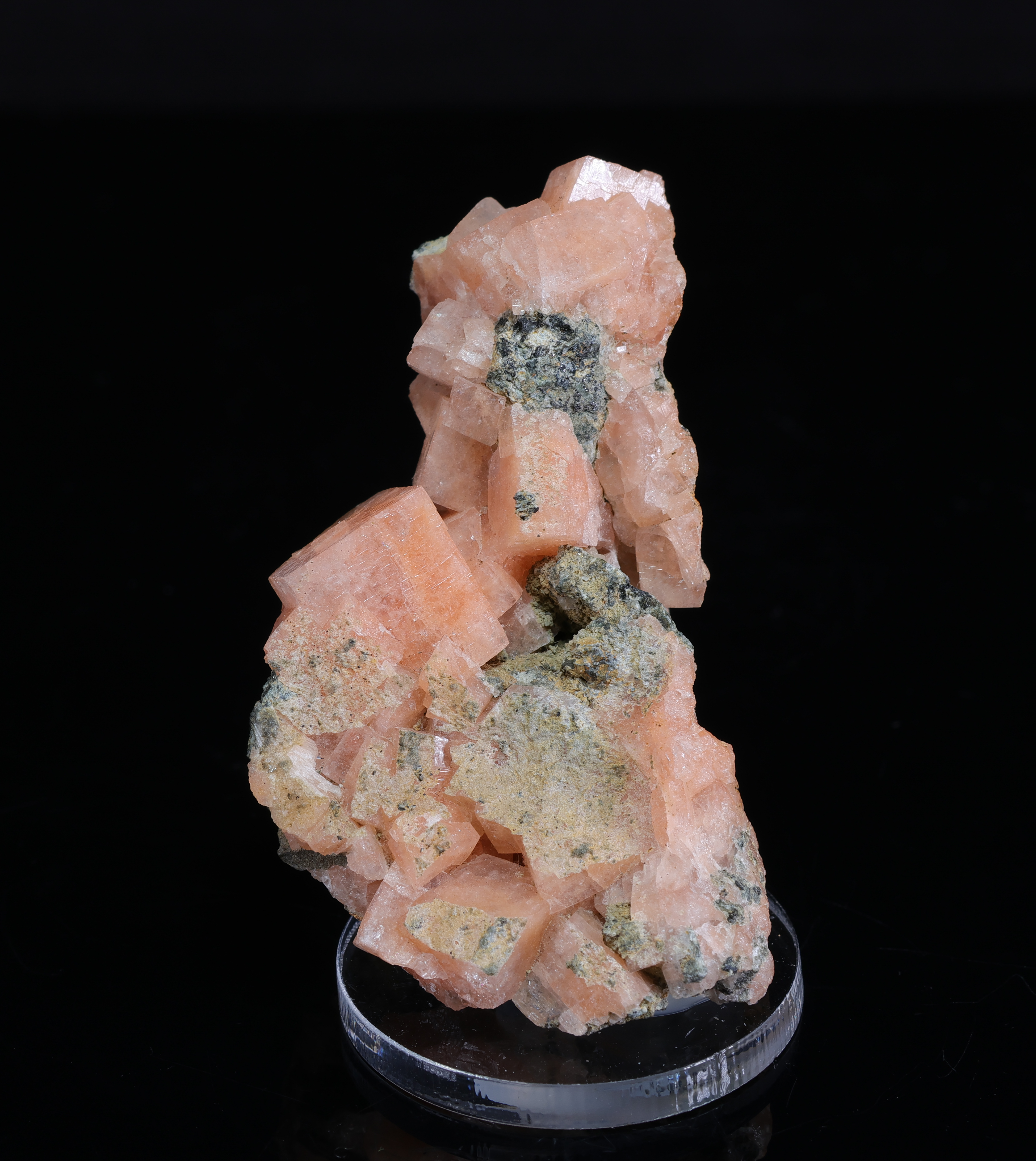
A specimen of chabazite originating from the Moroccan location of Imilchil, renowned for its very high-quality representatives of this mineral. The specimen has formed as a vertical group of well-defined rhombohedral crystals, stacked upon each other, exhibiting a characteristic intense peach-pink coloration. Main Features: peach-pink color; sharp, rhombohedral crystals; distinct, contrasting matrix; vertical spatial structure. Condition: Good.
Price: 20 EUR (89 PLN)
Availability: In stock
Location: Imilchil, Morocco
Size: 56 x 28 x 22 mm
Weight: 31.5 g
Chemical formula: CaAl₂Si₄O₁₂·6H₂O
Crystal system: rhombic
Mohs hardness: 4–5
Mineral group: Feldspathoid Groups
Rarity: Common
Characteristics Chabazite is a mineral belonging to the zeolite group, which are framework silicates. Typical chabazite specimens occur as rhombohedral crystals, often resembling cubes with truncated corners. Crystal surfaces can be dull or vitreous. This mineral can also form compact, granular aggregates. Physical Properties The hardness of chabazite on the Mohs scale is 4-5. This mineral exhibits a vitreous luster, sometimes pearly on cleavage surfaces. It is transparent to translucent. The density of chabazite typically ranges from 2.0-2.2 g/cm³. Colors and Varieties Chabazite occurs in many colors, most commonly white, colorless, yellow, pink, reddish, greenish, or brown. The color is often associated with the presence of impurities. There are no specific commercial varieties, but differences in chemical composition lead to the distinction of subgroups, such as chabazite-Ca, chabazite-Na, chabazite-K, and chabazite-Sr. History and Name The name chabazite comes from the Greek word "chabazios," which was an ancient term for an unknown stone. The mineral was first described in 1792 by Louis-Auguste d’Andrada. Applications Chabazite, like other zeolites, is used as an adsorbent, ion exchanger, and catalyst. It is utilized in water purification processes, in agriculture as a soil additive to improve its properties, and in the chemical industry.
Identification Chabazite can be recognized by its characteristic rhombohedral crystal habit, often forming pseudo-cubic shapes. It typically occurs in fissures and vesicles in volcanic rocks. Vitreous luster and a hardness of 4-5 on the Mohs scale are also helpful in identification. Distinguishing from Similar Minerals Chabazite is sometimes confused with other zeolites, such as analcime or gismondine, which also form similar crystalline shapes. It is distinguished from analcime by its trigonal crystallographic system (analcime is isometric). It usually differs from gismondine in crystal habit and hardness. For precise identification, X-ray diffraction studies are often necessary. Crystal Forms Chabazite most often forms well-developed rhombohedral crystals, often with visible penetration twinning, which gives them a pseudo-cubic appearance. It can also occur as granular, compact, or radial aggregates.
Genesis Chabazite is a secondary mineral, forming under low-temperature hydrothermal conditions. It occurs mainly in vesicles and fissures in volcanic rocks, such as basalts, andesites, and rhyolites. It can also form in lacustrine and marine sediments, as well as in altered volcanic tuffs. Mineral Associations Chabazite often co-occurs with other zeolites, such as stilbite, heulandite, analcime, laumontite, as well as with calcite, apophyllite, quartz, and prehnite. Localities Known chabazite localities are found worldwide. Important locations include: the Isle of Skye in Scotland, County Antrim in Northern Ireland, Fassa Valley in Italy, Nova Scotia in Canada, Iceland, India (Deccan Traps), and some places in the USA (e.g., Oregon, Washington).
Quality Criteria The most prized chabazite specimens are those with well-formed, large, and transparent crystals of intense color. Crystal clarity, absence of mechanical damage, and aesthetic arrangement on the matrix also contribute to collector's value. Specimens with rare twinning or in association with other attractive minerals are particularly sought after. Popular Localities Particularly valued chabazite specimens come from the Fassa Valley in Italy, where large, orange crystals occur. The Isle of Skye in Scotland is known for transparent, colorless or white crystals. Specimens from India (Deccan Traps) often feature beautiful, pink or orange colors and well-formed shapes.
See mineralogical reference for Chabazite in the Knowledge Base →