SKU: S_00144
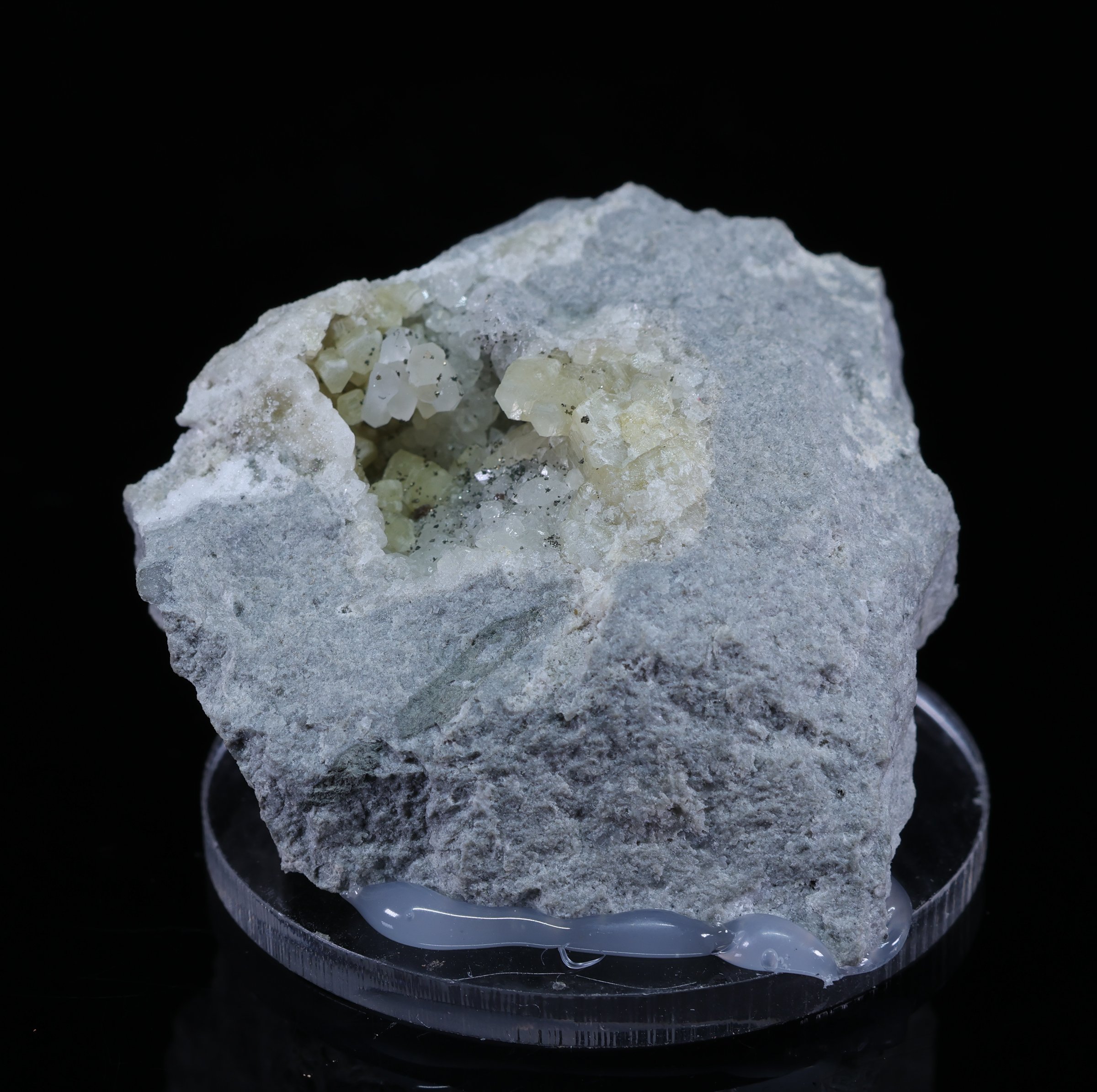
A very rare specimen of weloganite originating from its type locality, the famous Canadian Francon Quarry - the only place in the world that has provided macroscopic crystals of this species. Sharp, pale yellow crystals with a characteristic habit and distinctly striated faces have formed in the central void of the gray, massive matrix. Main Features: extremely rare species; Type Locality; sharp, pseudohexagonal crystals in natural void; ex coll Americo Urbinati Condition: Very Good.
Price: 103 EUR (449 PLN)
Availability: In stock
Location: Francon Quarry, Québec, Canada
Size: 37 x 35 x 27 mm
Weight: 42 g
Chemical formula: Na₂Sr₃Zr(CO₃)₆ · 3H₂O
Mohs hardness: 3.5
Characteristics Weloganite is a hydrated sodium, strontium, and zirconium carbonate. It usually occurs as radial or fibrous aggregates, often forming spherical or hemispherical clusters. Weloganite crystals are typically small, columnar or acicular, although larger, well-formed specimens are less common. The crystal surface may be striated. This mineral often forms incrustations or fissure fillings. Physical Properties Weloganite has a Mohs hardness of 3.5. It exhibits a vitreous to silky luster. It is translucent. The density of weloganite is approximately 3.20 g/cm³. Colors and Varieties Weloganite most commonly occurs in shades of pale yellow, amber-yellow, and also white. The color can be uneven, with lighter or darker zones. No specific varieties of weloganite are distinguished, but its color and aggregate form may vary depending on the locality. History and Name Weloganite was discovered in 1967. The mineral is named after Sir William Edmond Logan, a Canadian geologist and the first director of the Geological Survey of Canada, in recognition of his contributions to geology. Applications Weloganite has no industrial applications. It is a mineral of purely collector's interest due to its rarity and aesthetic appearance.
Identification Weloganite can be identified by its characteristic radial or fibrous aggregates, often spherical in habit, and its pale yellow to amber color. Its moderate hardness (3.5 on the Mohs scale) and vitreous luster are also diagnostic features. Occurrence in association with other carbonate minerals and alkaline rocks can be helpful in identification. Distinguishing from Similar Minerals Weloganite can be confused with some carbonate minerals, such as calcite or aragonite, especially in the case of similar aggregate forms. It differs from calcite by the absence of distinct cleavage and higher density. It differs from aragonite in chemical composition and crystallographic system. Color and specific radial aggregates are often key in distinguishing weloganite from other minerals. Crystal Forms Weloganite most commonly forms radial or fibrous aggregates, often spherical or hemispherical in habit. Crystals are usually columnar or acicular, although larger, well-formed single crystals are rare.
Genesis Weloganite is a secondary mineral, formed under low-temperature hydrothermal conditions. It occurs in cavities and fissures in alkaline igneous rocks, especially carbonatites. Its genesis is associated with hydrothermal processes that lead to the precipitation of carbonates from solutions rich in strontium, sodium, and zirconium. Mineral Associations Weloganite often co-occurs with other carbonate minerals, such as calcite, strontianite, and also with zeolite minerals. It can also be found in association with zirconium minerals and other rare earth element minerals, characteristic of alkaline environments. Localities The most important and well-known locality for weloganite is the Francon Quarry, Montreal, Quebec, Canada. This is also its discovery site and the main source of well-formed specimens.
Quality Criteria The most prized weloganite specimens are those characterized by well-formed, radial aggregates with an intense, uniform pale yellow or amber color. The purity of the mineral, absence of mechanical damage, and presence on a matrix that enhances its aesthetics are also important. Larger aggregates and distinct crystals are more desired by collectors. Popular Localities The Francon Quarry in Montreal, Quebec, Canada, is the most known and valued source of weloganite. Specimens from this locality are sought after for their quality and aesthetics.
See mineralogical reference for Weloganite in the Knowledge Base →