SKU: W_2_0012
The specimen is a miniature showcasing a single, distinctly exposed spherulite of thomsonite with an intense orange coloration. The spherical form exhibits a radiating acicular structure at its base, with visible small, light-colored crystals in the contact zone with the rock. Main Features: single orange spherulite; radiating acicular structure at the base; highly porous basaltic matrix; high color contrast; greenish coatings in the rock vesicles. Condition: Very good.
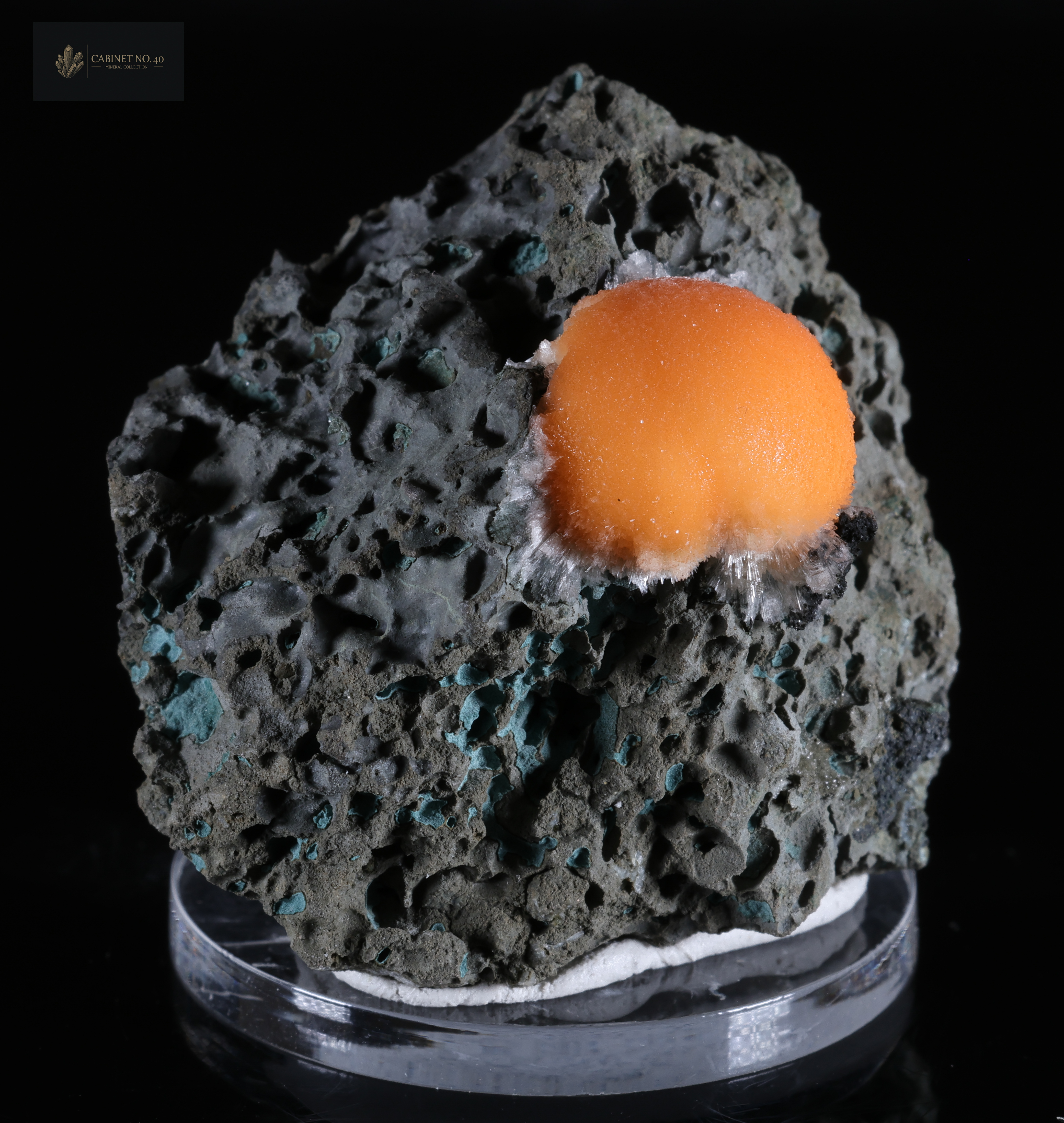
Price: 25 EUR (109 PLN)
Availability: In stock
Location: Maharashtra, India
Size: 37 x 27 x 38 mm
Weight: 27 g
Chemical formula: NaCa₂Al₅Si₅O₂₀·₆H₂O
Crystal system: Orthorhombic
Mohs hardness: 5.0–5.5
Characteristics Thomsonite is a hydrated sodium calcium aluminosilicate, belonging to the zeolite group. It typically occurs as radial, fibrous, or lamellar aggregates, often forming spherical or hemispherical concretions. Crystals are rare, columnar or tabular in habit, and exhibit characteristic twinning. The mineral's surface can be silky or vitreous, and its color can be white, pink, brown, greenish, or colorless. Physical Properties The Mohs hardness of thomsonite is 5-5.5. The mineral exhibits a vitreous to pearly luster on cleavage surfaces. It is transparent to translucent. The specific gravity of thomsonite ranges from 2.3-2.4 g/cm³. Colors and Varieties Thomsonite occurs in various shades, most commonly white, gray, pink, yellowish, greenish, or brown. The color is often associated with the presence of impurities. No specific commercial varieties are distinguished, but intensely colored specimens are more valued. History and Name The mineral was named after Thomas Thomson (1773-1852), a Scottish chemist and mineralogist who first described its chemical composition. The name was given in 1820 by H.J. Brooke. Uses Thomsonite has no significant industrial applications. It is mainly valued by mineral collectors for its aesthetic forms and rarity.
Identification Thomsonite can be identified by its characteristic radial, fibrous, or lamellar aggregates, often forming spherical concretions. Vitreous to pearly luster and a Mohs hardness of 5-5.5 are also helpful in identification. Occurrence in cavities of basalts and other volcanic rocks is typical. Distinguishing from Similar Minerals Thomsonite is sometimes confused with other zeolites, such as stilbite or heulandite, which also form radial aggregates. It is distinguished from stilbite by the absence of characteristic sheaf-like crystals. It differs from heulandite in chemical composition and often a more compact habit. X-ray or chemical analysis is often necessary for unambiguous identification. Crystal Forms Thomsonite crystals are rare, usually columnar or tabular in habit. Twinning is common. However, the most common forms are radial, fibrous, lamellar aggregates, forming spherical or reniform concretions, as well as massive forms.
Genesis Thomsonite forms under low-temperature hydrothermal conditions, most commonly in fractures and cavities of volcanic rocks, such as basalts, andesites, and rhyolites. It is a secondary mineral, forming as a result of the alteration of primary silicate minerals by solutions rich in sodium, calcium, and aluminum. Mineral Associations Thomsonite often co-occurs with other zeolites, such as chabazite, heulandite, stilbite, analcime, natrolite. It can also occur in association with calcite, apophyllite, prehnite, and quartz. Localities Known localities for thomsonite include India (especially in the Deccan region), the Faroe Islands, Iceland, Scotland (Kilpatrick Hills), the United States (Oregon, Colorado, Michigan), Canada (Nova Scotia), and Russia (Kola Peninsula).
Quality Criteria The most prized thomsonite specimens are characterized by well-formed, radial or spherical aggregates with intense and uniform color. Large, complete, and undamaged concretions are particularly sought after. Transparency and luster also contribute to the specimen's attractiveness. The purity of the mineral, absence of cracks and mechanical damage, increases its collector's value. Market Prices The prices of thomsonite vary and depend on the size, quality, and aesthetics of the specimen. Small, typical specimens can cost from several dozen to over a hundred Polish zlotys. Larger, well-formed, and aesthetic specimens, especially those from rare localities, can fetch prices from several hundred to even several thousand Polish zlotys. Popular Localities The most prized thomsonite specimens come from India, especially from the Deccan region, where beautiful pink and white concretions are found. Other popular localities include the Faroe Islands and Iceland, known for well-formed crystals and aggregates.
See mineralogical reference for Thomsonite in the Knowledge Base →