SKU: W_2_0020
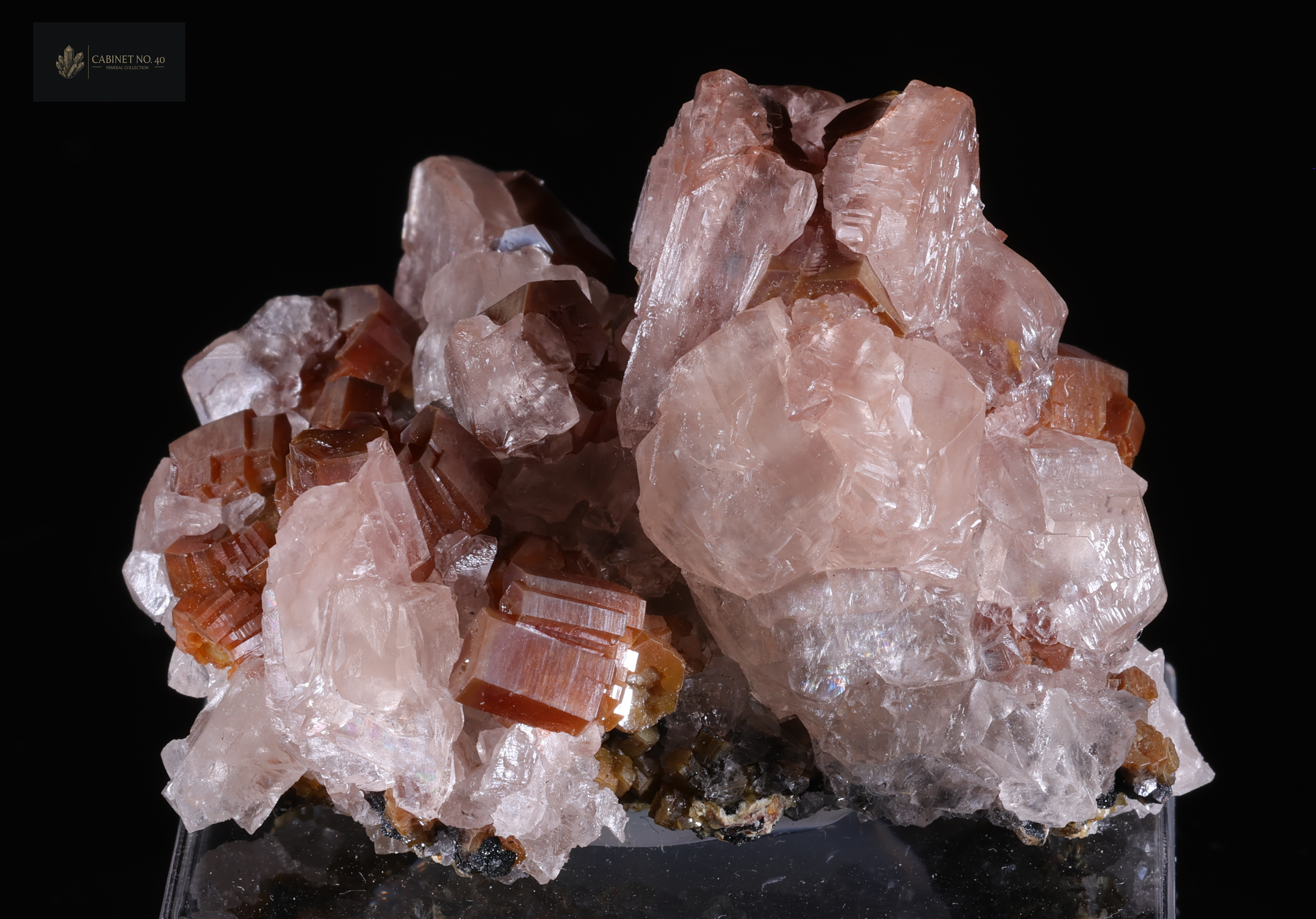
The specimen features a group of large, light pink calcite crystals, upon which red-brown vanadinite crystals are growing. Main Features: red-brown vanadinite; light pink calcite; distinct hexagonal crystals; massive form; a classic from Mexico. Condition: Very good. The calcite and vanadinite crystals are well-preserved, with sharp edges and natural terminations. No visible mechanical damage.
Price: 46 EUR (199 PLN)
Availability: In stock
Location: San Carlos, Chihuahua, Mexico
Size: 40 x 29 x 31 mm
Weight: 54 g
Chemical formula: Pb₅(VO₄)₃Cl
Crystal system: Hexagonal
Mohs hardness: 3.0–4.0
Characteristics Vanadinite is a mineral belonging to the apatite group, characterized by the presence of vanadium. Typical vanadinite specimens form hexagonal crystals, often columnar or tabular in habit, which may be hollow. Crystal surfaces can be smooth and lustrous, and their color ranges from bright red, through orange-red, to brown and yellow. It often forms aggregates on a matrix, creating aesthetic, contrasting compositions. Physical Properties Vanadinite is characterized by a low Mohs hardness of 2.5-3, making it a relatively soft mineral. It has a luster ranging from sub-resinous to sub-adamantine. It is a translucent mineral. Its specific gravity is 6.88, which is a relatively high value, reflecting the presence of lead in its composition. Colors and Varieties Vanadinite occurs in a wide range of colors, most commonly orange-red, red-brown, brown, and bright red shades. Yellow and even whitish specimens can also be found. In transmitted light, it can be colorless or weakly colored. The intensity of the color often depends on impurities and formation conditions. History and Name Vanadinite was discovered in 1838. The mineral's name comes from the element vanadium, which is a key component of its chemical composition. Its discovery contributed to a better understanding of vanadium-containing minerals. Uses Vanadinite is primarily a collector's mineral, valued for its aesthetic crystals and intense colors. Due to its vanadium content, it can serve as an ore of this element, but its rarity means it is not a primary source of vanadium in industry.
Identification Vanadinite can be identified by its characteristic hexagonal crystals, often columnar or tabular in habit, and intense colors ranging from red to orange and brown. Low hardness (2.5-3 on the Mohs scale) and high density (6.88) are also diagnostic features. A luster ranging from sub-resinous to sub-adamantine is another clue. Distinguishing from Similar Minerals Vanadinite is sometimes confused with mimetite and pyromorphite, which also belong to the apatite group and can form similar crystal habits. Key differences lie in their chemical composition (vanadinite contains vanadium, mimetite arsenic, and pyromorphite phosphorus) and often in color shades and density. Mimetite and pyromorphite usually have slightly different shades of yellow and green, although red varieties also exist. Precise identification requires chemical analysis. Crystal Forms Vanadinite most commonly occurs as hexagonal prisms, often with distinct prismatic and pinacoidal faces. Crystals can be short-prismatic, long-prismatic, or tabular, and can also form radial aggregates, crusts, and coatings. Hollow crystals are often observed.
Genesis Vanadinite is a secondary mineral, formed in the oxidation zones of lead deposits, where lead minerals react with vanadium-containing solutions. Typical environments for its formation are arid and semi-arid climates, which favor oxidation and element concentration. Mineral Associations Vanadinite often co-occurs with other secondary minerals of the oxidation zone, such as cerussite, anglesite, goethite, limonite, barite, calcite, and other vanadate minerals. Localities The most famous and prized vanadinite localities are in Mibladen, Morocco, where large, intensely red crystals are found. Other important localities include Arizona in the USA (e.g., Apache Mine, Old Yuma Mine), Mexico (e.g., Los Lamentos Mine), Namibia (Tsumeb), and Russia (Berezovskoye).
Quality Criteria The most prized vanadinite specimens are those with well-formed, large, hexagonal crystals of intense, uniform color (especially bright red or orange). Crystal transparency and their arrangement on an aesthetic matrix are also important. Specimens free of mechanical damage and impurities are more valuable. Popular Localities The most sought-after vanadinite specimens come from Morocco, especially from the Mibladen region, where crystals of exceptional color and size are mined. Specimens from Arizona in the USA and Mexico are also highly valued.
See mineralogical reference for Vanadinite in the Knowledge Base →