Vanadinite
Chemical formula: Pb<sup>2+</sup><sub>5</sub>(V<sup>5+</sup>O<sub>4</sub>)<sub>3</sub>Cl
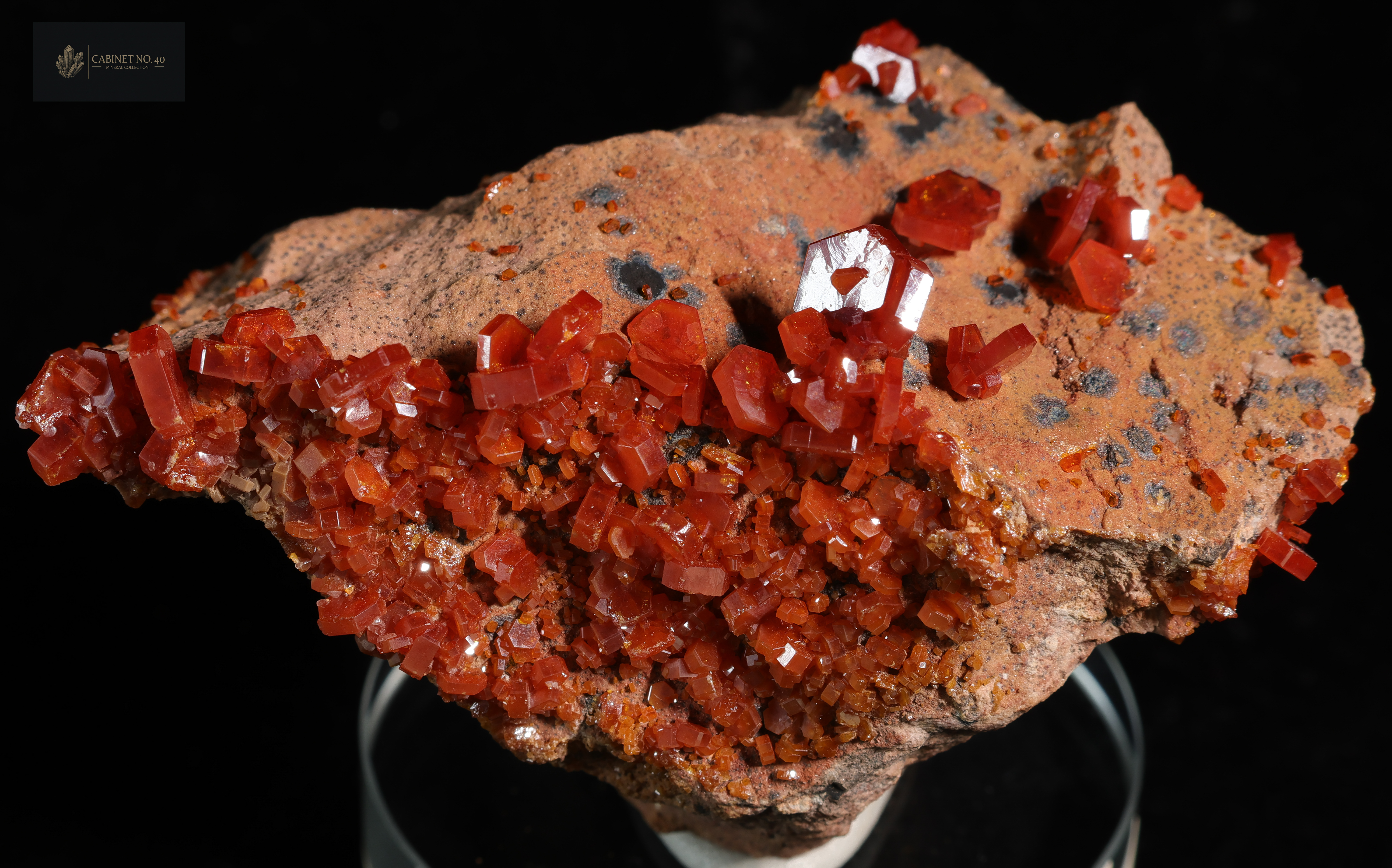
Vanadinite is a rare lead chlorovanadate mineral, known for its intensely red, orange, or brown hexagonal crystals.
Properties
- Mohs hardness
- 2.5-3
- Luster
- Sub-resinous to sub-adamantine
- Streak
- White to pale yellow and light brownish yellow
- Density
- 6.88
- Cleavage
- Brak
- Fracture
- Nierówny do muszlowego
- Transparency
- Translucent
- Crystal system
- Hexagonal
Diagnostic features
## Identification Vanadinite can be identified by its characteristic hexagonal crystals, often columnar or tabular in habit, and intense colors ranging from red to orange and brown. Low hardness (2.5-3 on the Mohs scale) and high density (6.88) are also diagnostic features. A luster ranging from sub-resinous to sub-adamantine is another clue. ## Distinguishing from Similar Minerals Vanadinite is sometimes confused with mimetite and pyromorphite, which also belong to the apatite group and can form similar crystal habits. Key differences lie in their chemical composition (vanadinite contains vanadium, mimetite arsenic, and pyromorphite phosphorus) and often in color shades and density. Mimetite and pyromorphite usually have slightly different shades of yellow and green, although red varieties also exist. Precise identification requires chemical analysis. ## Crystal Forms Vanadinite most commonly occurs as hexagonal prisms, often with distinct prismatic and pinacoidal faces. Crystals can be short-prismatic, long-prismatic, or tabular, and can also form radial aggregates, crusts, and coatings. Hollow crystals are often observed.
Geological environment
## Genesis Vanadinite is a secondary mineral, formed in the oxidation zones of lead deposits, where lead minerals react with vanadium-containing solutions. Typical environments for its formation are arid and semi-arid climates, which favor oxidation and element concentration. ## Mineral Associations Vanadinite often co-occurs with other secondary minerals of the oxidation zone, such as cerussite, anglesite, goethite, limonite, barite, calcite, and other vanadate minerals. ## Localities The most famous and prized vanadinite localities are in Mibladen, Morocco, where large, intensely red crystals are found. Other important localities include Arizona in the USA (e.g., Apache Mine, Old Yuma Mine), Mexico (e.g., Los Lamentos Mine), Namibia (Tsumeb), and Russia (Berezovskoye).
Rarity
Common
For collectors
## Quality Criteria The most prized vanadinite specimens are those with well-formed, large, hexagonal crystals of intense, uniform color (especially bright red or orange). Crystal transparency and their arrangement on an aesthetic matrix are also important. Specimens free of mechanical damage and impurities are more valuable. ## Popular Localities The most sought-after vanadinite specimens come from Morocco, especially from the Mibladen region, where crystals of exceptional color and size are mined. Specimens from Arizona in the USA and Mexico are also highly valued.
Care and storage
## Cleaning Vanadinite is a relatively soft mineral, so it requires gentle cleaning. It is best to use a soft brush or brush to remove dust. For heavier soiling, the specimen can be gently rinsed with distilled water, avoiding prolonged soaking. ## What to Avoid Avoid using any chemicals, acids, or detergents, which can damage the mineral's surface. Vanadinite is sensitive to high temperatures and direct sunlight, which can cause colors to fade. Due to its lead content, caution should be exercised, contact with the mouth should be avoided, and hands should be washed after handling the specimen. ## Storage Vanadinite specimens are best stored in enclosed display cases, away from direct sunlight and heat sources. Maintaining stable temperature and humidity is advisable. A soft lining in the display case will help protect the crystals from mechanical damage.