SKU: S_00154
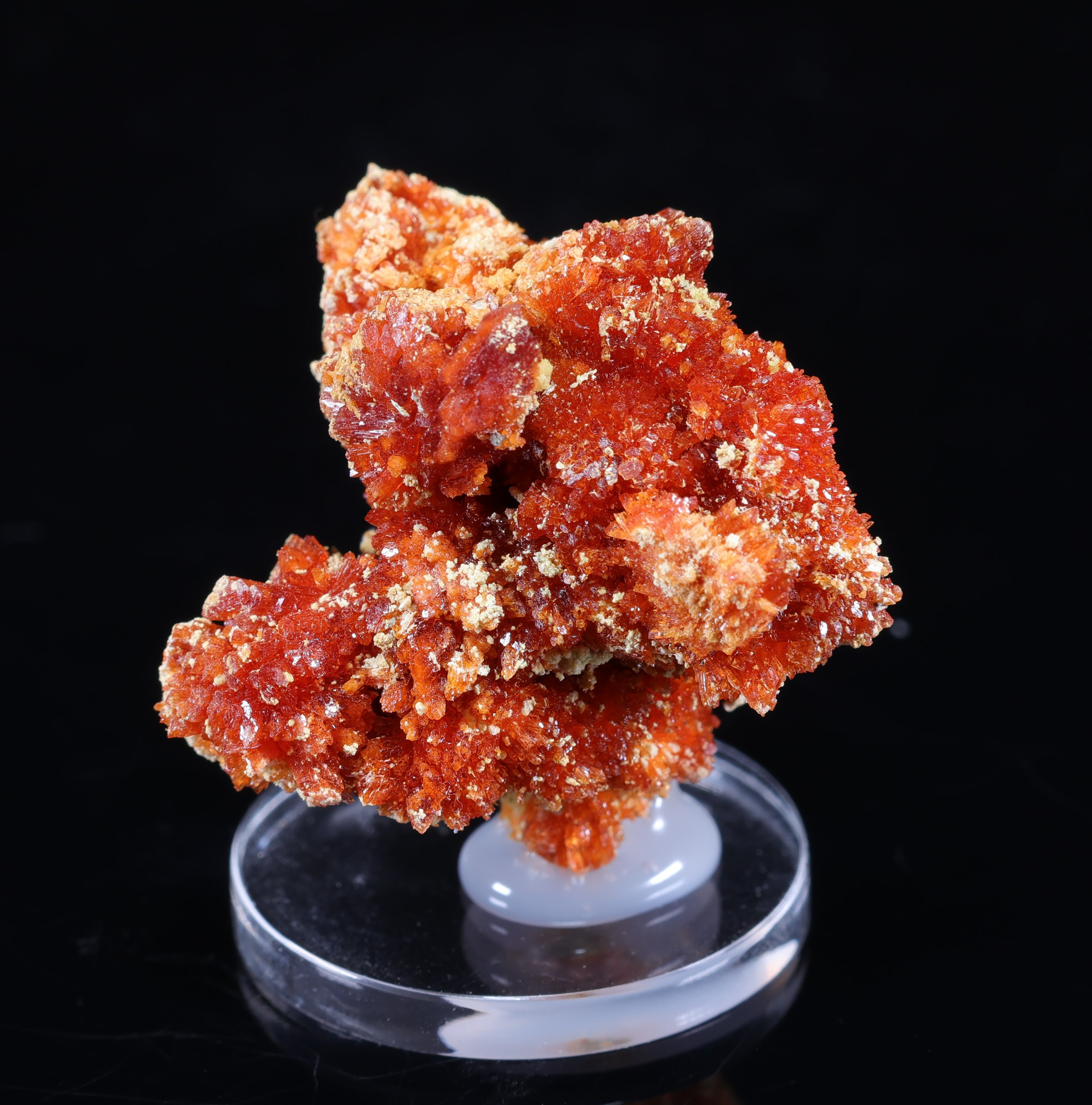
A spatial and extremely colorful specimen of rare sulfates from the classic Spanish location of Rio Tinto. The main mass of the specimen consists of intensely orange-red, glassy crystals of botryogen, which form dense, aggregate, and radiating clusters. On their surface and in natural depressions, contrasting, sulfur-yellow, powdery coatings of copiapite are embedded. Main Features: intense orange-red color of botryogen; contrasting powdery copiapite; historical and classic location. Condition: Very Good.
Price: 37 EUR (159 PLN)
Availability: In stock
Location: Floor 33, Alfredo Pit, Rio Tinto Mines, Huelva, Andalusia, Spain
Size: 25 x 25 x 20 mm
Weight: 8 g
Chemical formula: MgFe³⁺(SO₄)₂(OH)·7H₂O
Mohs hardness: 2-2.5
Characteristics Botryogen is a secondary sulfate mineral, known for forming spectacular aggregates. Its name, derived from Greek, means "grape-born," which perfectly describes its most common form of occurrence – spherical or reniform clusters with a radial-fibrous structure. Individual crystals are usually very small, prismatic, and elongated, densely packed into forms resembling bunches of grapes. Less commonly, it occurs as coatings or efflorescences. Physical Properties It is a relatively soft mineral, with a Mohs hardness of 2-2.5, making it brittle and susceptible to scratching. It has a vitreous luster, which can transition to pearly on fracture surfaces or crystal faces. Its density is low, around 2.14 g/cm³. One of its key properties is its partial solubility in water. Colors and Varieties Botryogen is distinguished by a vibrant and characteristic color palette. Shades from orange-yellow, through intense orange, to deep hyacinth-red are most commonly found. Color is one of its main visual attributes. There are no distinct commercial or gemological varieties. History and Name The mineral's name was given in 1815 by Jöns Jacob Berzelius. It comes from the Greek words βότρυς (botrys) meaning "bunch of grapes" and γεννάω (gennao) - "to bear," which is a direct reference to its typical, botryoidal appearance. The type locality is the Falun mine, in the Dalarna region of Sweden. Uses Due to its brittleness, softness, and solubility in water, botryogen has no industrial applications. However, it is a valued and sought-after collector's mineral. Chemical Formula MgFe(SO₄)₂·7H₂O
Identification The most important diagnostic features of botryogen are its unique form – botryoidal or reniform aggregates – and its intense, orange-red color. Its occurrence in the environment of oxidized sulfide deposits in association with other secondary sulfates is a strong indicator. The water solubility test is a confirming feature but is destructive. Distinguishing from Similar Minerals Botryogen is sometimes confused with other colorful, secondary iron sulfates, such as butlerite or parabutlerite. Differentiation often requires chemical or crystallographic analysis. However, the characteristic, distinctly botryoidal habit of botryogen is usually sufficient for preliminary visual identification. Crystal Forms It forms very small, prismatic crystals, which almost always occur in the form of complex aggregates. The most typical are botryoidal, reniform, and radial-fibrous clusters. Sometimes it also forms crusts and efflorescences.
Genesis Botryogen is a secondary mineral, forming in the oxidation zones (gossans) of sulfide ore deposits, especially pyrite. Its formation requires dry or semi-arid climatic conditions, which favor evaporation and concentration of sulfate solutions. It forms as a result of chemical weathering of iron minerals in the presence of magnesium ions. Mineral Associations It often co-occurs with other secondary sulfates that form under similar conditions. The most common associated minerals include copiapite, epsomite, coquimbite, voltaite, melanterite, alunogen, and gypsum. Localities Significant deposits and occurrences, from which good quality specimens originate, are found in several places around the world. Classic localities include the Falun mine (Sweden) - the type locality, and the Rammelsberg mine in the Harz Mountains (Germany). Currently, beautiful, brightly colored specimens come from the Atacama Desert in Chile (e.g., around Calama, Chuquicamata mine) and from the Dexter No. 7 mine in Utah (USA).
Quality Criteria The most highly valued botryogen specimens are characterized by an intense, uniform orange-red color and well-formed, undamaged botryoidal forms. Contrast with a light matrix rock enhances attractiveness. Large surfaces covered with lustrous, spherical aggregates are particularly sought after by collectors. The purity of the specimen, i.e., the absence of undesirable coatings of other minerals, also affects its value. Popular Localities Specimens from the Atacama Desert in Chile are currently considered the most desirable on the collector's market, distinguished by their exceptionally vivid color and excellent form. Historical specimens from European localities, such as Falun (Sweden) or Rammelsberg (Germany), have great scientific and historical significance.
See mineralogical reference for Botryogen in the Knowledge Base →