Botryogen
Chemical formula: MgFe<sup>3+</sup>(S<sup>6+</sup>O<sub>4</sub>)<sub>2</sub>(OH)·7H<sub>2</sub>O
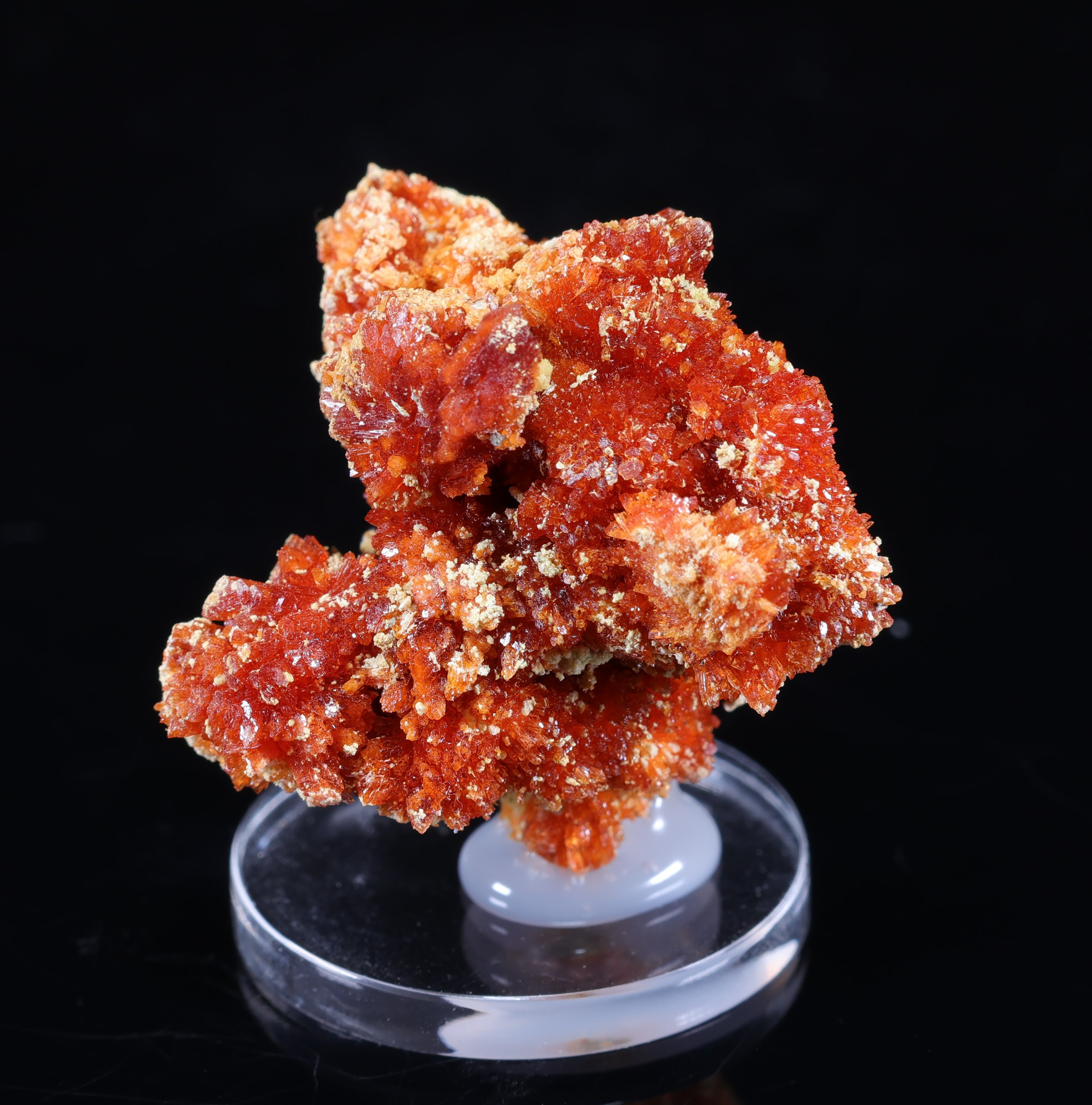
Botryogen is a hydrated magnesium and iron sulfate, forming characteristic, botryoidal aggregates of an intense orange-red color.
Properties
- Mohs hardness
- 2-2.5
- Color
- Light to dark orange-red; pale to dark orange
- Luster
- Vitreous
- Streak
- Ocher-yellow
- Density
- 2.14
- Cleavage
- On {010}, perfect; on {110}, good.
- Fracture
- Irregular/Uneven,Conchoidal
- Transparency
- Transparent,Translucent
- Crystal system
- Monoclinic
Diagnostic features
## Identification The most important diagnostic features of botryogen are its unique form – botryoidal or reniform aggregates – and its intense, orange-red color. Its occurrence in the environment of oxidized sulfide deposits in association with other secondary sulfates is a strong indicator. The water solubility test is a confirming feature but is destructive. ## Distinguishing from Similar Minerals Botryogen is sometimes confused with other colorful, secondary iron sulfates, such as butlerite or parabutlerite. Differentiation often requires chemical or crystallographic analysis. However, the characteristic, distinctly botryoidal habit of botryogen is usually sufficient for preliminary visual identification. ## Crystal Forms It forms very small, prismatic crystals, which almost always occur in the form of complex aggregates. The most typical are botryoidal, reniform, and radial-fibrous clusters. Sometimes it also forms crusts and efflorescences.
Geological environment
## Genesis Botryogen is a secondary mineral, forming in the oxidation zones (gossans) of sulfide ore deposits, especially pyrite. Its formation requires dry or semi-arid climatic conditions, which favor evaporation and concentration of sulfate solutions. It forms as a result of chemical weathering of iron minerals in the presence of magnesium ions. ## Mineral Associations It often co-occurs with other secondary sulfates that form under similar conditions. The most common associated minerals include copiapite, epsomite, coquimbite, voltaite, melanterite, alunogen, and gypsum. ## Localities Significant deposits and occurrences, from which good quality specimens originate, are found in several places around the world. Classic localities include the Falun mine (Sweden) - the type locality, and the Rammelsberg mine in the Harz Mountains (Germany). Currently, beautiful, brightly colored specimens come from the Atacama Desert in Chile (e.g., around Calama, Chuquicamata mine) and from the Dexter No. 7 mine in Utah (USA).
Rarity
Not very common
For collectors
## Quality Criteria The most highly valued botryogen specimens are characterized by an intense, uniform orange-red color and well-formed, undamaged botryoidal forms. Contrast with a light matrix rock enhances attractiveness. Large surfaces covered with lustrous, spherical aggregates are particularly sought after by collectors. The purity of the specimen, i.e., the absence of undesirable coatings of other minerals, also affects its value. ## Popular Localities Specimens from the Atacama Desert in Chile are currently considered the most desirable on the collector's market, distinguished by their exceptionally vivid color and excellent form. Historical specimens from European localities, such as Falun (Sweden) or Rammelsberg (Germany), have great scientific and historical significance.
Care and storage
## Cleaning Botryogen is partially soluble in water, so wet cleaning should be absolutely avoided. For removing dust and loose contaminants, it is best to use a soft brush or low-pressure compressed air. ## What to Avoid The greatest threat to botryogen specimens is water and high humidity, which can lead to its dissolution or chemical degradation. It should be protected from contact with all chemicals. Due to its low hardness, it is very susceptible to mechanical damage and scratching. ## Storage Botryogen specimens require storage in a dry environment. It is recommended to keep them in sealed containers or display cases, preferably with a desiccant (e.g., silica gel). Protect from dust and direct contact with harder minerals.