SKU: S-0218_5-RU
A classic and extremely colorful specimen from the Caucasian Elbrus Mine. The central part of the specimen features a distinct cavity, in which sharp, platy crystals of auripigment have formed, exhibiting an intense, deep orange color and a glassy-resinous luster. Main Features: intense orange color of the main crystals; bright yellow, fine-crystalline coatings; platy crystal habit in the central cavity; contrasting light matrix; resinous-glassy luster. Condition: Good.
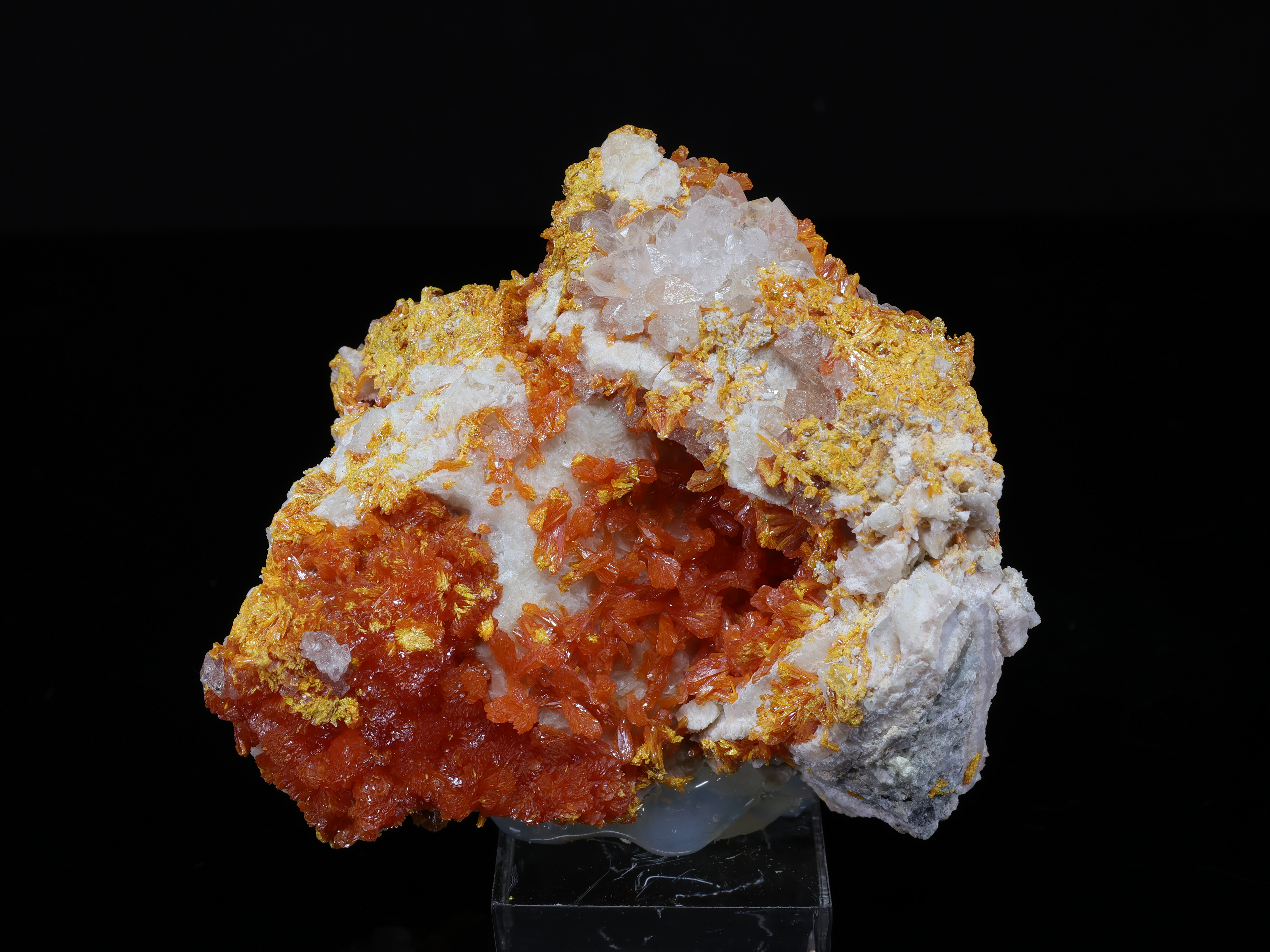
Price: 103 EUR (449 PLN)
Availability: In stock
Location: Kabardino-Balkaria, Caucasus, Elbrus Mine, Russia
Size: 68 x 44 x 56 mm
Weight: 150 g
Chemical formula: As₂S₃
Crystal system: Monoclinic
Mohs hardness: 1,5–2
Mineral group: Sulfur Group
Rarity: Very Rare
Characteristics Orpiment is an arsenic sulfide mineral with the chemical formula As₂S₃. It usually occurs as massive, lamellar, or radial aggregates, less frequently forming well-developed crystals. Its color ranges from lemon-yellow to orange-yellow, making it easily recognizable. Fresh fracture surfaces exhibit a strong, pearly luster, which can dull over time due to light exposure. Physical Properties This mineral is characterized by a low Mohs hardness of 1.5-2, meaning it is very soft and can be scratched with a fingernail. The density of orpiment is approximately 3.49 g/cm³. It possesses perfect cleavage in one direction, which manifests as easy delamination into thin sheets. Orpiment's luster is pearly on cleavage surfaces and adamantine on fractures. The streak of the mineral is light yellow. Colors and Varieties Orpiment occurs in shades of yellow, from lemon-yellow to orange-yellow. This color is characteristic of the mineral, and there are no significant color varieties, apart from minor differences in shade intensity. History and Name The name "orpiment" comes from the Latin words "aurum" (gold) and "pigmentum" (pigment), referring to its golden color and use as a pigment. This mineral was known and used in antiquity, both as a dye and in medicine, despite its toxicity. Applications Historically, orpiment was used as a yellow pigment in painting, known as "king's yellow." Due to its arsenic content and toxicity, modern applications are limited and primarily concern collecting purposes and as an arsenic ore.
Identification Orpiment can be identified by its characteristic yellow-orange color, pearly luster on cleavage surfaces, and low hardness. It often occurs in lamellar or radial aggregates. The streak of the mineral is light yellow. Distinguishing from Similar Minerals Orpiment is sometimes confused with realgar, another arsenic sulfide, which has a red-orange color. It is distinguished from realgar by its lighter, more yellow color and streak. It can also be confused with sulfur, but sulfur has a lower density and a different crystallographic system. Crystal Forms Orpiment forms monoclinic crystals, usually columnar or tabular, but these are rare. More often, it occurs as massive, lamellar, radial, or reniform aggregates. Lamellar aggregates are often flexible.
Genesis Orpiment forms in low-temperature, hydrothermal veins, often in association with realgar. It also occurs as a sublimation product near volcanic vents and fumaroles, as well as in hot spring deposits. It forms in arsenic- and sulfur-rich environments under reducing conditions. Mineral Associations Orpiment often co-occurs with realgar, stibnite, sulfur, gypsum, barite, and calcite. It can also occur in paragenesis with other arsenic minerals. Localities Significant deposits of orpiment are found in China (especially Hunan province), Peru (Huancavelica), the United States (Nevada, Utah), Russia (Caucasus), and Turkey. Historical occurrences also include Romania and Macedonia.
Quality Criteria The most prized orpiment specimens are those with an intense, uniform color, strong pearly luster, and well-formed, large crystals, although these are rare. The purity of the specimen, absence of mechanical damage, and aesthetic appeal of the aggregate are also important factors influencing its collectible value. Specimens with distinct lamellar or radial aggregates are sought after. Popular Localities The most prized orpiment specimens come from China, especially from the Shimen mine in Hunan province, where large and aesthetic aggregates are found. Other important localities include Peru and the United States.
See mineralogical reference for Orpiment in the Knowledge Base →