Orpiment
Chemical formula: As<sup>3+</sup><sub>2</sub>S<sup>2-</sup><sub>3</sub>
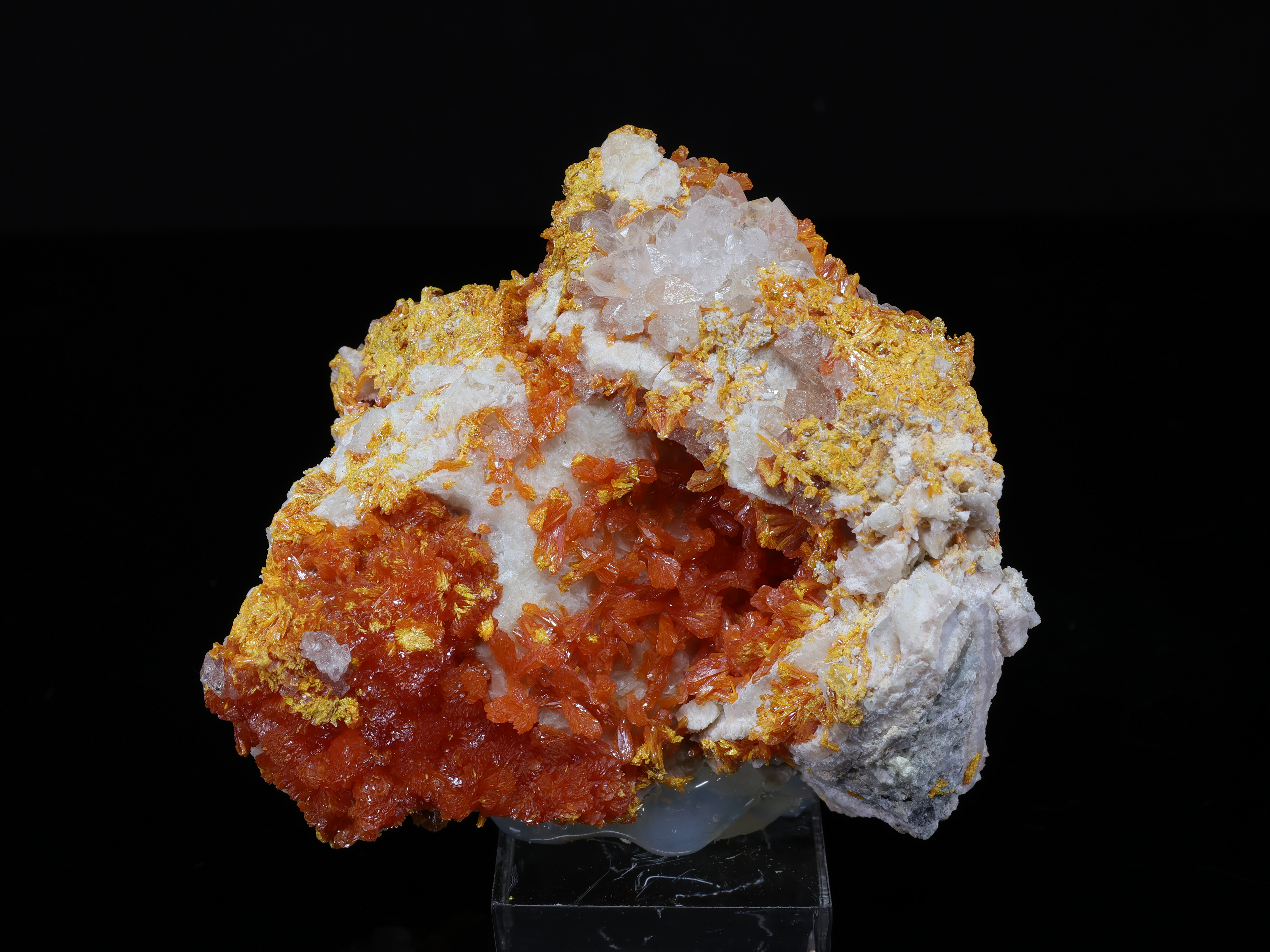
Orpiment is a sulfide mineral characterized by an intense yellow-orange color and pearly luster, often forming aggregates with a lamellar or radial structure.
Properties
- Mohs hardness
- 1.5-2
- Luster
- Pearly and adamantine splendent
- Streak
- Light lemon yellow
- Density
- 3.49
- Cleavage
- Perfect {010} imperfect {100}
- Fracture
- Nierówny
- Transparency
- Transparent
- Crystal system
- Monoclinic
Diagnostic features
## Identification Orpiment can be identified by its characteristic yellow-orange color, pearly luster on cleavage surfaces, and low hardness. It often occurs in lamellar or radial aggregates. The streak of the mineral is light yellow. ## Distinguishing from Similar Minerals Orpiment is sometimes confused with realgar, another arsenic sulfide, which has a red-orange color. It is distinguished from realgar by its lighter, more yellow color and streak. It can also be confused with sulfur, but sulfur has a lower density and a different crystallographic system. ## Crystal Forms Orpiment forms monoclinic crystals, usually columnar or tabular, but these are rare. More often, it occurs as massive, lamellar, radial, or reniform aggregates. Lamellar aggregates are often flexible.
Geological environment
## Genesis Orpiment forms in low-temperature, hydrothermal veins, often in association with realgar. It also occurs as a sublimation product near volcanic vents and fumaroles, as well as in hot spring deposits. It forms in arsenic- and sulfur-rich environments under reducing conditions. ## Mineral Associations Orpiment often co-occurs with realgar, stibnite, sulfur, gypsum, barite, and calcite. It can also occur in paragenesis with other arsenic minerals. ## Localities Significant deposits of orpiment are found in China (especially Hunan province), Peru (Huancavelica), the United States (Nevada, Utah), Russia (Caucasus), and Turkey. Historical occurrences also include Romania and Macedonia.
Rarity
Common
For collectors
## Quality Criteria The most prized orpiment specimens are those with an intense, uniform color, strong pearly luster, and well-formed, large crystals, although these are rare. The purity of the specimen, absence of mechanical damage, and aesthetic appeal of the aggregate are also important factors influencing its collectible value. Specimens with distinct lamellar or radial aggregates are sought after. ## Popular Localities The most prized orpiment specimens come from China, especially from the Shimen mine in Hunan province, where large and aesthetic aggregates are found. Other important localities include Peru and the United States.
Care and storage
## Cleaning Orpiment is a soft and brittle mineral, thus requiring gentle cleaning. It is best to use a soft brush or paintbrush to remove dust. For heavier soiling, lukewarm distilled water can be used, avoiding prolonged soaking. ## What to Avoid Avoid using any chemical cleaning agents, which can damage the mineral's surface or alter its color. Orpiment is sensitive to sunlight, which can cause fading and dulling. It is also sensitive to high temperatures. Due to its arsenic content, caution should be exercised, and inhalation of dust and direct skin contact should be avoided. ## Storage Orpiment specimens are best stored in closed display cases or containers, away from direct sunlight and heat sources. It is advisable to place them in an area with stable temperature and humidity. Due to its toxicity, it should be stored out of reach of children and pets.