SKU: P_26-6_54
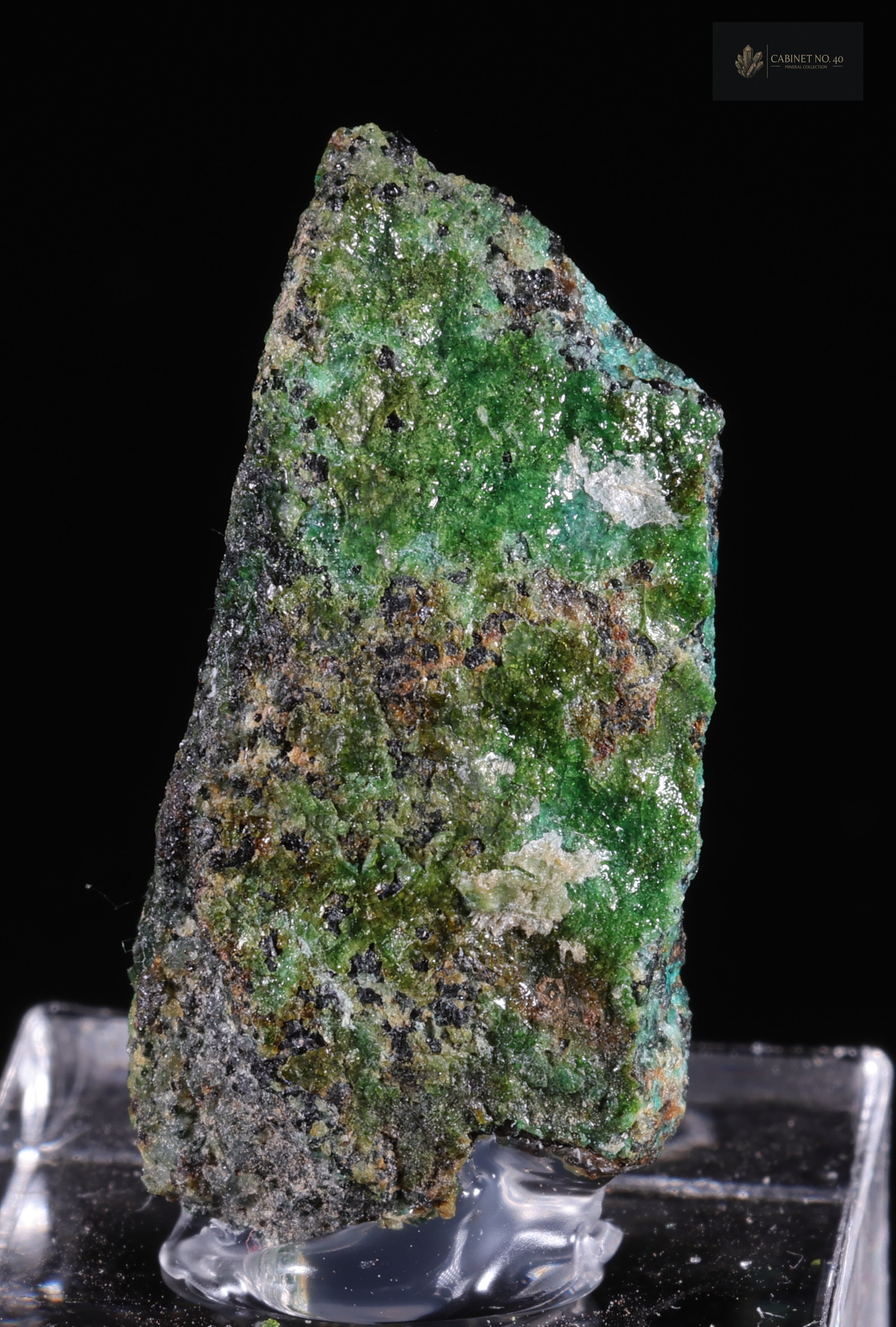
A true rarity for collectors of rare and systematic minerals. The specimen comes from the unique Bon Accord deposit, which is world-renowned. The main mass consists of black, metallic trevoryte, on which intensely green, almost vivid clusters of nepouite occur. The color contrast is exceptionally strong, making this small specimen very attractive due to such a rare paragenesis. Main Features: extreme rarity (Bon Accord is a legendary location); strong color contrast; high specimen density; scientific and historical significance. Condition: Very good - the specimen is compact and stable.
Price: 27 EUR (119 PLN)
Availability: In stock
Location: Bon Accord Ni deposit, Barberton, Mbombela Local Municipality, Ehlanzeni District Municipality, Mpumalanga, South Africa
Size: 13 x 10 x 24 mm
Weight: 7 g
Chemical formula: (Ba,Ca,Na)₂(Nb,Ta)₂O₆(O,OH,F)
Crystal system: Regularny
Mohs hardness: 5-5.5
Characteristics Trevorite is a rare mineral belonging to the spinel group. It usually occurs as small, isometric crystals, often forming granular aggregates or inclusions in other minerals. Its color is black, sometimes with a subtle green or brown tint, which is characteristic of this mineral. Physical Properties Trevorite has a hardness of 5 on the Mohs scale. It has a specific gravity of 5.164. It is an opaque mineral, and its streak is light brown. Colors and Varieties The typical color of trevorite is black, often with a greenish or brownish hue. There are no significant color or commercial varieties. History and Name Trevorite was discovered in 1921. The mineral's name comes from its discovery location – the Trepca mine in Kosovo, which is a well-known metal ore deposit. Applications Due to its rarity and small size of occurrence, trevorite has no industrial applications. However, it is of interest to mineral collectors, especially those specializing in rare oxides and spinels.
Identification Trevorite can be identified by its black color, often with a green or brown tint, and by the isometric habit of its crystals, if well-formed. Its light brown streak is also an important diagnostic feature. Occurrence in association with nickel and iron minerals may also indicate the presence of trevorite. Distinguishing from Similar Minerals Trevorite can be confused with other black minerals from the spinel group, such as magnetite or franklinite. It differs from magnetite by the absence of strong magnetic properties and the presence of nickel in its chemical composition. The light brown streak is also helpful in distinguishing it from other black oxides with a black streak. Chemical analysis is often necessary for unambiguous identification. Crystal Forms Trevorite typically forms small, isometric crystals, often with an octahedral or dodecahedral habit. It also frequently occurs as granular aggregates or inclusions in other minerals.
Genesis Trevorite forms in hydrothermal environments, often in nickel and iron ore deposits. It is a secondary mineral, forming as a result of metamorphic or metasomatic processes, where nickel-rich solutions interact with existing iron-bearing rocks. Mineral Associations Trevorite often co-occurs with other nickel and iron minerals, such as magnetite, hematite, goethite, as well as various silicates and carbonates, which are typical of hydrothermal environments and metal ore deposits. Localities The most important and historical locality for trevorite is the Trepca mine in Kosovo, where it was first discovered. Other occurrences include nickel deposits in New Caledonia and in some regions of Russia and Canada, although these are usually rare and small finds.
Quality Criteria The most prized trevorite specimens are those that exhibit well-formed, distinct crystals, even if small. The purity of the mineral, the intensity of its color, and the absence of mechanical damage also influence its collector's value. Specimens with clearly visible inclusions in other minerals can also be attractive. Popular Localities The most sought-after trevorite specimens come from its type locality – the Trepca mine in Kosovo, due to its historical significance and often better crystallization.
See mineralogical reference for Trevorite in the Knowledge Base →