Trevorite
Chemical formula: Ni<sup>2+</sup>Fe<sup>3+</sup><sub>2</sub>O<sub>4</sub>
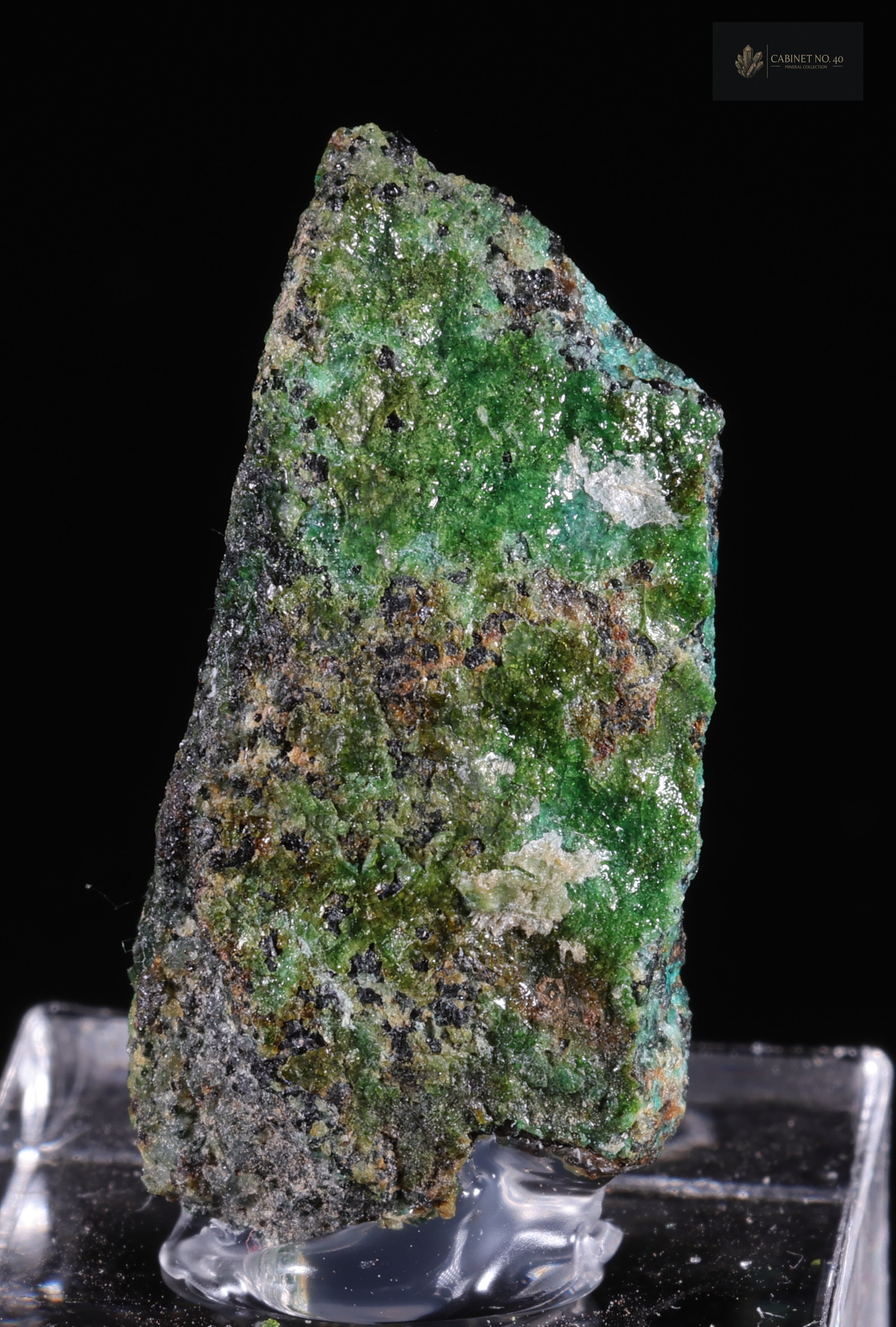
Trevorite is a rare mineral from the spinel group, an oxide of nickel and iron, characterized by a black color with a green or brown tint.
Properties
- Mohs hardness
- 5
- Luster
- Metaliczny
- Streak
- Light brown
- Density
- 5.164
- Cleavage
- Brak
- Fracture
- Nierówny
- Transparency
- Opaque
- Crystal system
- Isometric
Diagnostic features
## Identification Trevorite can be identified by its black color, often with a green or brown tint, and by the isometric habit of its crystals, if well-formed. Its light brown streak is also an important diagnostic feature. Occurrence in association with nickel and iron minerals may also indicate the presence of trevorite. ## Distinguishing from Similar Minerals Trevorite can be confused with other black minerals from the spinel group, such as magnetite or franklinite. It differs from magnetite by the absence of strong magnetic properties and the presence of nickel in its chemical composition. The light brown streak is also helpful in distinguishing it from other black oxides with a black streak. Chemical analysis is often necessary for unambiguous identification. ## Crystal Forms Trevorite typically forms small, isometric crystals, often with an octahedral or dodecahedral habit. It also frequently occurs as granular aggregates or inclusions in other minerals.
Geological environment
## Genesis Trevorite forms in hydrothermal environments, often in nickel and iron ore deposits. It is a secondary mineral, forming as a result of metamorphic or metasomatic processes, where nickel-rich solutions interact with existing iron-bearing rocks. ## Mineral Associations Trevorite often co-occurs with other nickel and iron minerals, such as magnetite, hematite, goethite, as well as various silicates and carbonates, which are typical of hydrothermal environments and metal ore deposits. ## Localities The most important and historical locality for trevorite is the Trepca mine in Kosovo, where it was first discovered. Other occurrences include nickel deposits in New Caledonia and in some regions of Russia and Canada, although these are usually rare and small finds.
Rarity
Rare
For collectors
## Quality Criteria The most prized trevorite specimens are those that exhibit well-formed, distinct crystals, even if small. The purity of the mineral, the intensity of its color, and the absence of mechanical damage also influence its collector's value. Specimens with clearly visible inclusions in other minerals can also be attractive. ## Popular Localities The most sought-after trevorite specimens come from its type locality – the Trepca mine in Kosovo, due to its historical significance and often better crystallization.
Care and storage
## Cleaning Trevorite specimens can be cleaned with a soft brush and lukewarm water. For heavier soiling, a mild soap solution can be used, followed by thorough rinsing with clean water. After washing, the specimen should be dried, preferably with a soft cloth or left to air dry. ## What to Avoid Avoid using strong acids and bases, which can damage the mineral's surface. Trevorite is stable under typical conditions, but prolonged exposure to intense sunlight or extreme temperature changes is not recommended, although it should not significantly affect its appearance. It is also important to avoid mechanical damage, such as impacts or scratches. ## Storage Trevorite is best stored in closed display cases or boxes, protecting it from dust and potential mechanical damage. Due to its hardness, it can be stored with minerals of similar or lower hardness to avoid mutual scratching. It is important that specimens are stably arranged to prevent their movement and damage.