SKU: P_26-6_09
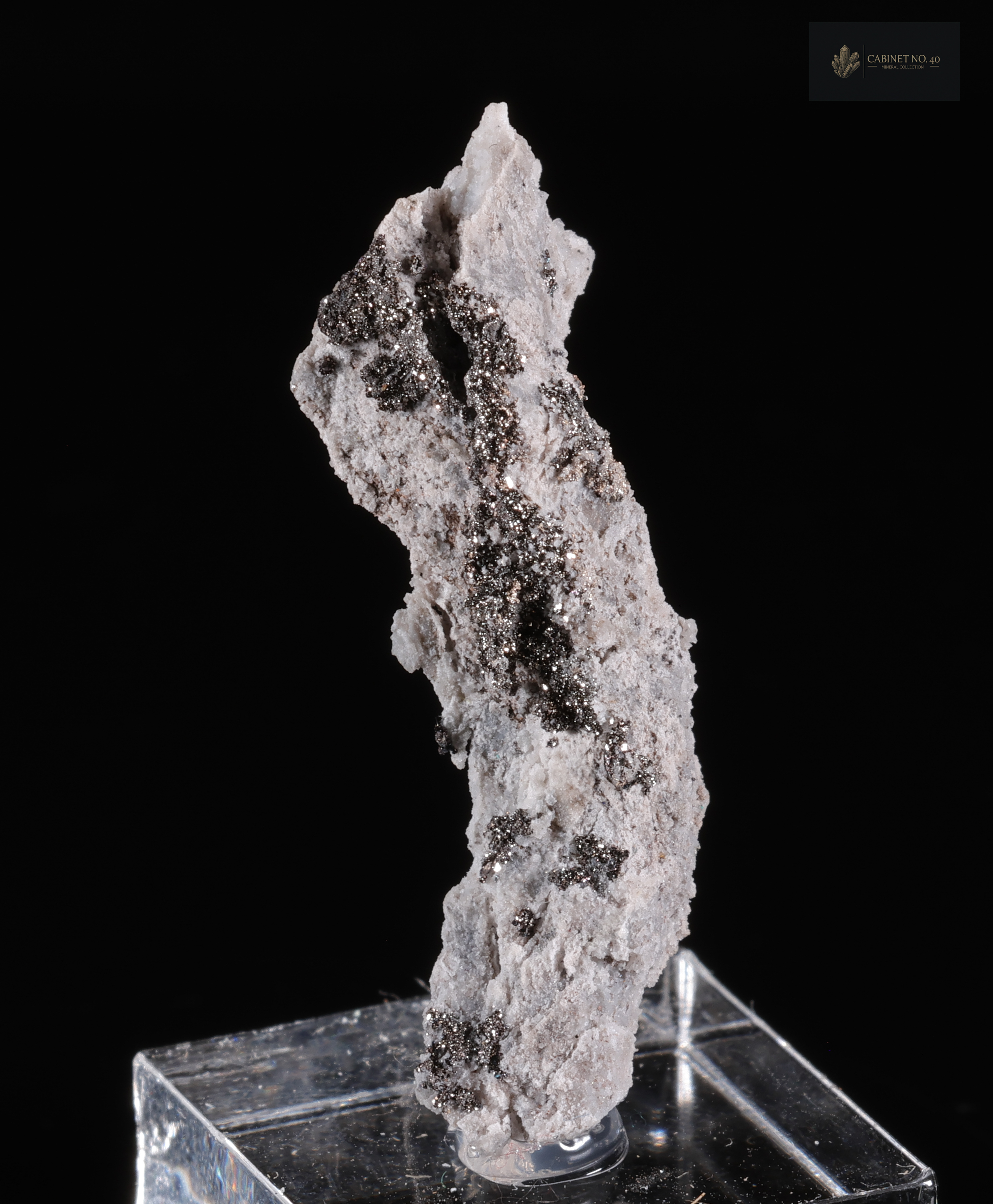
An interesting specimen showcasing clusters of silver set on a light, elongated matrix. This mineral forms fine-grained, dark gray to black aggregates with a distinct metallic luster, which strikingly contrasts with the matte surface of the matrix. The specimen has the form of a slender column, which, combined with the crystalline growths of silver crystals, adds to its aesthetic appeal. It is a classic example of silver mineralization, perfectly suited for a thumbnail systematic collection. Main Features: dark clusters of silver; granular appearance; metallic luster; bright, contrasting matrix; vertical form of the specimen. Condition: Very good. Silver is securely set on the matrix; the ore clusters are distinct and undamaged. The whole retains its natural structure without signs of any interference.
Price: 18 EUR (79 PLN)
Availability: Sold out
Location: Kongsberg silver mining district, Buskerud, Norway
Size: 12 x 9 x 34 mm
Weight: 5.5 g
Chemical formula: Ag₂S
Crystal system: Monoclinic
Mohs hardness: 2.0–2.5
Characteristics Native silver is a mineral composed of elemental silver. It most commonly occurs as irregular flakes, wires, dendrites, as well as in compact masses or grains. Wire-like specimens often form intricately intertwined, fanciful shapes resembling hair or threads. The surface of fresh native silver is silvery-white, but over time it tarnishes and darkens, taking on a color from gray to black, which is a result of the formation of sulfide tarnish. Physical Properties Native silver is characterized by a low hardness on the Mohs scale, ranging from 2.5-3, making it a relatively soft mineral. It possesses a distinct metallic luster. It is opaque, and its streak is silvery-white. The density of native silver is approximately 10.1 g/cm³. Colors and Varieties The typical color of native silver is silvery-white. Under the influence of oxidation or sulfur compounds, a tarnish forms on the mineral's surface, changing its color to gray, brownish, or even black. There are no specific commercial varieties of native silver, however, dendritic and wire-like forms are particularly valued by collectors due to their aesthetics. History and Name The name "silver" comes from the Old Germanic word "silabar" or the Latin "argentum". Native silver has been known and used by humans for thousands of years, even before the Bronze Age, due to its ease of processing and beautiful appearance. It was one of the first metals used for making jewelry, coins, and cult objects. Applications Native silver, although rarely found in large quantities, historically constituted an important source of silver. Currently, due to its rarity in pure form and the small size of most specimens, its industrial significance is marginal. However, it is a valued collector's mineral, especially specimens with well-formed wire-like or dendritic shapes.
Identification Native silver can be identified by its characteristic metallic luster, silvery-white color (often with tarnish), low hardness, and high density. It often occurs in wire-like, flaky, or dendritic forms, which is helpful for identification. It is malleable and ductile, meaning it can be bent and flattened without breaking. Distinguishing from Similar Minerals Native silver can be confused with other native metals, such as platinum or copper, but it differs from them in color and density. Native copper has a reddish color, and platinum is lighter and much harder. It can also be confused with some silver sulfides, such as argentite, but sulfides are brittle and do not exhibit malleability. Crystal Forms Native silver crystallizes in the isometric system. It most commonly occurs as dendrites, which are branched, tree-like forms, and as wires, which can be straight, twisted, or tangled. Flakes, grains, and irregular nuggets are also found.
Genesis Native silver forms in low-temperature hydrothermal veins, often associated with metasomatic processes. It also forms in the oxidation and cementation zones of ore deposits, where silver compounds are reduced. It can occur in sedimentary, volcanic, and metamorphic rocks. Mineral Associations Native silver often co-occurs with other silver minerals, such as argentite, proustite, pyrargyrite, as well as with other native metals, e.g., native copper. It can also be found in association with quartz, calcite, barite, and various metal sulfides, such as galena and chalcopyrite. Localities Known localities of native silver are found in various parts of the world. Historically important were the deposits in Kongsberg, Norway, where large wire-like specimens were found. Other significant localities include Freiberg, Germany, Batopilas, Mexico, as well as some regions of the United States (e.g., Michigan, Colorado) and Canada.
Quality Criteria The most prized native silver specimens are those with well-formed wire-like or dendritic shapes that are large, dense, and aesthetically arranged. Surface purity, absence of tarnish, and mechanical damage are also important. Specimens with distinct crystals, though rare, are also highly sought after. Popular Localities The most sought-after native silver specimens come from historical localities such as Kongsberg, Norway, known for its beautiful wires and dendrites. Other valued sources include Batopilas, Mexico, where large and spectacular forms were found, and Freiberg, Germany.
See mineralogical reference for Native Silver in the Knowledge Base →