Mimetite on matrix from Congo

SKU: B_36_0018

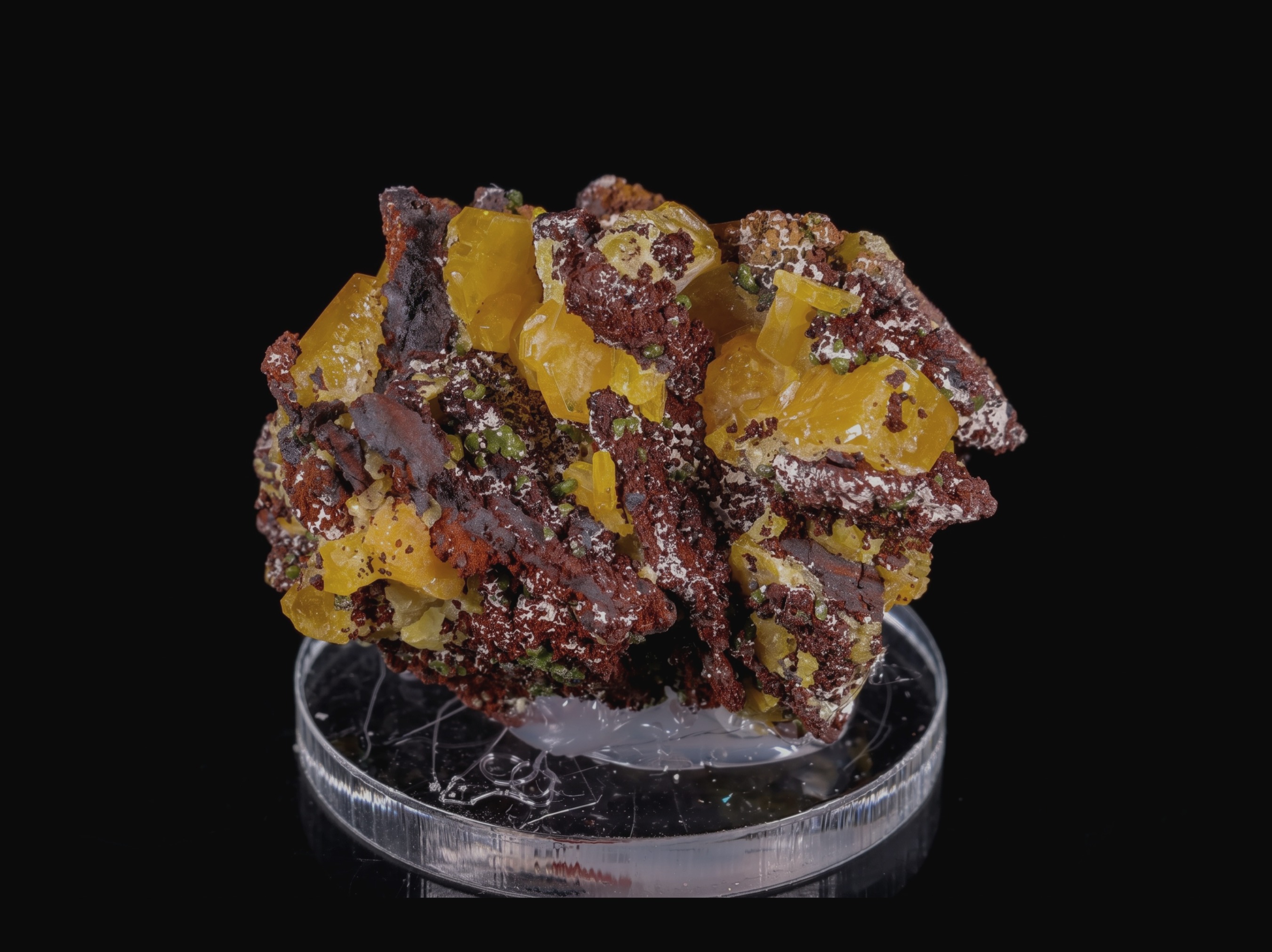
The mimetite specimen consists of numerous yellow crystals set on a brown-red matrix. The crystals have a glassy luster, forming clusters visible across the entire surface of the matrix. Main Features: yellow color; tabular crystal habit; strong color contrast with the matrix. Condition: Good.
Mimetite on matrix from Congo

Price: 46 EUR (199 PLN)

Availability: In stock

Location: Yanga Koubenza quarries, Mfouati, Mfouati District, Bouenza Department, Republic of the Congo

Size: 29 x 28 x 20 mm

Weight: 17.5 g

Chemical formula: Pb₅(AsO₄)₃Cl

Mohs hardness: 3.5–4.0

Characteristics Mimetite is a lead chloroarsenate belonging to the apatite group. It typically occurs as hexagonal crystals, often columnar or tabular. Reniform, spherical, botryoidal, or radial aggregates are also common. The crystal surface can be dull or vitreous, and its color is often intense, making mimetite an attractive collector's mineral. Physical Properties Mimetite has a Mohs hardness of 3.5-4. It exhibits a resinous to subadamantine luster. It is transparent to translucent, and its streak is white. The density of mimetite is 7.24 g/cm³. Colors and Varieties Mimetite occurs in a wide range of colors, from pale yellow, yellowish-brown, orange-yellow, orange-red, red, green, white, to colorless. In transmitted light, it can be colorless or slightly tinted. The intensity of the color depends on the presence of impurities, especially chromium or vanadium ions. History and Name Mimetite was described in 1832. Its name comes from the Greek word "mimetes," meaning "imitator," referring to its resemblance to pyromorphite, with which it is often confused. Uses Mimetite has no industrial applications. It is a valued collector's mineral due to its aesthetic crystals and intense colors.

Diagnostic features

Identification Mimetite can be identified by its characteristic hexagonal crystals, often forming reniform or spherical aggregates. Its resinous to subadamantine luster and wide range of colors, especially shades of yellow and orange, are also helpful. The density of the mineral is also an important diagnostic feature. Distinguishing from Similar Minerals Mimetite is often confused with pyromorphite, with which it forms an isomorphic series. They can be distinguished based on chemical composition (mimetite contains arsenic, pyromorphite contains phosphorus) and subtle differences in density and color. However, these differences are often difficult to observe without specialized testing. Mimetite typically has lighter, more yellow hues than pyromorphite. Crystal Forms Mimetite typically forms crystals with hexagonal columnar, tabular, or barrel-shaped habits. Radial, reniform, spherical, botryoidal, or earthy aggregates are also common.

Formation environment

Genesis Mimetite is a secondary mineral, forming in the oxidation zones of lead deposits. It forms as a result of the reaction of arsenic-containing solutions with lead minerals, such as galena. It occurs in paragenesis with other secondary lead and arsenic minerals. Mineral Associations Mimetite often co-occurs with minerals such as galena, cerussite, anglesite, wulfenite, pyromorphite, vanadinite, barite, calcite, and limonite. Localities Known mimetite localities include Tsumeb (Namibia), where beautiful orange crystals are found; Ojuela Mine (Mexico), where yellow and green specimens are found; Broken Hill (Australia); Les Farges (France); and many localities in the United States, including Arizona and Idaho.

For the collector

Quality Criteria The most prized mimetite specimens are those with intense, uniform colors, well-formed, large, and transparent crystals. Reniform and spherical aggregates with regular shapes and vibrant colors are also highly valued. The absence of mechanical damage and presence on an attractive matrix increase collector value. Popular Localities The most sought-after mimetite specimens come from Tsumeb, Namibia, famous for its orange and yellow crystals. Other valued localities include Ojuela Mine in Mexico and Broken Hill in Australia, where specimens of diverse morphology and color are found.

See mineralogical reference for Mimetite in the Knowledge Base →

View product →