Mimetite
Chemical formula: Pb<sup>2+</sup><sub>5</sub>(As<sup>5+</sup>O<sub>4</sub>)<sub>3</sub>Cl
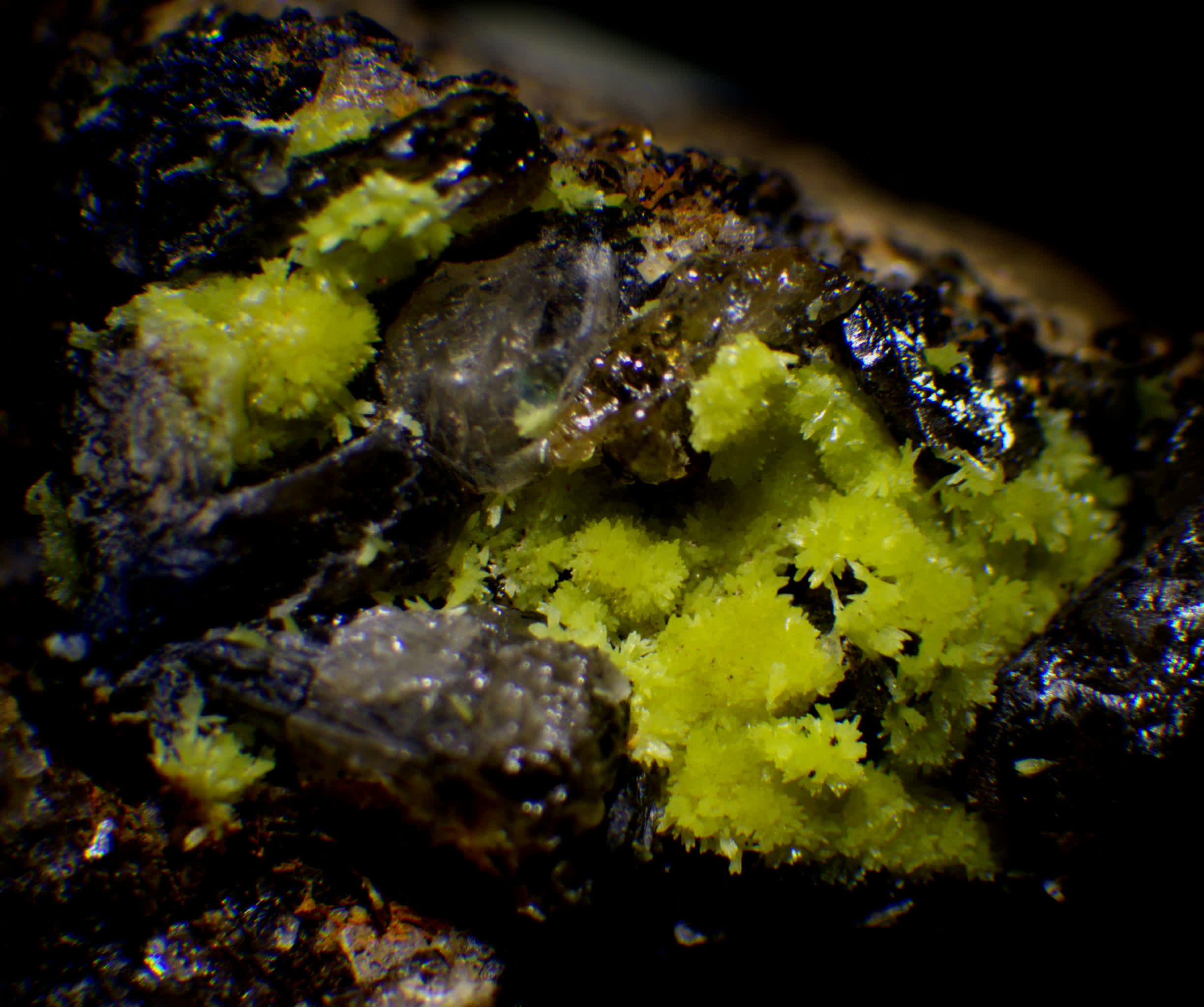
Mimetite is an arsenate mineral, often forming hexagonal crystals or radial aggregates, distinguished by its vibrant color, most commonly yellow or orange.
Properties
- Mohs hardness
- 3.5-4
- Luster
- Resinous to sub-adamantine
- Streak
- White
- Density
- 7.24
- Cleavage
- In traces on <mi>{10_11}</mi>.
- Fracture
- Nierówny do muszlowego
- Transparency
- Transparent,Translucent
- Crystal system
- Hexagonal
Diagnostic features
## Identification Mimetite can be identified by its characteristic hexagonal crystals, often forming reniform or spherical aggregates. Its resinous to subadamantine luster and wide range of colors, especially shades of yellow and orange, are also helpful. The density of the mineral is also an important diagnostic feature. ## Distinguishing from Similar Minerals Mimetite is often confused with pyromorphite, with which it forms an isomorphic series. They can be distinguished based on chemical composition (mimetite contains arsenic, pyromorphite contains phosphorus) and subtle differences in density and color. However, these differences are often difficult to observe without specialized testing. Mimetite typically has lighter, more yellow hues than pyromorphite. ## Crystal Forms Mimetite typically forms crystals with hexagonal columnar, tabular, or barrel-shaped habits. Radial, reniform, spherical, botryoidal, or earthy aggregates are also common.
Geological environment
## Genesis Mimetite is a secondary mineral, forming in the oxidation zones of lead deposits. It forms as a result of the reaction of arsenic-containing solutions with lead minerals, such as galena. It occurs in paragenesis with other secondary lead and arsenic minerals. ## Mineral Associations Mimetite often co-occurs with minerals such as galena, cerussite, anglesite, wulfenite, pyromorphite, vanadinite, barite, calcite, and limonite. ## Localities Known mimetite localities include Tsumeb (Namibia), where beautiful orange crystals are found; Ojuela Mine (Mexico), where yellow and green specimens are found; Broken Hill (Australia); Les Farges (France); and many localities in the United States, including Arizona and Idaho.
Rarity
Very Common
For collectors
## Quality Criteria The most prized mimetite specimens are those with intense, uniform colors, well-formed, large, and transparent crystals. Reniform and spherical aggregates with regular shapes and vibrant colors are also highly valued. The absence of mechanical damage and presence on an attractive matrix increase collector value. ## Popular Localities The most sought-after mimetite specimens come from Tsumeb, Namibia, famous for its orange and yellow crystals. Other valued localities include Ojuela Mine in Mexico and Broken Hill in Australia, where specimens of diverse morphology and color are found.
Care and storage
## Cleaning To clean mimetite, use a soft brush and lukewarm, distilled water. Gently remove dust and deposits, avoiding strong friction that could damage the crystal surface. ## What to Avoid Avoid contact of mimetite with acids and strong bases, which can cause damage to the mineral. High temperatures and direct sunlight can affect color changes. Mimetite is sensitive to impact, so it should be handled with care. ## Storage Mimetite is best stored in enclosed display cases or boxes, away from dust and direct light. Due to its relatively low hardness, avoid contact with harder minerals that could scratch it.