Metallic Carrolite from Kamoya Mine in Congo

SKU: S_00077

An attractive specimen of carrolite from the world's best, classic location for this species. A distinct crystal with an extraordinarily strong, mirror-like metallic luster is embedded in a light matrix. The silvery-gray ore beautifully contrasts with the white background of the host rock, and its partially exposed walls exhibit characteristic banding. Main Features: mirror-like, metallic luster; distinct crystal formation with visible wall banding; high contrast with the light matrix; the best global location for the species Condition: Good.
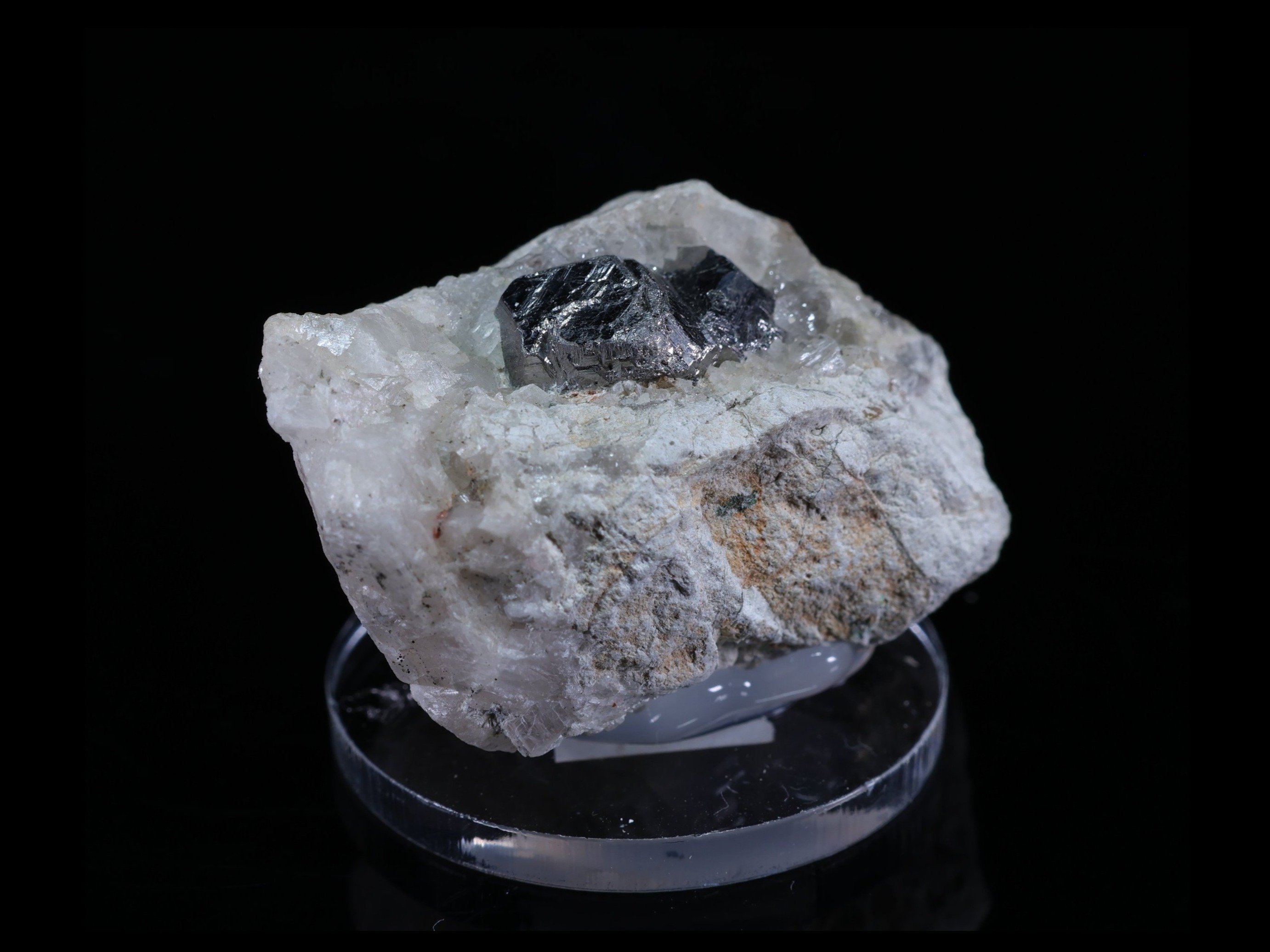
Metallic Carrolite from Kamoya Mine in Congo

Price: 64 EUR (279 PLN)

Availability: In stock

Location: Kamoya Mine, Congo

Size: 35 x 25 x 25 mm

Weight: 26 g

Chemical formula: Co₂CuS₄

Crystal system: Regularny

Mohs hardness: 5.5

Characteristics Carrollite is a sulfide mineral that typically forms isometric crystals with an octahedral or hexoctahedral habit. Its surfaces often exhibit a metallic luster and are steel-gray to silvery-white, sometimes with a delicate violet or pinkish tint. Carrollite crystals can reach significant sizes, although smaller, well-formed specimens are more common. Aggregates can be granular or massive. Physical Properties Carrollite is characterized by a Mohs hardness of approximately 5.5. It has a distinct metallic luster. It is opaque. Its density ranges from 4.8-5.0 g/cm³. Colors and Varieties The typical color of carrollite is steel-gray to silvery-white, often with a violet or pinkish tarnish, which may be a result of surface oxidation. There are no significant color varieties or commercial names for this mineral. History and Name Carrollite was first described in 1845 by W.F. Foshag. The mineral's name comes from Carroll County, Maryland, USA, where it was discovered in the Patapsco mine. Uses Carrollite is a mineral primarily of collector's interest. Due to its cobalt and copper content, in some deposits, it can be an ore of these metals, but its rarity limits practical industrial application.

Diagnostic features

Identification Carrollite can be identified by its characteristic metallic luster, steel-gray color with possible violet or pinkish tarnishes, and typical octahedral or hexoctahedral crystal habit. A Mohs hardness of approximately 5.5 is also a diagnostic feature. Distinguishing from Similar Minerals Carrollite can be confused with other sulfide minerals with a metallic luster, such as pyrite or chalcopyrite. It differs from pyrite by the absence of a yellow tint and lower hardness. It differs from chalcopyrite by color (chalcopyrite is more yellowish) and the absence of a greenish streak. Chemical analysis is the ultimate identification method. Crystal Forms Carrollite most often occurs as well-formed isometric crystals, most commonly octahedral or hexoctahedral. It can also form granular or massive aggregates.

Formation environment

Genesis Carrollite is a hydrothermal mineral, forming at low to medium temperatures. It occurs in hydrothermal veins, often associated with copper and cobalt deposits. It forms in environments rich in sulfur, cobalt, and copper. Mineral Associations Carrollite often co-occurs with other sulfide minerals, such as chalcopyrite, pyrite, bornite, sphalerite, galena. It can also be found in association with calcite, quartz, and other vein minerals. Localities The most important carrollite localities are in the Democratic Republic of Congo (Katanga region, e.g., Kamoya, Mashamba West mines), where large and well-formed crystals occur. Other known localities include the United States (Carroll County, Maryland - discovery site), Zambia, and Russia.

For the collector

Quality Criteria The most prized carrollite specimens are those with well-formed, distinct crystals, preferably with an octahedral or hexoctahedral habit. The size of the crystals, their luster, and the absence of mechanical damage are also important. Specimens with attractive violet or pinkish tarnishes are also sought after. Popular Localities The most prized carrollite specimens come from the Democratic Republic of Congo, especially from the Katanga region, where large and aesthetic crystals are found. Specimens from the USA (Maryland) are of historical significance.

See mineralogical reference for Carrollite in the Knowledge Base →

View product →